REAR-ENGINED RENAULT RALLY ICON
Renault 5 Turbo guide: Turbo 1, Turbo 2, Maxi 5 and buying advice
The Renault 5 Turbo took the outline of an everyday French hatchback, removed its rear seat and placed a turbocharged engine behind the occupants. This guide explains its history, road and rally versions, specifications and the checks that matter before buying a genuine car or recreation.

Why the Renault 5 Turbo is so unusual
Renault began with one of Europe’s most familiar small cars and created something structurally and mechanically different. The rear bench disappeared, the engine moved from the nose to a position behind the front seats, and huge rear arches covered a much wider track. Side intakes fed the mid-mounted engine and the rear wheels alone delivered the power.
The first mock-up appeared at the 1978 Paris Motor Show and the production car was launched in 1980. Renault says manufacture involved three locations: Flins supplied the shell, Heuliez adapted it and Alpine at Dieppe handled painting and final assembly.
Renault 5 Turbo specifications at a glance
| Version | Engine and drive | Quoted output | What distinguishes it |
|---|---|---|---|
| Renault 5 Turbo (often called Turbo 1) | 1,397cc turbo four; rear-mid-engine; RWD | 160hp | Early homologation road car with distinctive interior and greater use of aluminium panels. |
| Renault 5 Turbo 2 | 1,397cc turbo four; rear-mid-engine; RWD | About 160hp | Retained the layout while using more regular Renault 5 components to reduce cost. |
| Tour de Corse | Turbo four; rear-mid-engine; RWD | Varied | Group B development of the earlier competition car. |
| Maxi 5 Turbo | 1,527cc turbo four; rear-mid-engine; RWD | 350hp | Wider, more aerodynamic final works evolution; Renault records 20. |
Specification warning: rally cars evolved continuously and surviving examples may have later engines, shells and running gear. A headline power figure cannot authenticate a car.

Turbo 1 and Turbo 2: what changed?
“Turbo 1” is enthusiast shorthand for the original model; Renault sold it simply as the Renault 5 Turbo. Early cars are known for their dramatic two-tone interiors and lightweight opening panels. The Turbo 2 retained the mid-engined layout and performance concept but incorporated more components shared with series-production Renaults, reducing build cost.
Do not reduce the distinction to one visual detail. Cars have been repainted, retrimmed, repaired and converted over four decades. Establish identity from chassis details, build records and original specification, then use trim and panels as supporting evidence.

From Group 4 to Group B
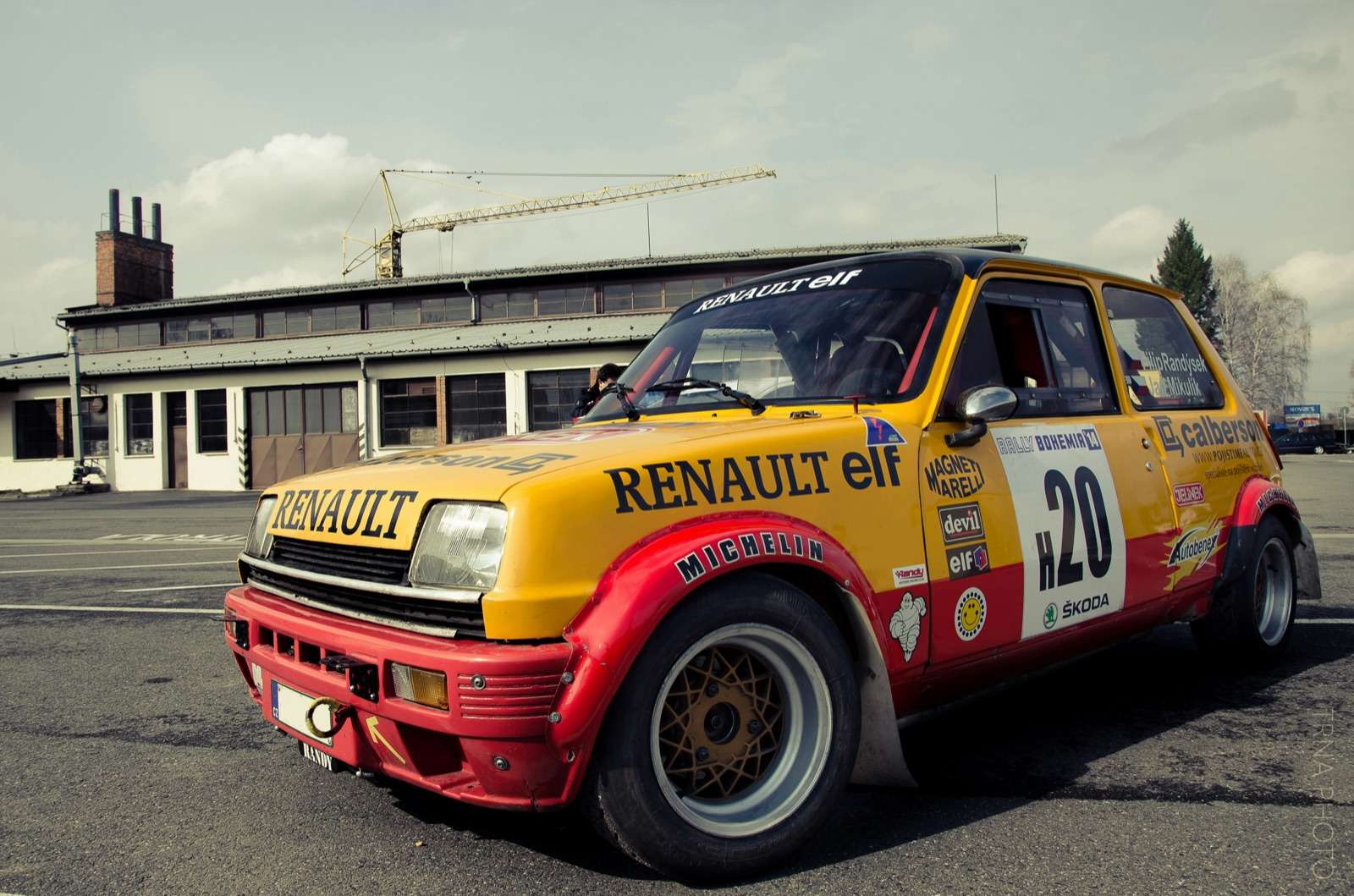
The Renault 5 Turbo began its frontline rally career under Group 4. Jean Ragnotti and Jean-Marc Andrié won the 1981 Monte Carlo Rally, demonstrating that a compact rear-drive car could defeat more conventional machinery. When Group B replaced Group 4, the model was homologated as B-205 on 2 February 1982. The FIA database records four cylinders, rear-wheel drive and a turbo-equivalent capacity of 1,956cc.
Renault developed the Cévennes and Tour de Corse specifications before creating the Maxi. Rather than switch to four-wheel drive, the team pursued lower weight, stronger performance and improved aerodynamics while retaining rear-wheel drive.
Maxi 5 Turbo: the ultimate evolution
The Maxi 5 Turbo arrived for 1985 with a 1,527cc engine, revised suspension and substantially altered aerodynamics. Renault’s heritage record quotes 350hp, 223km/h and production of 20 cars. Ragnotti and Pierre Thimonier gave it a famous World Rally Championship victory on the 1985 Tour de Corse.
Its significance is easy to miss when Group B is told only as a four-wheel-drive story. The Maxi remained rear-wheel drive and could not match the traction of the latest Audi, Peugeot and Lancia designs everywhere, but on asphalt its agility and performance made it formidable.

Renault 5 Turbo versus Renault 5 GT Turbo
Renault 5 Turbo / Turbo 2
Original Renault 5 body family; engine behind the seats; rear-wheel drive; bespoke wide rear structure; produced from 1980.
Renault 5 GT Turbo
Later Supercinq generation; engine in the front; front-wheel drive; practical rear seating; produced in far greater numbers.
The similar names create misleading adverts and search results. A GT Turbo is an important hot hatch in its own right, but it is not a cheaper or later version of the mid-engined homologation car.
Love cars you don’t see every day?
Get forgotten cars, surprising motoring stories and the most interesting finds from Unusual Cars by email.
Free to join. No spam. Unsubscribe whenever you like. See our privacy policy.
Buying a Renault 5 Turbo: what to check
Identity and provenance
Check chassis stamps and plates against registration and factory information. Trace invoices, ownership and—where claimed—competition history. Famous colours, rally lamps and decals prove nothing.
Structure and accident repairs
Inspect the adapted shell, floor, suspension pick-up points, engine bay and wide rear bodywork. Look for corrosion, stress cracking, heat damage, poor alignment and undocumented re-shelling. A marque specialist who understands the mixed-material construction is essential.
Engine, turbo and cooling
Start from cold. Verify oil pressure, smoke, coolant stability and boost behaviour. Ask when the turbocharger, fuel system, ignition and cooling components were rebuilt. Long storage can be as damaging as hard use.
Gearbox, suspension and brakes
Check selection cold and hot, differential noise, driveshafts, wheel bearings and brake condition. Competition parts may make a car less usable on the road and can be exceptionally expensive to replace.
Originality and parts supply
Record which panels, interior pieces, wheels and mechanical components are original, remanufactured or substituted. Completeness can matter more than fresh paint because rare trim and model-specific parts are difficult to source.
Replicas, conversions and tribute cars
Some cars wear Turbo-style arches but retain a front engine and front-wheel drive. Others are sophisticated mid-engined recreations. Either can be enjoyable, but the advert should disclose the base shell, builder, engine location, drivetrain, construction history and registration identity. Never assume that an FIA-style livery or a “Maxi” description establishes provenance.
Frequently asked questions
How many Renault 5 Turbos were built?
Renault’s museum records 4,857 examples for the Renault 5 Turbo family. It separately records only 20 Maxi 5 Turbo competition cars.
Is the Renault 5 Turbo rear-wheel drive?
Yes. Its engine is mounted behind the occupants and it drives the rear wheels. This separates it fundamentally from ordinary Renault 5s and the later front-wheel-drive GT Turbo.
Was it a Group B car?
Yes. The FIA lists the Renault 5 Turbo as Group B homologation B-205 from 2 February 1982. Earlier competition versions also raced under Group 4.
What is the most powerful version?
Renault quotes 350hp for the 1,527cc Maxi 5 Turbo. Historic cars vary, so verify the precise specification of an individual example.
Explore more Group B cars
Return to the complete Group B rally cars guide, then compare the Lancia 037, Peugeot 205 T16, Lancia Delta S4, Ford RS200 and MG Metro 6R4.
Continue the Renault story
Explore the Rare & Performance Renaults hub, compare the road-going Renault 5 GT Turbo, or continue with the 10 Things GT Turbo feature.
Research basis: Renault The Originals heritage records and FIA Historic Database homologation B-205. Specifications and histories differ among road cars, works cars, customer competition cars and later rebuilds; chassis-specific claims require independent verification.