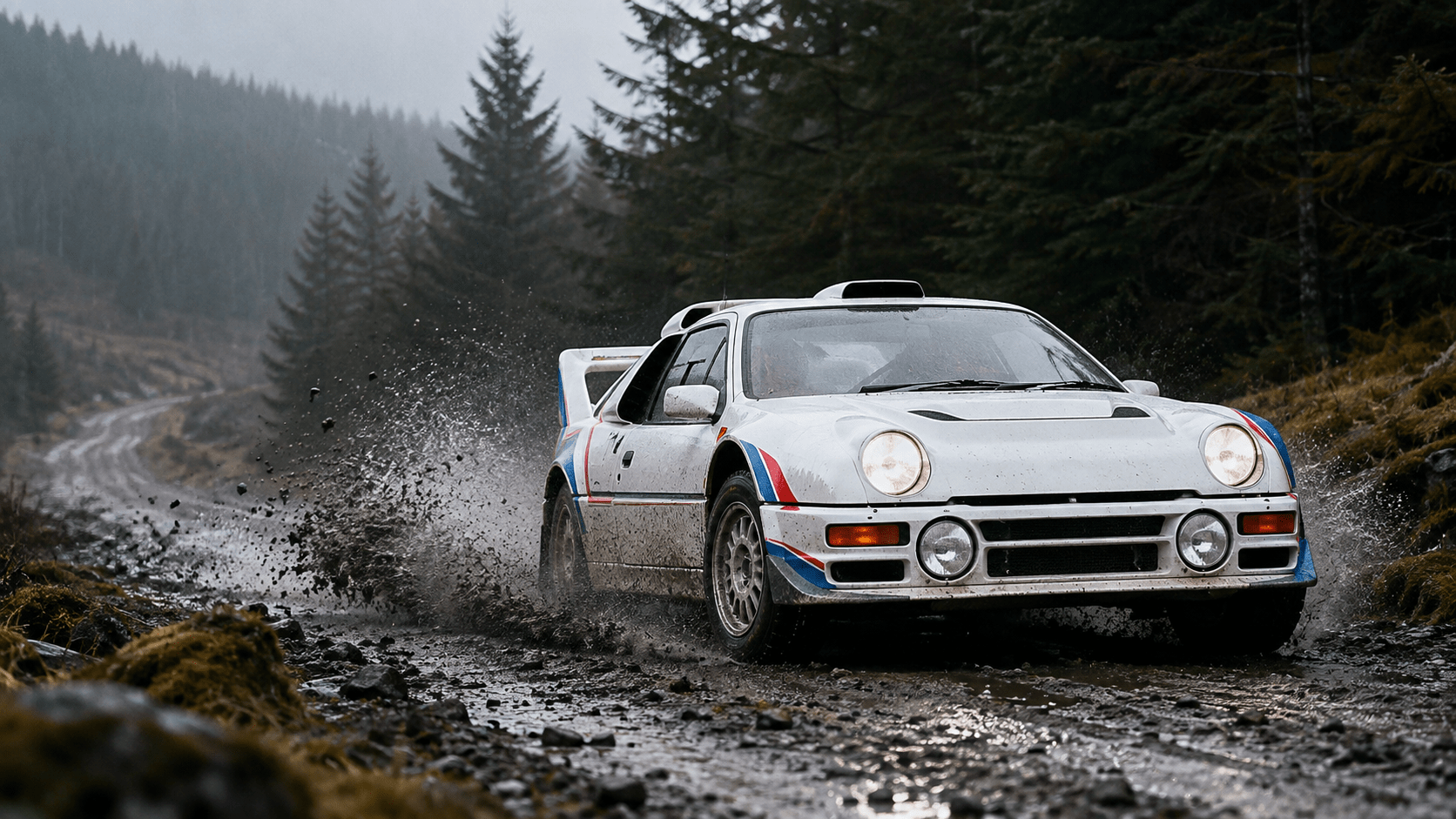
Ford RS200 guide
History, engineering, road-car specifications, Evolution models and the essential checks for identifying or buying Ford’s purpose-built Group B supercar.
What is a Ford RS200?
The RS200 was Ford Europe’s specialised answer to the Audi quattro, Peugeot 205 T16 and other four-wheel-drive Group B machinery. It did not share a conventional production-car platform. Its compact glassfibre-composite body covered a purpose-built structure, mid-mounted engine and unusually complex transmission designed to improve weight distribution.
Its name referred to the 200 examples theoretically required for homologation. The car first appeared publicly in road form at the 1984 Belfast Motor Show, but homologation arrived only in February 1986. That timing left Ford with less than a season at World Championship level before Group B was discontinued.
From Escort RS1700T to RS200
Ford initially developed the rear-wheel-drive Escort RS1700T. As Audi demonstrated the advantage of four driven wheels, the Escort project became strategically outdated and suffered development difficulties. Ford cancelled it and started again.
Formula One designer Tony Southgate and engineer John Wheeler contributed to the RS200 chassis concept. FF Developments worked on the drivetrain, Ghia styled the composite body and Reliant assembled the cars. Familiar production details, including a Sierra windscreen and rear lamps, were incorporated into an otherwise highly specialised design.
RS200 engineering explained
Mid-mounted BDT engine
The all-aluminium Cosworth BDT four-cylinder used turbocharging and dry-sump lubrication. It sat behind the two-seat cockpit.
Front-mounted gearbox
Placing the gearbox towards the front helped balance the mass but produced a complex route for power through the four-wheel-drive system.
Purpose-built structure
An aluminium honeycomb lower structure and strong subframes supported the powertrain and suspension.
Twin-damper suspension
Twin wishbones and twin dampers at each wheel provided the travel and control required on rough rally stages.
Ford RS200 road car specifications
| Feature | Road RS200 | Competition context |
|---|---|---|
| Engine | Turbocharged Cosworth BDT four-cylinder, approximately 1.8 litres | Works specifications evolved; outputs should be tied to a particular car and event specification. |
| Power | FIA’s historical account quotes 250hp at 6,500rpm | The FIA records more than 420hp for 1986 competition form. |
| Transmission | Five-speed manual and four-wheel drive | Layouts and torque-distribution arrangements can differ between specifications. |
| Body | Composite/carbonglass panels designed by Ghia | Competition damage, replacement panels and later restoration are common considerations. |
| Homologation | FIA B-280, 2 February 1986 | The homologation papers and extensions define permitted period changes. |
Competition career
The RS200 made its first official World Rally Championship appearance at the 1986 Monte Carlo Rally. Its potential was evident, but its WRC career was compressed into the final Group B season. Kalle Grundel’s third place on the 1986 Swedish Rally became its best-known top-level result.
The car is also inseparable from the tragedy at the 1986 Rally of Portugal, where an RS200 left the road and spectators were killed. Later that season Henri Toivonen and Sergio Cresto died in a Lancia Delta S4 accident on the Tour de Corse. Group B was ended after 1986. This history deserves accurate, respectful treatment rather than presenting danger as entertainment.
What is the RS200 Evolution?
The Evolution, commonly shortened to RS200E, was the intended next development step. The FIA historical record notes that its evolution was validated on 1 December 1986 and principally increased engine capacity to around 2.1 litres. It arrived too late for the World Rally Championship but found a second life in rallycross and other competition.
Evolution power claims vary widely and often describe later tuning rather than one fixed Ford factory specification. A seller should identify the block, build specification, turbocharger, fuel system and documentary history instead of relying only on the “Evo” description.

How many Ford RS200s were built?
The name and homologation programme centre on a 200-car requirement, but surviving-car discussions are complicated by incomplete cars, spares, later assembly, competition rebuilds and replacement structures. Treat exact production and survival claims according to their definition and source. “One of 200” does not establish where an individual car fits in the production sequence or whether its present identity is continuous.
How to identify a genuine RS200
Appearance is not proof. Verify chassis markings and plates, factory records, period invoices, ownership history and competition evidence together. Compare the engine and transmission actually fitted with the claimed specification. If a car has been re-shelled or rebuilt after competition damage, establish when, by whom and around which documented identity.
Identity trail
Chassis number, registration records, factory correspondence, invoices and photographs should form a coherent chronology.
Competition history
Check entry lists, results, period photographs and preparation records. A famous livery is not evidence of works history.
Present specification
Record the engine, turbo, gearbox, differentials, suspension, brakes, wheels, body and safety equipment now fitted.
Ford RS200 buying and inspection checklist
Structure and body
Inspect the honeycomb structure, bonded and bolted joints, subframes and suspension mountings for accident damage, fatigue, corrosion and previous repair. Composite panels can conceal poor alignment or an underlying structural problem.
Engine, turbo and fuel system
Insist on a cold start and current oil-pressure information. Check the BDT’s build history, dry-sump system, turbocharger, cooling, fuel lines and tanks. Establish service intervals by specification and use, not ordinary road-car mileage.
Transmission and suspension
Test every gear and investigate driveline noise, vibration or oil leakage. Replacement transmission components are specialist and potentially expensive. Examine wishbones, dampers, uprights, hubs and brakes for cracking, wear and correct fitment.
Safety and intended use
Seats, harnesses, fire systems, fuel cells and other dated competition equipment may require replacement. Before entering historic motorsport, obtain confirmation from the organiser and governing body that the car and specification are eligible.
Replicas and recreations
RS200 replicas range from road-car lookalikes to sophisticated competition recreations. They can be fascinating cars, but should be described by what they are. Ask about the chassis manufacturer, donor components, engine, driven wheels, build date, registration route and structural inspection. An RS200-shaped body does not create Ford provenance.
Frequently asked questions
Is the Ford RS200 based on an Escort?
No. It followed the cancelled Escort RS1700T programme but was a clean-sheet, purpose-built mid-engined car.
Why is the gearbox at the front?
The layout was chosen to improve weight distribution. Power travelled forward from the mid-mounted engine and was then distributed through the four-wheel-drive system.
Did the RS200 win a World Rally Championship event?
No. Its short WRC career produced promising results, including third in Sweden in 1986, but no overall WRC victory.
Can an RS200 compete in historic rallies?
Eligibility depends on current regulations, documentation and specification. FIA Appendix K restricts certain powerful Group B cars, so owners must confirm the intended event before preparing or buying a car.
Research basis: FIA Historic Database RS200 history and homologation form B-280. Individual cars change through competition, restoration and modification; verify any purchase with recognised specialists.