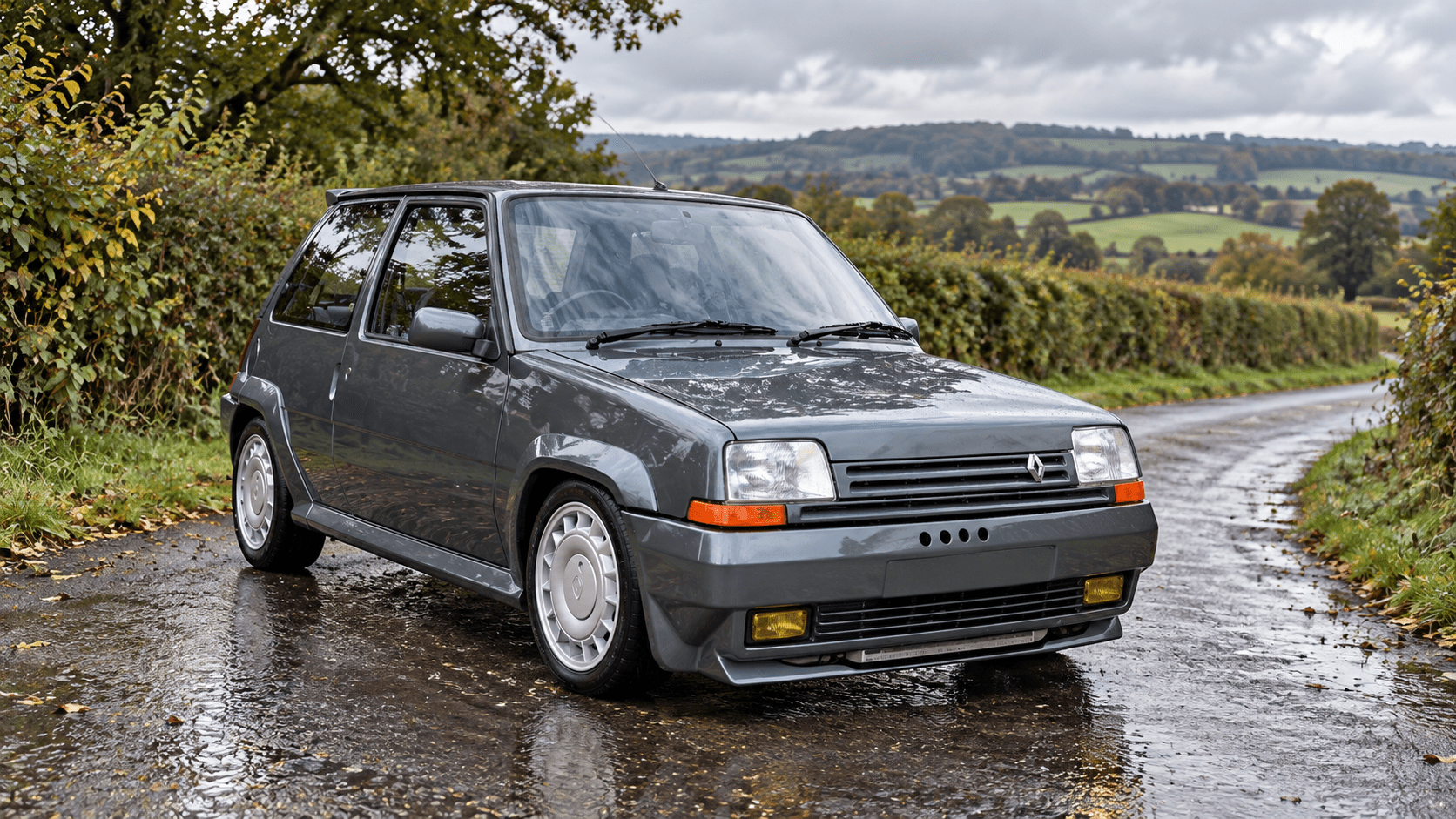
The Renault 5 GT Turbo was one of the most explosive small hot hatchbacks of the 1980s. Light, carburettor-fed and proudly turbocharged, it offered a very different flavour from the Peugeot 205 GTI and Volkswagen Golf GTI. It is also frequently confused with another Renault 5 that shares almost none of its layout.
.jpg?width=1400)
1. It is not the famous mid-engined Renault 5 Turbo
The names are confusing, but the cars are fundamentally different. The Renault 5 Turbo and Turbo 2 of the early 1980s were wide-bodied, mid-engined, rear-wheel-drive homologation specials created for rallying.
The GT Turbo was the performance version of the second-generation Renault 5, known in France as the Supercinq. Its engine remained under the bonnet and drove the front wheels. It was a practical production hot hatch rather than a road-going competition special—although it developed an impressive competition career of its own.
2. It was based on an entirely new Renault 5
The original Renault 5 ended its career in 1984 and was replaced by the roomier, better-equipped Supercinq. Although Marcello Gandini’s new body deliberately echoed the familiar shape, the platform beneath it was completely different.
The old car’s longitudinal engine layout gave way to a transverse engine, while MacPherson-strut front suspension replaced the earlier arrangement. Renault introduced the GT Turbo in 1985, exploiting a shell and chassis far better suited to high performance than the 1972 original.

3. Its engine design could trace its roots to 1962
Under the bonnet sat Renault’s cast-iron Cléon-Fonte four-cylinder. In its earliest 1,108cc form this durable pushrod engine had appeared in the Renault 8 in 1962—more than two decades before the GT Turbo.
For the hot hatch it displaced 1,397cc and retained two valves per cylinder and pushrod-operated overhead valves. Renault transformed this apparently old-fashioned unit with a Garrett T2 turbocharger, an air-to-air intercooler and carefully developed ignition and cooling systems.
4. The Phase 1 made 115hp—and weighed very little
The first GT Turbo produced 115hp. Depending on specification, period figures put its kerb weight at roughly 820–850kg, giving it an exceptional power-to-weight ratio for an affordable small car.
Renault quoted 0–100km/h in around eight seconds and a maximum speed close to 197km/h. A contemporary UK press release listed 115bhp, a five-speed gearbox and 125mph. In a short, lightly insulated hatchback, those numbers felt far more dramatic than they look today.
Love cars you don’t see every day?
Get forgotten cars, surprising motoring stories and the most interesting finds from Unusual Cars by email.
Free to join. No spam. Unsubscribe whenever you like. See our Privacy Policy.
5. It used a carburettor, not fuel injection
Most rivals were moving towards electronic or mechanical fuel injection, but the GT Turbo fed its engine through a single-choke Solex carburettor. Boost from the Garrett T2 was cooled by an intercooler before the mixture entered the engine.
The arrangement helped give the Renault its distinctive personality: comparatively little at low revs, followed by a forceful surge when the turbo began working. Correct carburettor setup, intact hoses and a healthy cooling system are therefore central to how an original car performs.

6. The 1987 Phase 2 addressed more than the styling
A facelift in 1987 brought the Phase 2 GT Turbo. Power increased from 115 to 120hp and Renault’s official top-speed figure rose from 197 to 204km/h. New ignition mapping and other detail changes improved its delivery.
More importantly, the turbocharger gained water cooling and the under-bonnet cooling arrangements were revised. An anti-percolation fan helped reduce fuel evaporation after a hot shutdown—a response to the Phase 1’s reputation for reluctant hot starting. Outside, a revised grille, new wheels and colour-coordinated body trim make the later car easier to identify.
7. Renault built far more of them than rarity suggests
According to Renault’s own heritage records, approximately 160,000 Phase 1 and Phase 2 GT Turbos were produced between 1985 and 1991. That was a significant share of the 3.4 million second-generation Renault 5s built.
The car feels much rarer today because so many were modified, raced, crashed, stolen or consumed by corrosion and mechanical neglect. A complete, standard-looking survivor is now conspicuous precisely because the GT Turbo was once so accessible to young enthusiasts and tuners.

8. Britain had a one-make racing version with about 150hp
The GT Turbo was chosen for the Renault 5 Elf Turbo UK Cup in 1985. Renault’s contemporary press material stated that the championship cars would be based on the new road model.
Prepared for circuit competition, Cup versions produced roughly 150hp—an enormous figure in a car of this size and weight. The series placed turbocharged Renaults in close, highly visible racing and reinforced the road car’s reputation long before track-day hot hatches became commonplace.
9. It achieved a unique overall World Rally Championship victory
At the 1989 Rallye Côte d’Ivoire—also known as the Bandama Rally—Alain Oreille and Gilles Thimonier won outright in a Renault 5 GT Turbo. Renault states that it remains the only Group N car to have won a round of the World Rally Championship overall.
Group N rules were intended for cars much closer to series production than the spectacular Group B machines. Winning a gruelling WRC event outright against more extensively modified opposition was therefore a remarkable result for the humble front-wheel-drive hatchback.

10. The Alain Oreille edition celebrated that rally triumph
Renault marked the Bandama victory with a limited run commonly known as the Alain Oreille edition. Only 2,000 were produced, all finished in distinctive metallic Sport Blue with colour-matched wheels and special equipment.
In Britain the closely related blue final edition became known as the Raider. Whichever market name appears on the paperwork, originality matters: correct paint, trim, wheels and documentation distinguish a genuine limited car from a standard GT Turbo refinished to resemble one.
Love cars you don’t see every day?
Get forgotten cars, surprising motoring stories and the most interesting finds from Unusual Cars by email.
Free to join. No spam. Unsubscribe whenever you like. See our Privacy Policy.

A hot hatch built around boost
The Renault 5 GT Turbo was not as polished as some rivals, and that is a large part of its appeal. An old pushrod engine, a carburettor and a small turbo created an urgent, lightweight machine whose performance arrived with real theatre. The later Phase 2 was more resolved, but neither version hid what was happening under the bonnet.
Continue the 1980s hot-hatch story with our 10 facts about the Mk1 Volkswagen Golf, 10 facts about the Ford Escort XR3i and 10 facts about the Mk1 Vauxhall Astra GTE. You can also browse the Renault archive.
Sources
- The Originals Renault Museum: Supercinq GT Turbo
- Renault Group: Renault 5 GT Turbo—30 years
- Renault Press: 40 years of the Renault 5
- Contemporary Renault UK press material: Renault 5 in the UK
- Contemporary Renault UK press material: GT Turbo Cup
- Wikimedia Commons: Renault 5 GT Turbo images
For more about this car, read our Renault 5 GT Turbo guide.