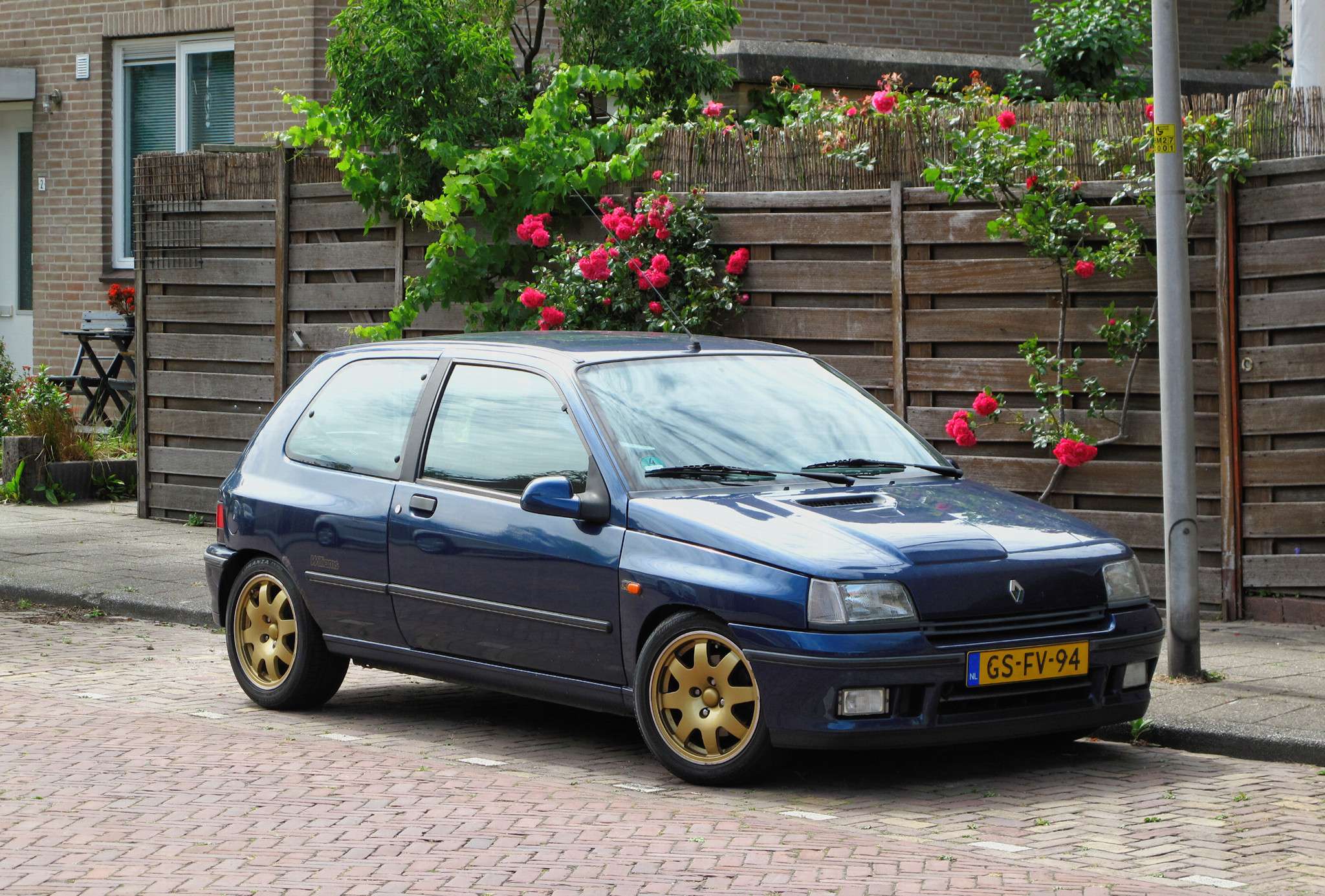
The Renault Clio Williams was not merely a blue Clio 16V with gold wheels. Created to give Renault a two-litre foundation for rallying, it combined a purpose-developed 1,998cc engine with wider front suspension, a carefully revised chassis and a remarkably focused specification. The result became one of the defining hot hatchbacks of the 1990s.
This guide explains how the Williams was born, what Renault changed beneath the body, how Williams 1, Williams 2 and Williams 3 differ, and why the car still matters. For the less familiar details, read our companion feature: 10 Things You Probably Didn’t Know About the Renault Clio Williams.
Renault Clio Williams at a glance
| Production | 1993–1995 |
|---|---|
| Engine | 1,998cc F7R 16-valve inline-four |
| Power | 150hp (110kW) |
| Top speed | 215km/h (134mph) |
| Transmission | Five-speed manual, front-wheel drive |
| Body | Three-door hatchback |
| Total production | 12,200 according to Renault |

Why Renault built the Clio Williams
The first-generation Clio had already produced a serious performance model in the 1.8-litre 16V. Renault, however, wanted to compete in the two-litre class of international and national rallying. Homologation demanded a road-going production base, so Renault Sport developed a Clio with the capacity, suspension geometry and robustness required for competition.
The Williams name reflected Renault’s successful Formula One association with Williams Grand Prix Engineering. It did not mean that the British racing team designed the road car. Development belonged to Renault and Renault Sport, while production took place at Dieppe alongside other specialist sporting Renaults.
Renault originally planned a limited run of 3,800 numbered cars. Demand immediately exceeded that plan: Renault records 5,500 customers in the first production year and 12,200 cars across the complete 1993–1995 run. What began as a homologation model became a small-volume performance icon.
The F7R engine: more than a larger 1.8
The Williams used Renault’s F7R four-cylinder engine, displacing 1,998cc and producing 150hp. Although related to the 1.8-litre F7P fitted to the Clio 16V, it was not simply bored out. A longer-stroke crankshaft, different connecting rods and revised internal components created the extra capacity and helped deliver stronger mid-range torque.
Peak power alone does not explain the character. The engine’s broad delivery makes the Clio eager out of bends and flexible on the road, while the close relationship between throttle response, gearing and relatively low weight gives it an immediacy missing from many later turbocharged cars. Renault quoted 215km/h, or about 134mph.

The chassis changes that made it special
The most important differences are underneath the familiar Clio shell. Renault widened the front track using longer wishbones and model-specific driveshafts, revised the steering and suspension geometry, and fitted firmer springs, dampers and anti-roll control. The Williams also used a strengthened front subframe and carefully selected wheel offset.
Those changes gave the car unusually direct turn-in without removing the adjustability that made fast front-wheel-drive Renaults entertaining. The rear torsion-beam arrangement could help the car rotate when the driver lifted the throttle, yet the Williams remained progressive rather than theatrical. The chassis, not the paintwork, is the main reason the model earned its reputation.
Why blue paint and gold wheels became iconic
Sports Blue metallic paint, gold Speedline alloy wheels and gold Williams script created one of the most recognisable combinations of the decade. The bonnet bulge and intake were inherited from the Clio 16V rather than invented for the Williams, but the broader stance and distinctive wheels made the new model look more purposeful without resorting to a large body kit.
Inside, blue carpets, embroidered seats, blue-faced instruments and a numbered plaque on the original series distinguished it from lesser Clios. The cabin was still unmistakably early-1990s Renault: compact, practical and relatively simple, which reinforced the sense that engineering mattered more than luxury.
Love cars you don’t see every day?
Get forgotten cars, surprising motoring stories and the most interesting finds from Unusual Cars by email.
Free to join. No spam. Unsubscribe whenever you like. See our privacy policy.
Williams 1, Williams 2 and Williams 3 explained
Clio Williams 1
The original 1993 Williams is the version most closely tied to the homologation story. The first 3,800 cars were individually numbered on a dashboard plaque. Equipment was deliberately focused, with weight and body integrity taking priority over indulgence. Specifications varied by market, so details such as sunroofs should be checked against the car’s original sales territory rather than treated as a universal rule.
Clio Williams 2
Demand persuaded Renault to continue production with the Williams 2. The fundamental F7R engine, wide-track chassis and 150hp output remained. Later cars adopted phase-two Clio detail changes and were not individually numbered in the same manner as the first series. They are genuine factory Williams models, not lesser replicas, despite the absence of the original numbered plaque.
Clio Williams 3
The Williams 3 completed the production story and is most easily recognised by its slightly lighter Monaco Blue paint. It also brought detail equipment changes, including a sunroof in some markets. Mechanically it preserved the essential Williams formula. Buyers and enthusiasts may favour one edition, but condition, originality and documented identity matter more than assuming every early car is automatically superior.

From homologation road car to rally success
The road car provided the platform Renault needed, but competition versions developed far beyond the showroom specification. Drivers including Jean Ragnotti, Philippe Bugalski and Alain Oreille demonstrated the Clio’s ability on tarmac and loose surfaces. Renault later created the Clio Maxi, a dramatically widened Kit Car with approximately 250hp, a dog-engagement gearbox, adjustable suspension and competition brakes.
The Williams name therefore connects several stories: Formula One marketing, Group A homologation, national rallying and the spectacular front-wheel-drive Kit Car era. That breadth helps explain why it resonates beyond ordinary hot-hatch nostalgia.

Why the Clio Williams still matters
Many fast hatchbacks are remembered mainly for acceleration figures. The Williams endures because every major change served a clear purpose: the two-litre engine supported the rally programme, the wider front end improved the way the car placed its power on the road, and the focused equipment kept the experience immediate.
It also arrived at the point when a small performance car could feel genuinely specialised without becoming unusable. A Williams still offers a practical hatchback body, clear visibility and modest dimensions, yet the steering, engine and chassis communicate with a precision that made it a reference point for later Renaultsport models.
Authenticity matters
The blue-and-gold appearance has been widely copied. A convincing replica may use genuine wheels and trim, but visual details alone do not establish identity. A real Williams should combine the correct model documentation with F7R engine details, wide-track suspension hardware, appropriate body and interior equipment, and a history consistent with the chassis number. Numbered plaques apply to the first series, but a plaque by itself proves very little.
Surviving cars also vary because many spent years as affordable performance machinery. Competition use, replacement shells, accident repairs and modifications are part of the model’s history. For the enthusiast, understanding that history is more valuable than relying on a single badge or production myth.
Renault Clio Williams FAQ
Did Williams F1 design the Clio Williams?
No. Renault and Renault Sport developed the car. The Williams name celebrated Renault’s Formula One partnership with Williams Grand Prix Engineering.
How much power did it produce?
Renault quotes 150hp from the 1,998cc F7R 16-valve engine.
How many Clio Williams cars were made?
Renault’s heritage archive records 12,200 cars produced from 1993 to 1995. The first 3,800 were individually numbered.
Are Williams 2 and Williams 3 genuine Williams models?
Yes. They continued the factory-developed two-litre Williams formula after the original numbered production run, with phase and equipment differences.
Continue the Renault story
Discover more surprising details in 10 Things About the Clio Williams, explore the mid-engined Renault 5 Turbo, or visit the Rare & Performance Renaults hub.
Research note: Production, engine, performance and dimensional figures were checked against Renault’s official The Originals heritage archive. Clio Maxi competition specifications were checked against Renault’s official heritage record. Image licensing is linked beneath each photograph.