Lancia 037 Group B guide
History, engineering, rally victories, Stradale differences and the checks that matter when assessing a genuine 037 or a modern recreation.
Why the Lancia 037 matters
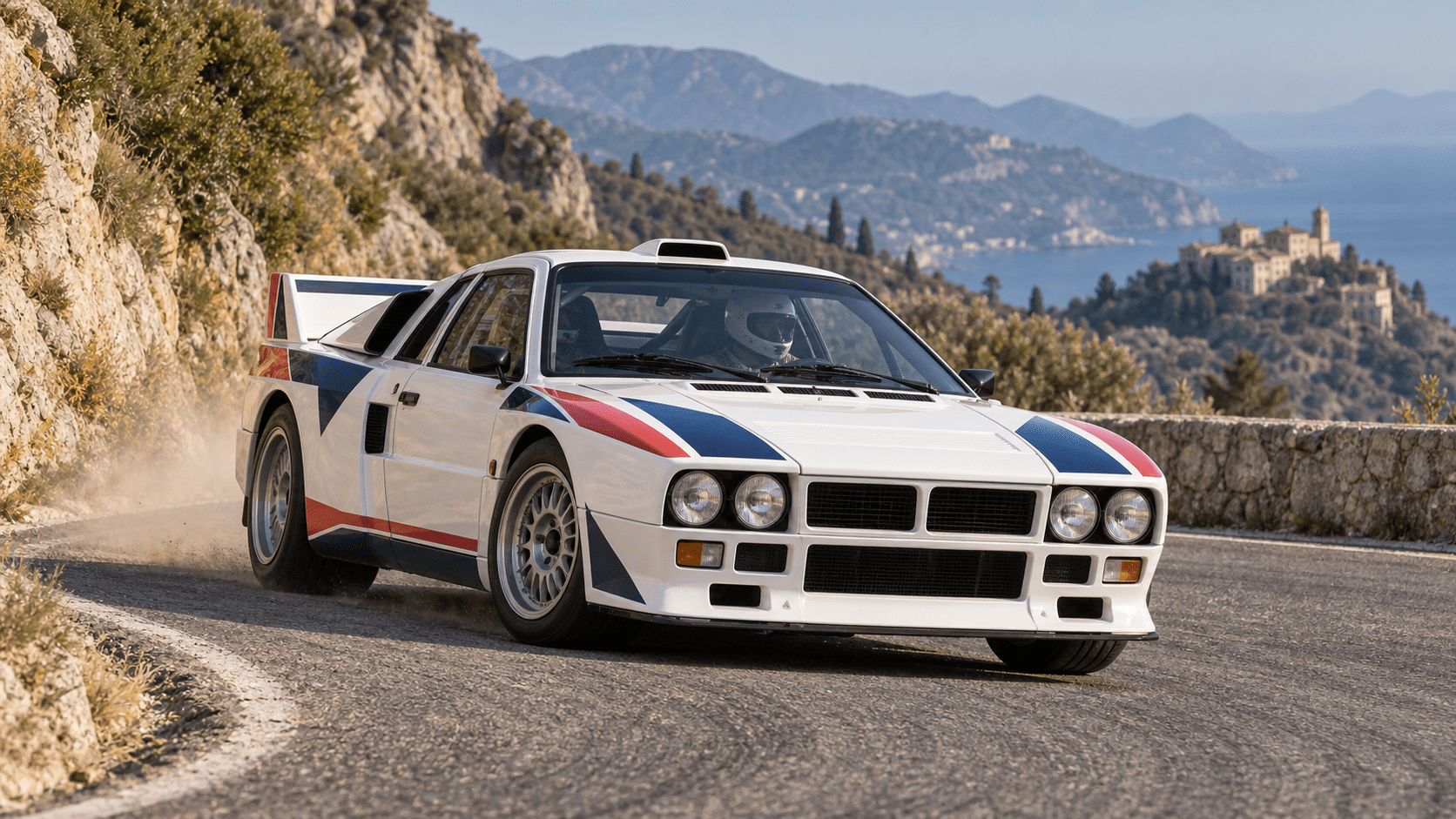
The 037 occupies a special place in rally history. Group B rapidly encouraged four-wheel drive, huge power and extreme purpose-built machinery, yet Lancia won the 1983 manufacturers’ championship with a light, agile rear-wheel-drive car. That achievement was not simply romantic. It came from a clear engineering philosophy, careful tyre selection, rapid servicing and a team that exploited the 037’s balance on tarmac while collecting enough points elsewhere.
Its familiar name was originally a project designation. The competition programme brought together Lancia, Abarth and Pininfarina expertise, and the resulting machine looked related to the Beta Montecarlo without being a lightly modified production coupé. Its removable composite front and rear sections, tubular structures and longitudinal mid-mounted engine made its priorities unmistakable.
Lancia 037 specifications at a glance
| Feature | 037 Stradale | Competition development |
|---|---|---|
| Layout | Longitudinal mid-engine, rear-wheel drive | Same fundamental layout, extensively developed for rallying |
| Engine | 1,995cc twin-cam inline four | 1,995cc initially; later Evolution 2 cars used 2,111cc |
| Induction | Abarth Volumex supercharger and carburettor | Volumex supercharger with competition fuel and induction systems |
| Quoted output | 205hp in Lancia heritage material | Approximately 260–305hp depending on version and specification |
| Structure | Steel central cell with tubular front and rear frames | Lightweight competition construction with quickly removable body sections |
| Homologation | 200 road cars stated by Lancia | FIA homologation B-210 |
Historic rally specifications are not represented by one immutable set of figures. Works cars evolved, customer cars differed and surviving examples may have been rebuilt several times. Treat quoted power, weight and component lists as version-specific rather than universal.
Why Lancia chose a supercharger
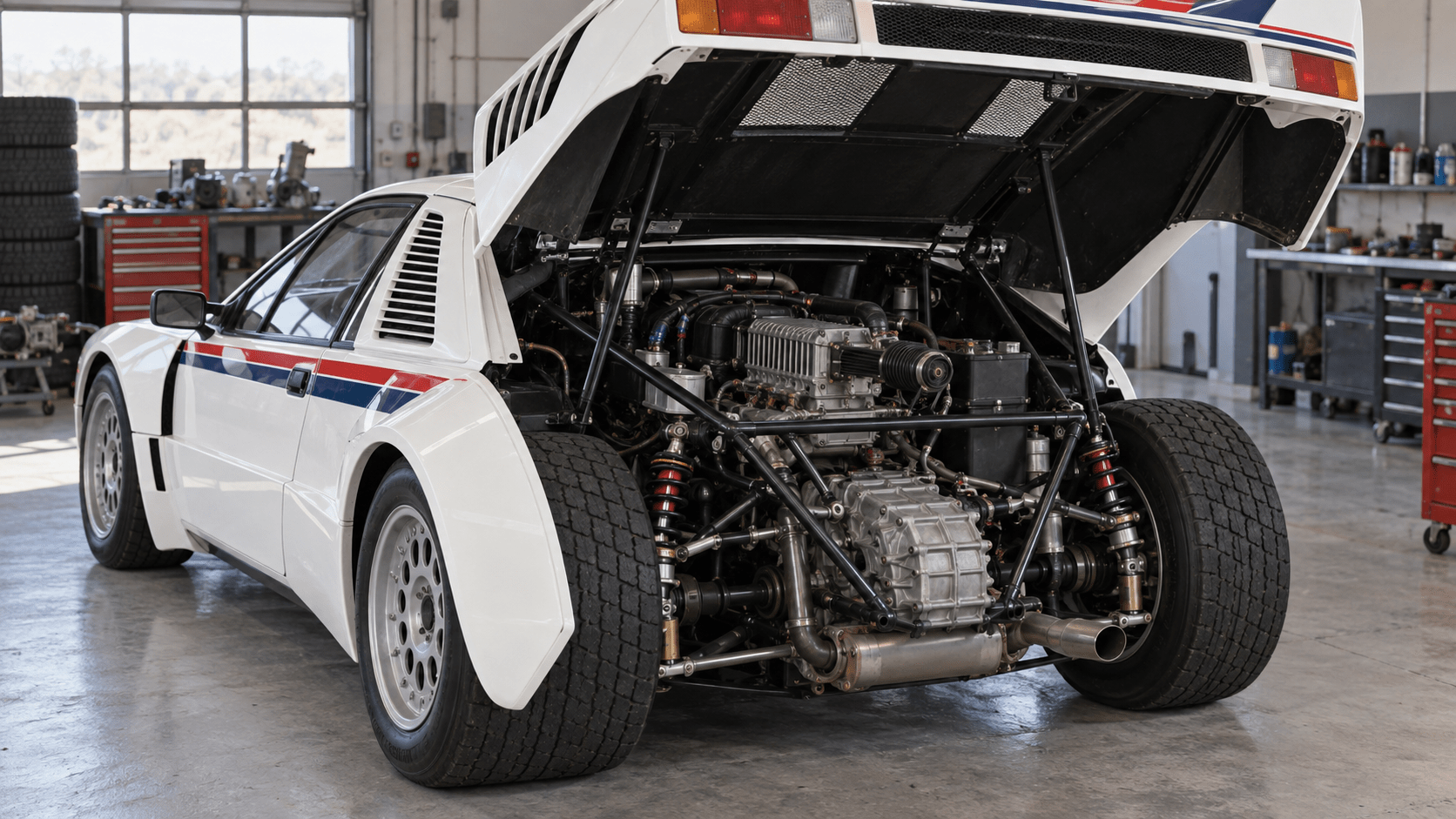
The 037’s four-cylinder engine used an Abarth Volumex positive-displacement supercharger rather than relying on a large exhaust-driven turbocharger. The advantage was immediate response: useful torque arrived without waiting for exhaust flow to build boost. On narrow stages, that predictable delivery helped the driver balance a rear-wheel-drive car on the throttle.
The layout carried a disadvantage against the four-wheel-drive Audi quattro on loose or slippery ground. Lancia countered with low weight, sophisticated suspension and strong performance on dry asphalt. Later development increased capacity from 1,995cc to 2,111cc and brought further changes to injection, induction, bodywork and cooling.
Stradale versus rally car
Road homologation car
The Stradale provided the production basis required for Group B. It retained the special structure and supercharged mid-engine layout but used road equipment, a softer specification and a quoted 205hp.
Works competition car
Rally versions gained competition suspension, brakes, transmission, fuel system, safety equipment and progressively more powerful engines. Body and cooling details changed as the programme evolved.
Modern recreation
A recreation may use a bespoke frame, different donor components or an alternative engine. It can be exciting and valuable, but it should never borrow the identity or history of a genuine car.
The 1983 championship story
The 037’s competition debut came at the 1982 Rally Costa Smeralda. Its defining season followed in 1983. Walter Röhrl won the Monte Carlo Rally, with Markku Alén second, immediately demonstrating the car’s ability on suitable roads. Lancia’s campaign produced further major results, and victory at Sanremo on 7 October secured the manufacturers’ championship with two rounds remaining.
Lancia filled four of the first five places at Sanremo. Alén, Röhrl and Attilio Bettega occupied the podium, while a young Miki Biasion finished fifth in a Jolly Club 037. Röhrl ended the season second in the drivers’ championship; Biasion won the European and Italian championships.
Evolution 1 and Evolution 2
“Evo 1” and “Evo 2” are useful shorthand, but identity should be established through the homologation papers and the physical car. Competition development brought revised bodywork, mechanical fuel injection, changes to the Volumex installation and continuing weight reduction. The later 2,111cc engine was intended to keep the car competitive as four-wheel-drive rivals became faster.
By 1984 the Peugeot 205 T16 had shifted the competitive balance. Alén gave the 037 its final World Rally Championship victory at the 1984 Tour de Corse. Lancia continued using the model while developing its four-wheel-drive, supercharged-and-turbocharged Delta S4 successor.
How to assess a genuine Lancia 037
Paint scheme, wide arches and a famous competition number do not prove identity. Begin with the chassis and work outwards. Examine stamped numbers and plates, the FIA homologation documents, factory or recognised preparer records, ownership history and period photographs. Check whether the specification matches the date and events claimed.
Provenance
Trace the chassis through invoices, logbooks, entry lists, results and dated photographs. Ask specialists to challenge gaps rather than explain them away.
Structure
Inspect the central cell, tubular frames, suspension mountings and bonded composite panels for accident repairs, corrosion, fatigue and later alteration.
Specification
Record the engine number and capacity, supercharger, injection or carburettor system, gearbox, brakes, suspension and safety equipment.
Eligibility
A car can be genuine yet unsuitable for a particular historic series in its present form. Confirm the organiser’s requirements before purchase or restoration.
Lancia 037 buying and ownership checks
Engine and Volumex supercharger
Cold-start the engine and verify oil pressure, cooling stability, fuel delivery and crankcase breathing. Listen for bearing or valvetrain noise and establish the supercharger’s rebuild history. Competition maintenance intervals depend on output and use, not ordinary road mileage.
Gearbox and driveline
Check gear selection when cold and hot, final-drive noise, limited-slip differential behaviour, driveshafts and joints. Competition ratios can make a car awkward on the road, while scarce original casings and internals can be expensive to replace.
Body and chassis
Remove or open the large front and rear sections so the supporting structure can be examined. Look for stress cracking, poorly aligned pick-up points, heat damage near the engine and evidence of a previous re-shell. Panel fit is less important than structural truth.
Parts and specialist support
Establish which components are original, period-correct, remanufactured or substituted. A sensible spares package and access to a marque specialist may be worth more than cosmetic perfection.
Replicas and continuation-style builds
The 037’s rarity has encouraged replicas ranging from visually inspired road cars to sophisticated space-frame competition builds. Judge one on the quality of its engineering and the honesty of its description. Ask who built the chassis and body, which donor components were used, how it was registered, what competition papers it holds and whether replacement parts remain available.
A replica should have its own identity and documentary trail. An accurate colour scheme is not provenance, and a modern chassis plate must not be confused with an original Lancia or Abarth competition identity.
Love cars you don’t see every day?
Get forgotten cars, surprising motoring stories and the most interesting finds from Unusual Cars by email.
Free to join. No spam. Unsubscribe whenever you like. See our privacy policy.
Frequently asked questions
Was the Lancia 037 four-wheel drive?
No. It was rear-wheel drive. Its 1983 manufacturers’ title remains the last World Rally Championship title won by a two-wheel-drive car.
Was the 037 based on the Beta Montecarlo?
It used the Beta Montecarlo as its homologation starting point, but the special structure, longitudinal engine installation and removable bodywork made the 037 a far more purpose-built machine.
How many road cars were made?
Lancia’s heritage material states that 200 road-going examples were produced for Group B homologation and that 53 cars were prepared for competition.
Did Walter Röhrl win the 1983 drivers’ championship?
No. Röhrl finished second. Lancia won the manufacturers’ title, while Hannu Mikkola won the drivers’ championship for Audi.
What replaced the 037?
The four-wheel-drive Lancia Delta S4 replaced it at works level during 1985, combining a supercharger and turbocharger.
Research basis: Lancia and Stellantis Heritage historical material plus FIA documentation for homologation B-210. Specifications and histories of surviving road, rally and recreated cars vary; verify chassis-specific claims independently.