Audi quattro Group B guide
How the original rally quattro, A1 and A2 led to the short-wheelbase Sport quattro and spectacular S1 E2—plus road-car differences, homologation facts and buying checks.
Why the Audi quattro changed rallying
Four-wheel drive was not a new idea, but Audi demonstrated its value at World Rally Championship level with a speed and consistency that forced rivals to rethink their programmes. The production quattro’s five-cylinder turbo engine and permanent four-wheel-drive system gave the rally car exceptional traction on snow, gravel and broken surfaces.
Audi entered the World Rally Championship in 1981, before Group B became the premier formula. By 1982 the team had won the manufacturers’ championship; Hannu Mikkola became drivers’ champion in 1983. In 1984 Audi claimed both titles, with Stig Blomqvist winning the drivers’ championship.
Original quattro, A1, A2, Sport quattro and S1
| Version | Period and role | What changed |
|---|---|---|
| Rally quattro | Entered WRC from 1981 under the preceding regulations | Established the turbo five-cylinder and four-wheel-drive formula. |
| quattro A1 | Early 1983 Group B evolution | First Group B development of the long-wheelbase car. |
| quattro A2 | 1983–84 | Weight, engine and chassis development made the established car more competitive. |
| Sport quattro | Homologated May 1984 | Wheelbase shortened by about 30cm, four-valve engine and specialist road homologation model. |
| Sport quattro S1 / E2 | 1985 | More aggressive aerodynamics, revised weight distribution and approximately 350kW/476PS in Audi’s historical account. |
The names are frequently blurred in adverts. “S1” is often applied loosely to any short, wide-bodied quattro replica, while enthusiasts commonly use “E2” for the heavily winged 1985 evolution. Identify the precise homologation specification and construction of an individual car rather than relying on graphics.
How the Sport quattro differed
Shorter wheelbase
Audi shortened the wheelbase by roughly 30cm to improve agility; internally it was known as the “short one”.
Five-cylinder engine
The turbocharged five-cylinder remained front-mounted, unlike the mid-engined Peugeot and Lancia challengers.
Four-valve head
The Sport quattro introduced a four-valve-per-cylinder engine as Audi sought greater performance.
Special body
Shortened proportions, wide arches and composite panels made the homologation model visibly distinct from the regular quattro.
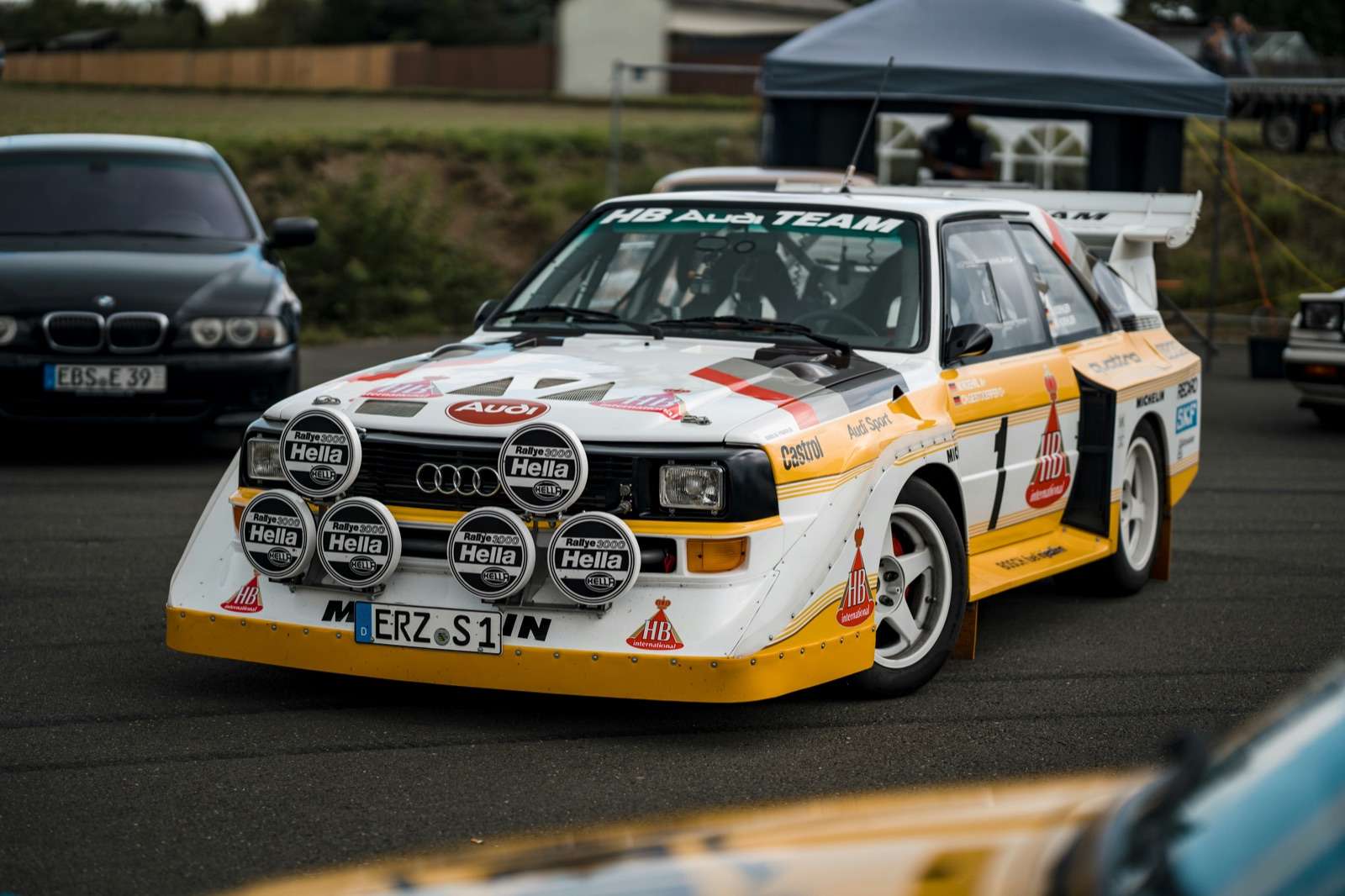
Sport quattro S1 E2 engineering
The 1985 evolution used conspicuous aerodynamic devices at the front, sides and rear. They were not merely styling: the additions managed airflow while Audi worked to overcome the inherent disadvantage of retaining a front-mounted engine against compact mid-engined rivals.
Audi’s historical material quotes 350kW (476PS), a weight of 1,090kg and 0–100km/h in 3.1 seconds in the middle transmission ratio. Those figures describe a particular factory context, not every surviving quattro competition car. Engine output, bodywork and driveline specification changed during the programme and many cars were modified later.
Homologation: B-242 and B-264
The FIA Historic Database lists the long-wheelbase Audi quattro as B-242, homologated on 2 May 1983, and the Sport quattro S1 as B-264, homologated on 2 May 1984. Turbocharged engine capacity is expressed by the FIA with an equivalence factor for classing purposes, which is why database “cylinder capacity” fields can appear different from the engine’s physical swept volume.
The Sport quattro road car
The road-going Sport quattro existed to satisfy Group B production requirements and is substantially rarer than a standard Ur-quattro. Its shortened shell, wide composite body panels, more powerful four-valve engine and distinctive proportions make it immediately recognisable—but also widely replicated.
Exact production figures are quoted differently depending on whether prototypes and competition cars are included. Audi’s own anniversary publication states that 22 Sport quattros were made in rally form. When assessing a road car, use factory records and chassis-specific evidence rather than a rounded internet production claim.
Major victories and drivers
Audi’s rally era involved Michèle Mouton, Hannu Mikkola, Stig Blomqvist and Walter Röhrl among other leading drivers. Mouton became the first woman to win a World Rally Championship event and narrowly missed the 1982 drivers’ title. Mikkola won the 1983 championship, while Blomqvist and Audi secured the 1984 drivers’ and manufacturers’ titles.
The Sport quattro’s 1984 debut brought development problems. The later S1 became an icon despite arriving as the balance of power moved towards Peugeot. After Group B, the concept achieved further fame at Pikes Peak: Michèle Mouton, Bobby Unser and Walter Röhrl won in successive years, with Röhrl setting a record in 1987 in an extensively modified S1.
How to identify a genuine competition quattro
A wide body, rally lamps and period livery prove nothing. Establish the chassis identity, homologation form, factory or recognised preparation records, continuous ownership and competition history. Match alleged events with entry lists, results and photographs, paying attention to body and specification changes over time.
Identity
Check chassis markings, plates and documentation as one evidence chain.
Specification
Record the physical engine, turbo, gearbox, differentials, suspension, brakes and body configuration.
History
Verify works, customer or privateer claims independently; a replicated livery is not provenance.
Audi Sport quattro buying checklist
Body and structure
Inspect composite panels, bonded areas, suspension mountings and the underlying structure for accident damage and poor repairs. A competition car may have been re-shelled or extensively rebuilt, which must be reconciled with its claimed identity.
Five-cylinder engine and turbo
Obtain a documented build specification. Check cold starting, oil pressure, crankcase breathing, cooling, fuel delivery, turbo condition and evidence of detonation. Maintenance needs depend on output and use rather than normal road mileage.
Four-wheel-drive system
Investigate transmission noise, gear selection, centre and axle differentials, shafts, joints and oil leakage. Identify whether the system matches the claimed road or competition specification.
Specialist components
Correct body, engine, transmission and suspension components are scarce and valuable. Confirm what is fitted, what spares accompany the car and who can maintain it before agreeing a price.
Replicas, S1 recreations and hill-climb cars
Many striking S1-style cars are later recreations, hill-climb specials or modified Ur-quattros. Some are extremely sophisticated and powerful, but they should not be described as original Group B cars without evidence. Record the donor or chassis, builder, date, body material, wheelbase, engine, drivetrain and registration route.
A modern competition build may outperform a period car while having no historical provenance. Its value rests on engineering, condition, eligibility and documentation—not borrowed works history.
Frequently asked questions
What does quattro mean?
It is Audi’s name for four-wheel drive. A lowercase “quattro” normally describes the system; the original model is often called the Audi quattro or Ur-quattro.
Why was the Sport quattro shortened?
The shorter wheelbase was intended to make the car more agile against compact mid-engined rivals.
Is every winged short quattro an S1?
No. Many are replicas or later competition specials. Confirm the chassis identity and documentary history.
How powerful was the S1 E2?
Audi quotes 350kW (476PS) for the 1985 S1 in its historical material. Other figures may refer to different settings or later development.
Research basis: Audi Tradition/Audi MediaCenter historical material and FIA homologation records B-242 and B-264. Individual road, rally, hill-climb and recreated cars vary; verify chassis-specific claims independently.