UNUSUAL CARS MODEL GUIDE
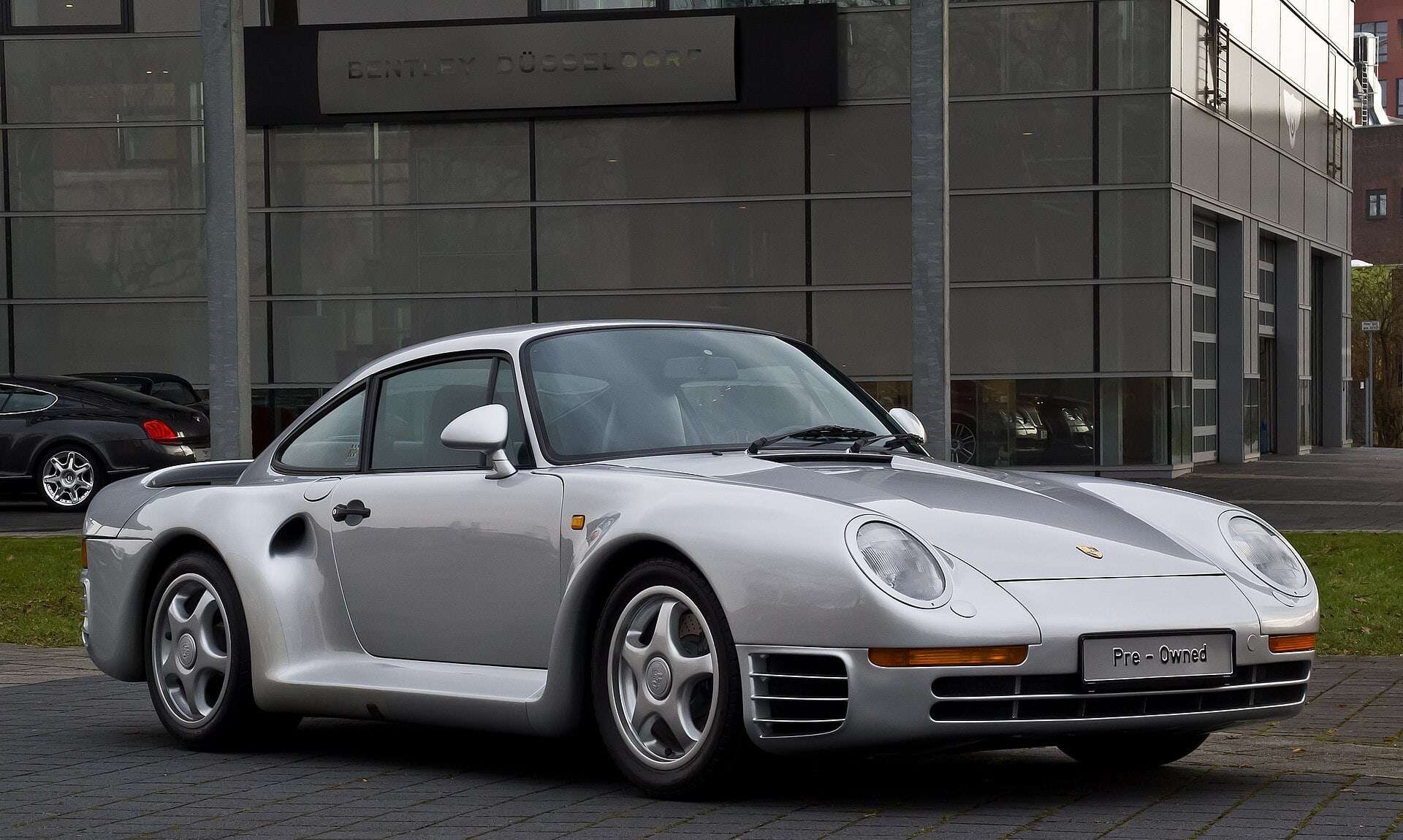
The Porsche 959 was the company’s 1980s technology demonstrator made road legal: a 2.85-litre sequentially twin-turbocharged, four-wheel-drive supercar developed from Porsche’s Group B programme. The production model appeared in 1985 and customer cars followed from 1987. Porsche records 292 series-production examples, a quoted 450 PS and a 317 km/h maximum speed.
Quick answer: the 959 matters because it combined electronically controlled variable all-wheel drive, adjustable suspension, tyre-pressure monitoring, sophisticated composite bodywork and sequential turbocharging years before those ideas became common in high-performance road cars. Any purchase requires factory-level expertise, detailed provenance and a maintenance budget appropriate to a hand-built technological landmark.
From Group B study to road-going supercar
Porsche presented its Group B study at the 1983 Frankfurt motor show. Group B regulations offered a route into international competition, but the project also allowed Porsche to test systems that could influence future road cars. The 959 retained the familiar outline of the 911 while using a purpose-designed body, advanced aerodynamics and a drivetrain far removed from a conventional production 911.
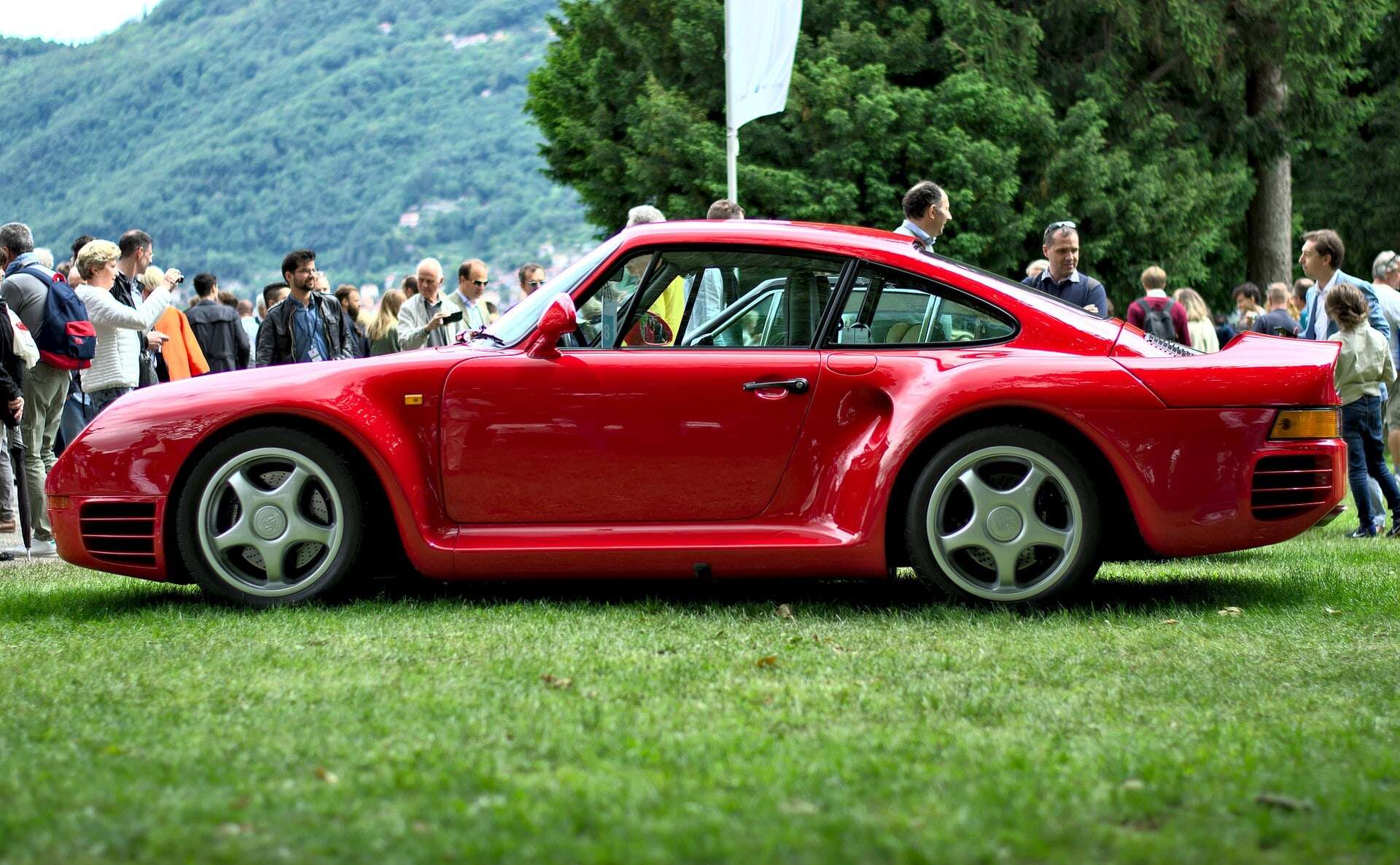
The road model debuted at the 1985 Frankfurt show. Delays caused by the complexity of its systems meant production deliveries began later, by which time the 959’s specification still looked extraordinary. Porsche described the car as a technology platform rather than simply a faster 911.
Engine and sequential twin turbocharging
The 2,848 cc flat-six used four-valve cylinder heads cooled by water while the cylinders remained air-cooled. Two turbochargers operated sequentially: one supplied boost at lower engine speeds and the second joined at higher load. This arrangement reduced the abrupt lag associated with many contemporary turbo cars while supporting a quoted 450 PS and 500 Nm in the regular road car.
Titanium connecting rods reduced reciprocating mass, and the compact engine was linked to a six-speed gearbox. One ratio was marked G for Gelände, or terrain, reflecting the project’s competition origins rather than creating a conventional off-road low range.

PSK four-wheel drive and adaptive chassis
The electronically controlled Porsche-Steuer Kupplung system could vary the torque split between the axles. The driver selected programmes and the control system responded to conditions rather than relying on a fixed mechanical distribution. The 959 also used speed-sensitive adjustable dampers, self-levelling suspension, ABS and tyre-pressure monitoring.
Its body mixed Kevlar and glass-fibre-reinforced epoxy panels with aluminium doors and bonnet. Porsche quoted a drag coefficient of 0.31. These systems worked together: the shape controlled lift and drag, the suspension managed high-speed stability, and the drivetrain sought traction without removing the rear-engined character.

Porsche 959 versions
| Version | Output | Purpose and distinction |
|---|---|---|
| 959 Komfort | 450 PS | The main road specification, with adjustable suspension and a more fully equipped cabin. |
| 959 Sport | Higher-output lightweight derivative | Porsche states that 29 Sport examples were sold; equipment was reduced and larger turbochargers increased performance. |
| 959 Paris-Dakar | Competition specification | Long-distance rally version; Porsche finished first, second and sixth in the 1986 Paris-Dakar. |
| 961 | Competition specification | Circuit-racing development of the 959; it finished seventh overall and won its class at Le Mans in 1986. |

Love cars you don’t see every day?
Get forgotten cars, surprising motoring stories and the most interesting finds from Unusual Cars by email.
Free to join. No spam. Unsubscribe whenever you like. See our privacy policy.
Dakar and Le Mans legacy
The four-wheel-drive system was developed through the 953 that won the 1984 Paris-Dakar. The 959 programme then returned with turbocharged cars in 1986, when René Metge and Dominique Lemoyne won ahead of Jacky Ickx and Claude Brasseur; a third factory car finished sixth. This result connected the road car’s drivetrain technology to a demanding competition programme rather than a marketing exercise.

Porsche also adapted the platform for circuit racing as the 961. Its 1986 Le Mans result demonstrated the breadth of the underlying package, although the 959 arrived too late to establish the originally intended Group B career before the category ended.
Production, identity and rarity
Porsche states that 292 series-production road cars were built from 1987 to 1988. Other totals sometimes include prototypes, competition cars and a small later group assembled from remaining components, so advertisements should specify exactly what their number represents. The Sport derivative is rarer still, with Porsche recording 29 sold.
Identity must be established from the chassis number, factory records and the car’s original market specification. A 959’s value depends not only on condition but on provenance, originality, correct systems and traceable work by recognised specialists.

Porsche 959 buying and ownership checks
This is not a car for a conventional pre-purchase inspection. The engine, sequential turbo system, variable four-wheel drive, hydraulic ride-height and damping equipment, tyre-pressure system, composite panels and model-specific electronics require someone familiar with the 959. Long storage can be as significant as mileage: seals, hoses, fuel-system components, accumulators and electrical connections all age.
Verify scheduled maintenance, major recommissioning work, software or control-unit repairs, correct wheels and tyres, tool kit, books and documentation. Inspect the composite exterior and aluminium panels for accident damage and unsuitable repairs. Confirm that every selectable suspension and drivetrain function operates correctly and that no warning has simply been disabled.
Parts availability is specialist and some repairs can require bespoke work or factory support. A complete inspection should include fluid analysis, leak-down or compression testing where appropriate, boost behaviour, drivetrain diagnostics, brake condition, suspension hydraulics and evidence of corrosion in the underlying structure and fasteners.
Why the Porsche 959 still matters
The 959’s importance is not confined to its period speed record. It anticipated the high-performance formula of managed turbocharging, adaptable all-wheel drive, active chassis systems and lightweight mixed-material construction. Later Porsche Turbos became easier to use in poor conditions, and modern supercars routinely integrate systems that the 959 brought together in the mid-1980s.
Sources and further reading
- Porsche Newsroom: 959 technology platform
- Porsche Newsroom: 30 years of the Porsche 959
- Porsche Newsroom: Porsche 959 S history and technical data
Continue the Porsche story
The 959 links Porsche rally engineering to the modern all-wheel-drive supercar. Explore the Rare & Performance Porsche hub, then read the Porsche 911 Turbo 964 guide and the Porsche 996 Turbo guide.
Frequently asked questions
How many Porsche 959 road cars were built?
Porsche records 292 series-production examples built from 1987 to 1988. Totals that include prototypes, competition cars or later factory completions need to be labelled separately.
How much power does a Porsche 959 have?
Porsche quotes 450 PS for the regular production 959 from its 2,848 cc sequentially twin-turbocharged flat-six.
Did the Porsche 959 win the Paris-Dakar Rally?
Yes. Porsche 959s finished first, second and sixth in the 1986 Paris-Dakar Rally.
Is the Porsche 959 four-wheel drive?
Yes. Its electronically controlled PSK system varies the torque distribution between the front and rear axles.
What should be checked before buying a Porsche 959?
Use a recognised 959 specialist to verify provenance and inspect the sequential turbo system, variable four-wheel drive, hydraulic suspension, electronics, composite body and maintenance history.