UNUSUAL CARS MODEL GUIDE
The Porsche Carrera GT is a mid-engined, carbon-fibre supercar powered by a naturally aspirated 5.7-litre V10 and a six-speed manual gearbox. Revealed as a concept in Paris in 2000 and built from 2003 to 2006, it turned an unused Porsche endurance-racing engine into a 612 PS road car. Porsche produced 1,270 examples in Leipzig.
Quick answer: the Carrera GT is important because it transferred an abandoned LMP racing programme into a road car with a carbon monocoque, pushrod suspension, ceramic brakes and the world’s first ceramic two-plate dry clutch. Buying one demands complete provenance, current tyres and meticulous factory-specialist maintenance.
From LMP 2000 to the Paris concept
The Carrera GT’s V10 began in Porsche’s LMP 2000 programme, a prototype intended for endurance racing. When Porsche cancelled the racing project in 1999 to concentrate resources on production models, the compact high-revving engine survived. Engineers adapted it as the centrepiece of a new road-going supercar.

Porsche presented the concept at the Paris motor show in September 2000. Its reception justified production, but the road car was not a lightly modified show vehicle. The engine grew from 5.5 to 5.7 litres, the structure was developed for series manufacture and Porsche established carbon-fibre production capability at Leipzig.
V10 engine and six-speed manual gearbox
The 68-degree V10 displaces 5,733 cc and produces 450 kW, or 612 PS, at 8,000 rpm with 590 Nm at 5,750 rpm. It is naturally aspirated and connected to a close-ratio six-speed manual gearbox. Porsche quoted 0-100 km/h in 3.9 seconds, 0-200 km/h in 9.9 seconds and a 330 km/h maximum speed.

The compact Porsche Ceramic Composite Clutch uses two dry plates and measures only 169 mm in diameter. Its small size allowed the engine and gearbox to sit low, but its behaviour and replacement implications make correct operation and specialist measurement essential during an inspection.
Carbon structure, suspension and brakes
The monocoque and separate engine carrier were made from carbon-fibre-reinforced plastic, a first for a series-production Porsche. The lightweight structure was combined with double-wishbone pushrod suspension, ceramic composite brake discs, magnesium components and Kevlar seat shells.
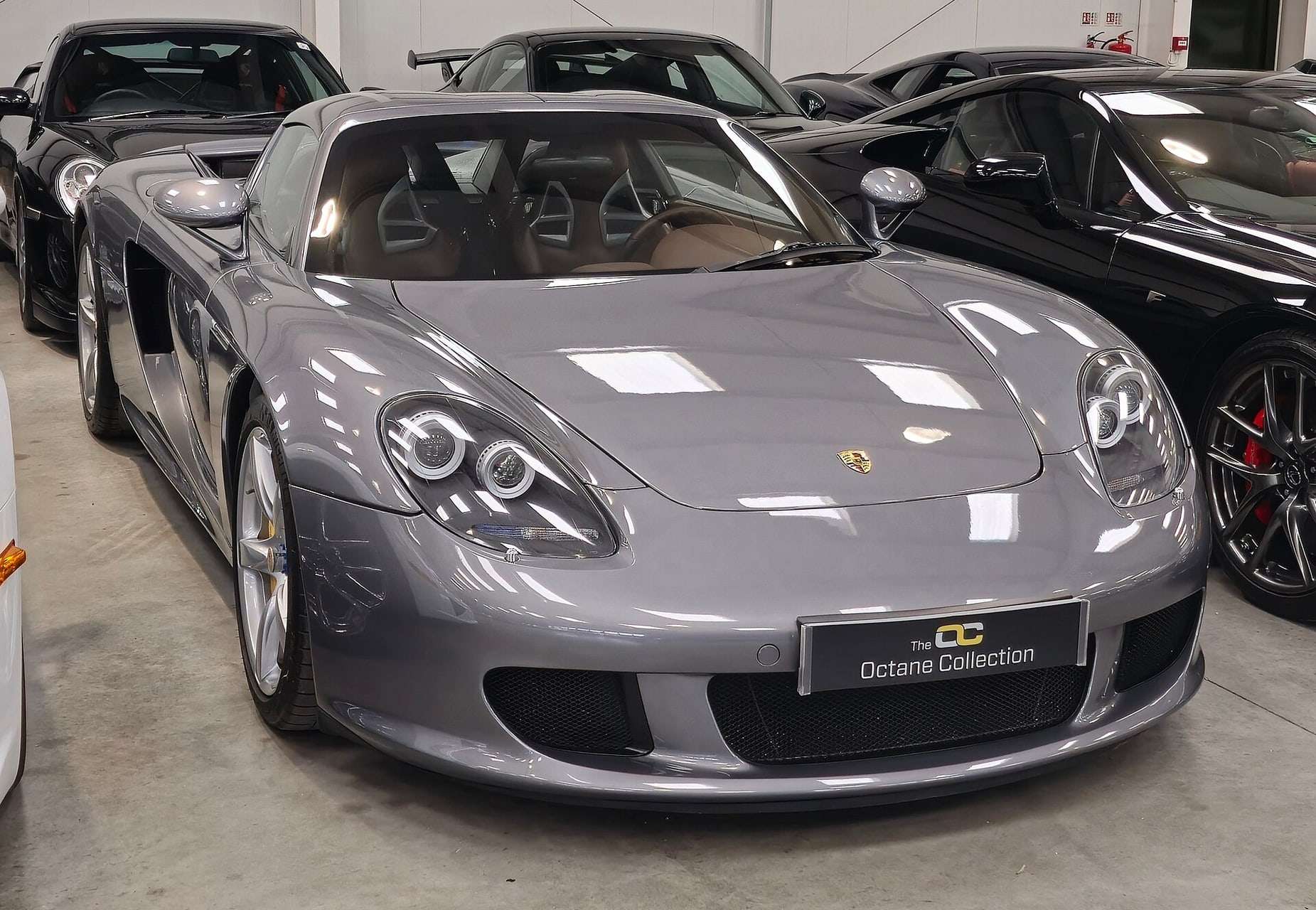
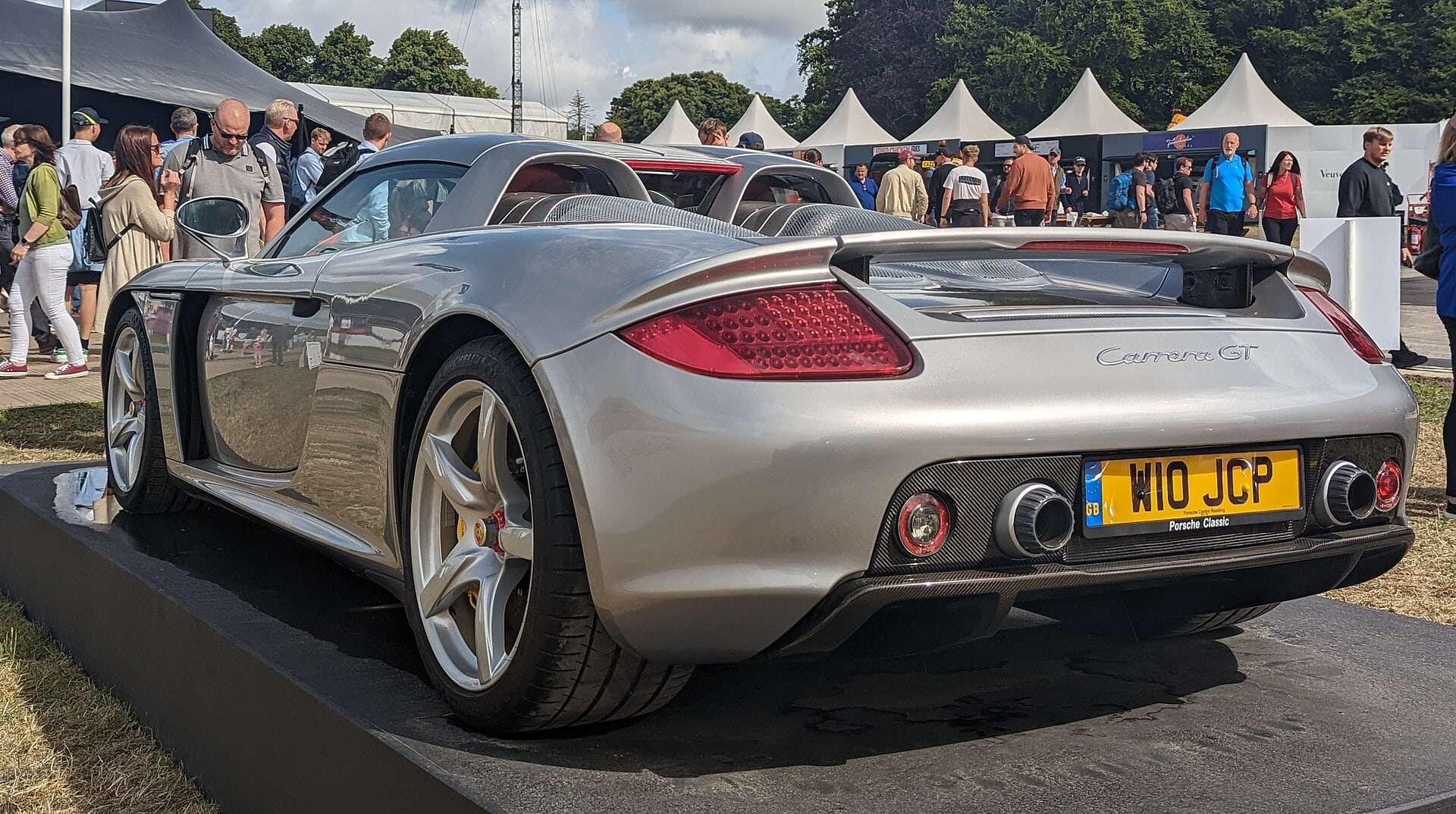
Ground-effect aerodynamics and an automatically extending rear wing managed stability without a large fixed spoiler. The roof comprises two removable panels that can be stored in the front luggage compartment, making the Carrera GT a true open targa rather than a conventional convertible.
Porsche Carrera GT specifications
| Item | Factory figure |
|---|---|
| Engine | 5,733 cc naturally aspirated 68-degree V10 |
| Power | 612 PS at 8,000 rpm |
| Torque | 590 Nm at 5,750 rpm |
| Transmission | Six-speed manual with ceramic two-plate dry clutch |
| Kerb weight | 1,380 kg |
| 0-100 km/h | 3.9 seconds |
| Top speed | 330 km/h |
| Production | 1,270 cars, 2003-2006 |
Love cars you don’t see every day?
Get forgotten cars, surprising motoring stories and the most interesting finds from Unusual Cars by email.
Free to join. No spam. Unsubscribe whenever you like. See our privacy policy.
Cabin and driving controls
The cabin placed the gear lever high on the centre console, close to the steering wheel. A laminated beech gear knob referenced the 917 and other Porsche racing cars. The fixed carbon and Kevlar seat shells, compact clutch and direct steering emphasised control and low mass rather than insulation.

There is no dual-clutch gearbox, four-wheel drive or modern stability-management layer to conceal poor inputs. That directness is central to the Carrera GT’s reputation, but it also means tyres, suspension condition, alignment and driver preparation are safety-critical rather than merely matters of feel.
Production and colours
Series production ran from autumn 2003 until May 2006. Porsche records 1,270 hand-built cars, produced at Leipzig with engines assembled in Stuttgart. GT Silver, Guards Red, Fayence Yellow, Basalt Black and Seal Grey were among the factory colours, with paint-to-sample and special interiors adding further variation.

Porsche Carrera GT buying and ownership checks
Provenance comes first. Confirm the chassis number, original specification, ownership and service history through Porsche records and a recognised Carrera GT specialist. Examine the carbon monocoque and engine carrier for damage, repairs or evidence of incorrect lifting. Even apparently minor accidents require expert assessment because structural carbon is not evaluated like steel or aluminium.
The V10 should have complete servicing evidence and stable oil pressure, temperatures and diagnostic records. Check for leaks, ageing hoses, cooling-system condition, exhaust damage and correct operation of the variable intake and engine-management systems. The ceramic clutch needs a measured wear assessment and the gearbox should shift cleanly once warm.
Inspect the ceramic brake discs for damage and recorded wear, and examine dampers, pushrods, joints, wheel condition and alignment. Correct manufacturer-approved tyres of suitable age and specification are essential. A car that has spent years static may require more recommissioning than its mileage suggests.
Confirm that the roof panels, luggage, books, tools, battery equipment and model-specific accessories remain with the car. Modifications should be reversible, documented and engineered to a standard appropriate to the vehicle.
Why the Carrera GT matters
The Carrera GT belongs to a short period when manufacturers translated racing technology into road cars without replacing the manual gearbox or naturally aspirated engine. Its V10 came from a real competition programme, while its structure forced Porsche to develop carbon manufacturing expertise later reflected in further high-performance projects.
Sources and further reading
- Porsche Newsroom: 25 years of the Carrera GT
- Porsche Newsroom: Carrera GT engineering and technical data
- Porsche press kit: Carrera GT anniversary
Continue the Porsche story
The Carrera GT is Porsche’s analogue V10 counterpoint to the electronically managed 959. Explore the Rare & Performance Porsche hub, then read the Porsche 959 guide and the Porsche 928 GTS guide.
Frequently asked questions
How many Porsche Carrera GTs were built?
Porsche produced 1,270 Carrera GTs between 2003 and 2006 at Leipzig.
What engine does the Porsche Carrera GT use?
It uses a naturally aspirated 5,733 cc V10 derived from Porsche’s cancelled LMP 2000 endurance-racing programme.
How much power does a Porsche Carrera GT have?
Porsche quotes 612 PS at 8,000 rpm and 590 Nm at 5,750 rpm.
Is the Porsche Carrera GT a manual?
Yes. It has a six-speed manual gearbox and a compact ceramic two-plate dry clutch.
What should be checked before buying a Carrera GT?
Commission a recognised specialist to verify provenance and inspect the carbon structure, ceramic clutch, V10, brakes, suspension, tyres and complete service record.