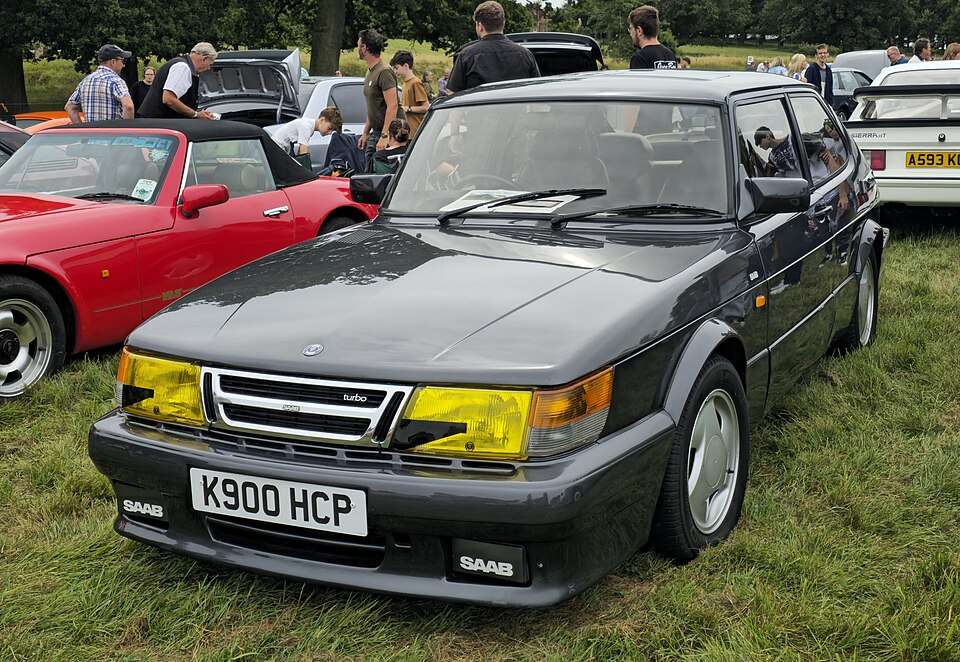
The original Saab 900 Turbo offers a distinctive driving position, useful hatchback practicality and an engine character that helped define Saab. It is also an ageing specialist car whose structure and transmission deserve careful attention. This guide covers the classic-generation Turbo, including 8-valve, 16-valve, low-pressure and convertible context, with UK viewing checks and a practical maintenance plan.
Our buying verdict
Buy a sound shell and a healthy, documented drivetrain before chasing a desirable body kit or badge. A specialist inspection of the wishbone mounting structure, driveshaft-tunnel areas and gearbox is money well directed. A good lower-specification Turbo can be a more satisfying purchase than an impressive-looking car with hidden corrosion and transmission noise.

Classic 900 Turbo versions explained
The original 900 was introduced in the late 1970s and developed through the 1980s into the early 1990s. Hatchback and saloon production ended before the classic convertible’s final run. The later NG900 is a different design; registration year alone is not always enough to distinguish the final classic convertibles from newer cars.
| Version | Distinction | Buying focus |
|---|---|---|
| 8-valve Turbo | Earlier turbocharged engine and period character | Identify the exact engine, fuel system and service parts. |
| 16-valve Turbo / T16 | Later twin-cam turbo engine, with market and year variations | Oil history, chain noise, cooling, turbo and boost-control health. |
| Low-pressure Turbo / 900S | Different boost specification from full-pressure versions | Authenticate the fitted system; do not infer output from body trim. |
| Aero / 16S / Carlsson descriptions | Trim and performance terminology varies by market and year | Verify provenance and specification independently. |
| Convertible | Additional hood, sealing and structural considerations | Assess roof operation, water entry and full underside condition. |
Full-pressure and low-pressure cars should be compared as their actual specifications, not simply as “Turbo” adverts. Saabtec’s period guide notes the boost gauge as an identification clue, but instruments and other parts can be changed. Build information and the installed engine-management hardware provide a stronger basis.
Body kits, wheels and badges can be fitted later. They may enhance a car you want to use, but they do not establish that it left the factory as a particular derivative. Pay an originality premium only when the documentation and detail inspection support it.
The three-door hatch is an obvious choice for buyers drawn to the familiar silhouette, while five-door and saloon versions provide alternatives. A convertible adds open-air appeal but also another major system to inspect and budget for.
Try the seating position, visibility and controls before deciding. The 900’s ergonomics differ from many modern cars. Check that you can comfortably operate the clutch and gearlever and that the cabin and luggage arrangement suit the intended use.
Our preference is a car supported by a knowledgeable specialist and accompanied by clear records. Modifications can be well executed, but increased torque and altered boost create additional questions for an old transmission. A claimed tune is not a substitute for evidence of the whole installation.
Classic Saab 900 Turbo prices and asking evidence
Car & Classic listings checked on 3 November 2026 included a 1992 900S 16V Turbo convertible automatic with 143,786 miles advertised at £4,500, a 1991 Turbo 16S convertible automatic with 173,000 miles at £8,995, and a 1993 LPT convertible manual with 134,000 miles at £9,995.
The same search showed 1991 900S Aero adverts with 197,654 miles at £6,250 and 206,100 miles at £12,500. These are seller descriptions and asking prices, not authenticated specifications, inspected condition grades or completed sales. They illustrate the difficulty of valuing the badge without understanding the car.
Separate body style, transmission, turbo specification, market and originality before comparing prices. A convertible’s hood condition or a hatchback’s structural restoration can be more material than a small difference in mileage. A large pile of invoices needs reading, not merely counting.
Ask for photographs of the underside, mounting areas, door bottoms, arches and boot floor before travelling. Request details of gearbox work, chain-related repairs, cooling maintenance and any engine conversion. Clarify what “restored” means and whether the work is documented before final paint and protection.
Build purchase plus immediate repair and servicing into one figure. An old Saab can remain useful, but the apparent saving on a cheap example can disappear through body repair, transmission work and missing trim. Do not assume future appreciation will fund repairs.

Structural rust: look beyond the wheelarches
Start with a lift inspection by someone familiar with the classic 900. Front wishbone mounting areas, inner wings, chassis sections and the structure around the driveshaft passages deserve particular attention. Corrosion here is a different proposition from an isolated cosmetic blemish.
Check inner and outer sills, floorpans, jacking areas and box sections. Look around rear suspension link and mounting areas as well as the boot floor. A shiny underside coating can limit inspection; ask for photographs and invoices establishing what is beneath it.
Inspect the battery-tray area and surrounding structure. Leaks, trapped moisture and past repairs can create local problems. A new battery or cleaned tray does not establish the condition of the metal underneath.
Check all wheelarches, especially behind plastic edging and deep cladding. Bubbling at the trim edge can be the visible sign of a larger affected area. Ask an inspector to assess accessible inner metal and explain what cannot be seen without removal.
Door bottoms, bonnet seams, tailgate or boot-lid edges and the lower rear of front wings also warrant examination. Later cars can have seam corrosion despite apparently attractive outer paint. Inspect drains and repair seams rather than relying on the model’s reputation for sturdy construction.
Look for accident repairs, distorted seams, inconsistent gaps and unusual suspension geometry. A vehicle-history check is useful but cannot identify every unrecorded repair. Road behaviour and tyre wear should be considered alongside structural evidence.
On a convertible, inspect the underside and body carefully rather than assuming an attractive hood means a sound car. Check for damp beneath accessible carpets and in the boot. Roof leaks can damage trim and contribute to corrosion well away from the obvious entry point.
Good repairs are valuable when the scope and workmanship can be assessed. Obtain an itemised quotation where rust remains, including inner structure, access, paint and protection. The price of an outer repair panel is not the price of restoring the complete area.
Engine, turbo and gearbox checks
Understand the unusual drivetrain
The classic 900 has a longitudinal engine arrangement with the transmission below it, despite driving the front wheels. This makes generic front-wheel-drive assumptions unhelpful. Choose a workshop familiar with the layout and the model’s service procedures.
Identify the fitted engine and gearbox before ordering parts. Over decades, engines, transmissions and turbo equipment may have been replaced. Ask for records showing what was installed and whether the work retained or altered the original specification.
Engine and gearbox lubrication require the correct individual procedures and specifications. Do not treat the layout as evidence that one casual fluid change services everything. Have a specialist set the appropriate plan for the exact car.
Cold starting, oil and timing chain
Check oil and coolant levels before a genuine cold start. Observe starting, idle, smoke and warning lamps, then repeat the assessment fully warm. Ask about measured oil consumption and any need for regular coolant top-ups.
The engines use timing chains rather than a routine cambelt replacement. Chain noise needs diagnosis, particularly where oil history is poor. Saabtec’s classic guide warns that proper chain-related repair can involve substantial access and engine removal; a cheap chain listing is not a complete repair estimate.
Listen for persistent rattles and other abnormal mechanical sounds. Avoid accepting the explanation that every old Saab makes the same noise. A specialist should distinguish chain, accessory, exhaust and internal-engine concerns before a price is agreed.
Look for oil leaks and evidence of recent cleaning. Check again after the road test. A few visible seals may be manageable, but multiple leaks, poor running and uncertain consumption create a different ownership risk from a well-documented minor seep.
Cooling, head gasket and turbo system
Inspect radiator, hoses, water-pump area and coolant condition. Confirm stable temperature, fan operation and cabin heat. Investigate contamination, unexplained loss or a previous overheating episode. Do not open the cooling system when hot and pressurised.
Turbo condition should be assessed through the whole operating cycle. Observe smoke at start, after idling and during a properly warmed road test. Smoke has several possible causes, so a diagnosis should precede a turbo purchase.
Check boost delivery against the car’s actual specification. Surging, hesitation, unexpected pressure or poor performance can involve hoses, ignition, fuel delivery, controls or mechanical issues. Full-pressure APC-equipped cars and low-pressure versions do not share an identical diagnostic checklist.
Ask about turbo replacement or rebuilding, including unit identity, oil and coolant connections where applicable, and the work done to address the original cause. A shiny replacement component does not establish the health of the surrounding system.
Modified boost requires coherent supporting evidence. Request the mapping or control specification, fuel requirements, cooling changes and relevant invoices. Extra torque can increase the demands on an ageing transmission, so assess the car as a complete build.
Manual and automatic transmissions
The manual gearbox is a major buying priority. Test all gears from cold and hot, under gentle acceleration and on the overrun. Listen for bearing whine and check for difficult engagement, weak synchromesh or a tendency to jump out of gear.
Do not force a reluctant change. A seller may attribute a fault to linkage or clutch adjustment, but that needs verification. Ask a classic Saab specialist for a diagnosis and written repair plan before assuming the gearbox itself is sound.
Rebuild records should identify the work, parts and specialist rather than just saying “gearbox done”. Availability and the condition of internal components can affect both price and lead time. A used transmission with no test history may simply exchange one uncertainty for another.
Automatic cars need a proper test too. Check engagement, changes, kickdown and behaviour once fully warm, plus fluid condition and leakage through the correct procedure. The three-speed automatic changes the driving experience and should be compared as such.
Assess clutch operation, hydraulic condition where applicable and any leakage. The model’s access arrangements differ from many modern cars; obtain a quote from someone who knows the car. Do not assume either unusually cheap or expensive labour without a defined scope.
Steering, suspension and brakes
Check power-steering assistance, leaks and noise. Stiffness can require specialist assessment; do not buy a rack solely from one symptom without confirming the fault. Inspect hoses, joints and mounting condition.
Look at driveshaft boots and listen for CV-joint noise. Inspect suspension bushes, arms, springs and dampers, including the surrounding structural metal. Replacing a worn component does not solve corrosion at its attachment point.
Brake equipment changed during production, including parking-brake arrangements. Identify the actual system before ordering parts or planning work. Check caliper operation, pipes, hoses, discs, pads and the parking brake, and investigate warning lamps.
Correct tyres and alignment help preserve the car’s road behaviour. Uneven wear can indicate several causes, including wear or structural issues. A steering wheel held off-centre should prompt investigation rather than a promise that a quick adjustment will cure everything.

Interior, headlining and convertible roof
Inspect seat bolsters, upholstery, runners, seat belts and mounting security. A durable-looking cabin may still have cracked trim or worn mechanisms. Price the correct replacement material before assuming a cosmetic refresh will be straightforward.
Sagging headlining and cracked dashboards are familiar age-related concerns. Decide whether you can live with them or obtain a complete restoration quote. A loose fabric repair and a properly retrimmed headlining are different jobs.
Test windows, mirrors, locking, heating, ventilation, lighting and instruments. Verify warning lamps perform their normal check. Older alarms, immobilisers and stereo installations can create faults unrelated to the original car, so inspect their workmanship.
On convertibles, demonstrate the complete hood operation and inspect fabric, seams, rear window, seals and frame. A new outer cover may leave worn seals or mechanisms. Ask whether a quote includes fitting, lining, window details, adjustment and leak testing.
Check for damp insulation beneath accessible carpets and explain any musty smell or staining. A car dried for sale may still leak. Roof and body condition should be considered together, particularly if the car will live outside.
Maintenance costs and model-specific parts
Affiliate disclosure: eBay parts links below are affiliate links using our campaign. We may earn a commission if you buy, at no extra cost to you. Links open search results rather than a verified individual product. Check engine, year, part number, seller, condition and returns; search results can contain incompatible items.
An eBay search checked on 3 November 2026 showed an alternator described specifically as a classic Saab 900 70-amp unit at £156.70. This is a seller’s asking price and application claim, not a verified compatible part or installed quote. The same search returned NG900 and later 9-3 components, demonstrating why generation and part numbers matter.
| Item | Budget and diagnosis focus | Compare parts |
|---|---|---|
| Alternator | Test charging and match rating, pulley, mountings and connectors. | Compare classic 900 alternators |
| Timing chain | Diagnose noise and obtain the full access and component scope. | Compare identified B202 chain components |
| Cooling | Inspect the full system before selecting replacement parts. | Compare classic Turbo cooling parts |
| Turbocharger | Identify unit and cause of failure; compare documented rebuild terms. | Compare classic 900 turbo listings |
| Clutch | Match engine and transmission; include hydraulics and related work as required. | Compare classic Turbo clutch kits |
| Brakes | Check production-specific equipment and parking-brake arrangement. | Compare classic 900 brake parts |
| Service items | Correct filters, plugs, belts and specified fluids. | Compare classic Turbo service items |
| Body repair | Inspect all affected layers; panel price excludes welding and finishing. | Compare classic 900 repair panels |
These searches can include incorrect or loosely described applications. Verify generation, engine, build year and component numbers with the supplier. Compare new, used, refurbished and exchange terms separately, including warranty, VAT, delivery and any core deposit.
A gearbox or structural-repair quote needs a clear scope and allowance for discoveries. Ask about parts availability and lead time before committing to a car that cannot be used. The ability to buy one gasket online does not establish that a complete rebuild can be completed promptly.
After purchase, create a baseline record of fluids, cooling, brakes, tyres, leaks and electrical operation. Agree maintenance intervals with a specialist, taking account of mileage, storage and modifications. Retain photographs and invoices that make the work understandable to the next owner.
Hidden ownership costs
Set a first-year budget before making an offer. Add the purchase price, fees and collection, independent inspection, immediate servicing, diagnosed repairs, insurance, storage and a reserve for unresolved work. Use quotations for the car in front of you; a percentage of the purchase price is a poor substitute for knowing what needs doing.
- Gearbox diagnosis, internal-parts availability and workshop lead time can matter as much as the initial repair figure.
- Cladding can hide structural work; an outer panel price is not a complete corrosion budget.
- Headlining, dashboard and original trim repairs can accumulate into a significant refurbishment.
- Convertible hood quotes need fitting, seals, lining and adjustment specified; a fabric-only price is incomplete.
- Parts are only part of the bill. Access, diagnosis, fluids, alignment, seized fasteners and VAT can change the total. Ask the workshop what its quotation includes and how additional work will be agreed.
- Exchange units and delivery. Alternators, starters and other rebuilt components can require a returnable old unit. Compare the surcharge, return postage, deadline and warranty before choosing a supplier.
- Insurance and downtime. Obtain a quote for the actual specification and declared modifications. Allow for recovery and alternative transport if this will be your only car.

Viewing and test-drive checklist
Before travelling
- Confirm registration, exact version, seller identity and ownership history. Ask about accidents, insurance write-offs, engine changes and modifications.
- Read the MOT chronology and request invoices, not just a stamped service book. Agree a cold start, inspection access and a properly insured test drive.
- Get a written list of included keys, original parts and any outstanding faults. For a distant car, request current underside and engine-bay photographs.
At the car
- □ Verify classic-generation identity, turbo specification and any Aero or Carlsson claim.
- □ Inspect wishbone mounts, driveshaft-tunnel areas, sills, floors and rear link mountings on a lift.
- □ Test the gearbox cold and hot for whine, synchromesh wear and gear retention.
- □ Observe cold start, warm running, chain noise, cooling and boost behaviour.
- □ Identify production-specific brakes and actual replacement components.
- □ Inspect headlining, damp carpets and the full convertible hood system where fitted.
- □ Compare identification with documents, check panel alignment and inspect accessible structure on a lift. Never go beneath a car supported only by a jack.
- □ Try lights, wipers, washers, heater, locks and warning lamps. Inspect tyres for age and damage as well as tread.
- □ Drive from cold to fully warm, using gears and brakes progressively. Note smoke, overheating, vibration, warning lights or hesitant acceleration; stop if a serious fault develops.
- □ Recheck hot starting and visible leaks afterwards. Record unresolved faults and obtain specialist estimates before paying a deposit.
Proceed when identity, structure and maintenance evidence fit the description. Investigate when a fault has a plausible cause but no diagnosis. Walk away when crucial inspection is refused, identity remains uncertain or the budget depends on a serious fault being cheap. Put any inspection condition and deposit terms in writing.
Buying questions answered
Is a 1994 Saab 900 always an NG900?
No. Classic convertible production overlapped the changeover period. Identify the actual generation and VIN rather than using registration year alone.
Does the classic 900 Turbo need a cambelt?
Its engine uses a timing chain. Oil servicing and investigation of chain noise remain important; a chain repair can involve substantial labour.
Is the gearbox a weak point?
Manual transmission condition is a major buying check. Listen for bearing noise, assess synchromesh and ensure gears remain engaged. A specialist should diagnose symptoms.
Are all Aero-badged cars full-pressure Turbos?
Do not assume so. Market names and surviving modifications vary. Authenticate build specification and fitted boost-control hardware.
Can I use it every day?
A well-maintained car can be practical, but rust, parts supply, repair lead time and age need a realistic plan. Inspect and budget for the individual example.
For another distinctive practical performance car, compare our Volvo 850 T-5 guide.
Sources and research method
Independently written desk research by Unusual Cars UK, checked on 3 November 2026. We have not road-tested or inspected the illustrated cars or independently authenticated sellers’ claims. Buying recommendations and inspection priorities are our editorial assessment. Historical guides inform technical context; their old price bands are not current valuations. Confirm service requirements against the actual vehicle and suitable workshop information.
- Saabtec classic 900 buyer guidance — Primary specialist and owners-club technical guidance, updated in 2004; historic costs are excluded.
- Classics World original 900 guide — Technical cross-check; derivative details should be verified against the actual car.
- Car & Classic 900 Turbo listings — Dated seller asking evidence, not authenticated specifications or completed-sale values.
- GOV.UK used-car checks and MOT history — document and test-history checks.
Images are illustrative surviving vehicles, not the advertised cars discussed in the market section. Individual credits and licence links accompany each photograph. No endorsement by a photographer, club, supplier or seller is implied. Prices and availability can change.