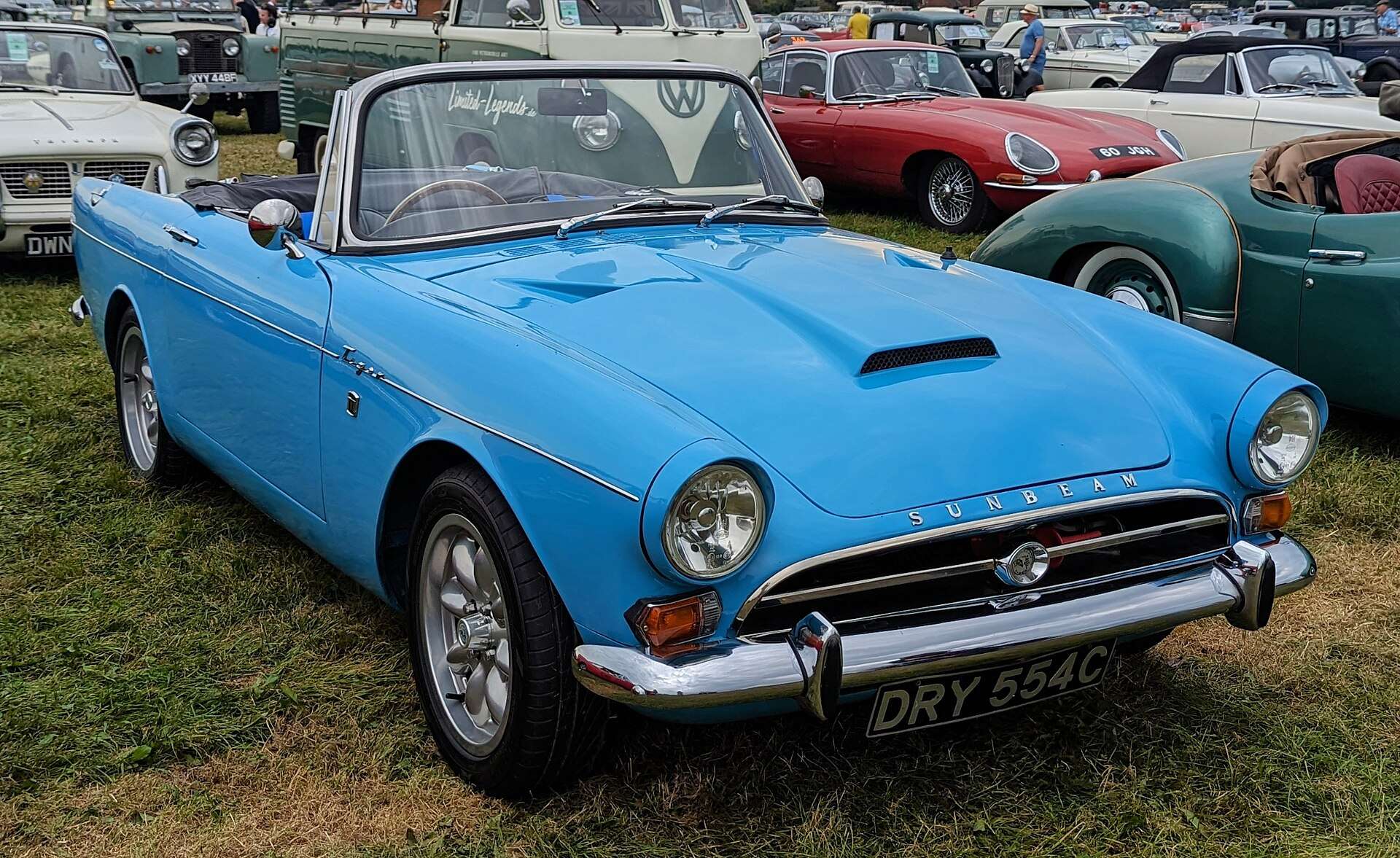
The Sunbeam Tiger placed a Ford V8 inside the elegant Alpine shell and created one of Britain’s most charismatic Anglo-American sports cars. Built by Jensen for Rootes between 1964 and 1967, the Tiger is fast, compact and now highly collectible. This UK-focused Sunbeam Tiger buying guide covers the Mk I, Mk IA and rare Mk II, with particular attention to authenticity.
Sunbeam Tiger at a glance
| Production | 1964–1967 |
|---|---|
| Assembly | Jensen Motors, West Bromwich |
| Mk I engine | Ford 260 cu in (4.2-litre) V8 |
| Mk II engine | Ford 289 cu in (4.7-litre) V8 |
| Gearbox | Four-speed manual |
| Drive | Rear-wheel drive |
From Alpine to Tiger
American racer and designer Carroll Shelby demonstrated that a compact British sports car could be transformed by a light Ford V8. Rootes approved a production version, with development engineering adapting the Alpine body, steering, cooling and transmission. Jensen assembled the cars because Rootes’ own lines were not suited to the low-volume conversion.
The early 260-cubic-inch Tiger offered around 164 bhp in standard form—enough to make it dramatically quicker than the four-cylinder Alpine without turning it into an uncivilised special. The V8’s torque is the key: the Tiger accelerates strongly without needing high revs and cruises with an easy gait.
Mk I, Mk IA and Mk II differences
Tiger Mk I
The Mk I used the Ford 260 V8 and retained much of the Alpine Series IV appearance. Home-market availability began during 1965. Approximately 6,500 Mk I cars were built, although production records and later terminology can make precise subdivision difficult.
Tiger Mk IA
“Mk IA” is an enthusiast shorthand for later 260-engined cars using the Alpine Series V body, notably with a folding hood rather than the earlier removable hood arrangement. Rootes did not market it as a wholly separate model, so identification depends on chassis details rather than a dashboard badge.
Tiger Mk II
The final Mk II received the 289-cubic-inch 4.7-litre V8, revised trim and external detail changes. Only 536 were made and almost all were exported, making a genuine UK-market Mk II exceptionally scarce. Its rarity and value demand careful authentication.
What is a Sunbeam Tiger like to drive?
The Tiger feels muscular rather than delicate. Its compact dimensions, immediate torque and V8 soundtrack give it enormous character. Steering is by recirculating ball rather than the Alpine’s rack-and-pinion arrangement, and the car rewards smooth inputs. Standard brakes and suspension are adequate when fresh, but modified engines can overwhelm tired chassis components.
Sunbeam Tiger buying guide
Proving it is a genuine Tiger
Authentication is the first job. Genuine cars have Tiger-specific chassis-number sequences and factory modifications around the transmission tunnel, steering, engine bay and rear axle. Check the identity plate, stamped numbers and body features against Sunbeam Tiger Owners Club records. A converted Alpine can be enjoyable, but it must not be priced or described as a factory Tiger.
Body structure and rust
Inspect the inner and outer sills, floorpan, front crossmember, spring hangers, wheelarches, boot floor and the areas around the doors and windscreen. The V8 adds stress, so previous accident repairs and weakened structures matter. Uneven gaps, fresh underseal and localised patches justify a specialist inspection.
Ford V8 and cooling
The small-block Ford is durable and well supported, but the tight engine bay magnifies cooling faults. Check the radiator, fan, hoses, water pump and evidence of repeated overheating. Listen for valvetrain noise and inspect for oil leaks. Many cars have non-standard carburettors, camshafts and exhausts; ask whether the cooling, brakes and gearing were upgraded to match.
Gearbox, axle and clutch
A healthy four-speed should shift positively. Crunching, jumping out of gear or heavy clutch operation need investigation. Listen for differential whine and check for vibration under power. Correct Tiger transmission and axle components carry a premium over generic replacements.
Steering, suspension and brakes
Excessive steering play, worn front bushes and tired dampers spoil the car. Inspect the steering linkages and mountings closely. Front discs and rear drums work well in standard form, but seized calipers, old hoses and contaminated drums are common on infrequently used cars.
Originality and modifications
Original air cleaners, manifolds, wheels, gauges and trim are valuable. Period modifications are part of Tiger culture, yet reversible upgrades are preferable on a rare car. Demand invoices and photographs for any restoration; a glossy exterior can conceal an Alpine shell or poorly executed repairs.
Which Tiger should you buy?
A well-documented 260-engined Mk I is the most realistic choice for most UK buyers. The Mk II is a specialist collector car whose identity should be verified before money changes hands. Condition and provenance are worth more than claimed horsepower.
Sunbeam Tiger FAQs
How can you tell a real Sunbeam Tiger?
Use the chassis number, factory body modifications and club records together. Do not rely on badges, engine size or a V8 alone.
Did Carroll Shelby build the production Tigers?
Shelby’s prototype and concept were crucial, but series production was carried out by Jensen in West Bromwich for Rootes.
How rare is the Sunbeam Tiger Mk II?
Only 536 were produced and very few stayed in Britain, so genuine Mk IIs are much rarer than 260-engined cars.
Verdict
The Tiger combines British scale and style with American torque in a way few classics can match. Its value makes provenance essential: authenticate first, inspect the structure second and only then consider performance or cosmetics.
Research sources: Sunbeam Tiger Owners Club development history, Sunbeam model history, Rootes vehicle identification guidance. Image source and licence.