

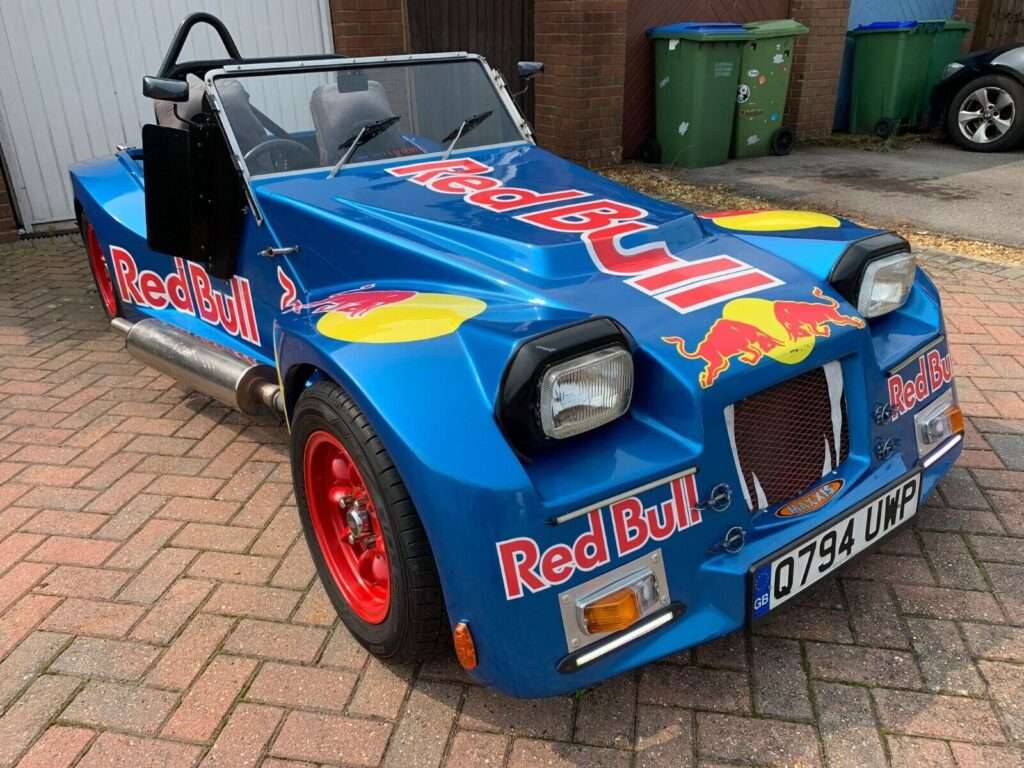
This Sylva Leader stood out not just for its Red Bull-style graphics but for a tuned Fiat twin-cam engine in place of the Ford power commonly expected in older British kit cars. Built for hill-climb use, it illustrates how varied and individual early Sylvas can be.
At a glance
- Model: Sylva Leader
- Designer/manufacturer family: Jeremy Phillips / Sylva
- Configuration: lightweight front-engined, rear-wheel-drive sports car
- Featured engine: tuned Fiat 124 twin cam, as advertised
- Use: hill climb and competition-oriented road car
Where the Sylva Leader fits in kit-car history
The Leader was an early model in Jeremy Phillips’ line of lightweight sports cars and helped establish ideas later developed through the Striker and Fury families. Surviving cars can contain decades of competition modifications, engine swaps and home engineering, so the exact chassis and specification require careful documentation.
The car originally featured by Unusual Cars
The following details describe the car when it appeared in its original marketplace advert. Availability, asking prices and seller claims are historical and should not be treated as current or independently verified.
The seller writes “This is a Sylva Leader with some interesting features, and not only the decals!”.
Pushing out 160bhp, and not fitted with the typical Ford Pinto engine. This ‘ready to race’ hill climber has been fitted with a tuned Fiat 124 twin cam 1772cc lump.
If you appreciate vehicular engineering, this is well worth a closer look.
AD ON EBAY –> https://ebay.us/dFi9wm

ALSO OF INTEREST
- Daihatsu Sirion Rally 2 and Rally 4: History and Buying Guide
 UNUSUAL CARS MODEL GUIDE The Daihatsu Sirion Rally 2 and… Read more: Daihatsu Sirion Rally 2 and Rally 4: History and Buying Guide
 - Daihatsu Terios: J100 and J200 History and Buying Guide
 UNUSUAL CARS MODEL GUIDE The Daihatsu Terios brought four-wheel drive,… Read more: Daihatsu Terios: J100 and J200 History and Buying Guide
 - Daihatsu Sportrak: 1.6 4×4 History and Buying Guide
 UNUSUAL CARS MODEL GUIDE The Daihatsu Sportrak was a compact,… Read more: Daihatsu Sportrak: 1.6 4×4 History and Buying Guide
 - Daihatsu YRV Turbo 130: History, Specifications and Buying Guide
 UNUSUAL CARS MODEL GUIDE The Daihatsu YRV Turbo 130 hid… Read more: Daihatsu YRV Turbo 130: History, Specifications and Buying Guide
 - Daihatsu Fourtrak: 2.8 Turbo Diesel History and Buying Guide
 UNUSUAL CARS MODEL GUIDE The Daihatsu Fourtrak was a compact… Read more: Daihatsu Fourtrak: 2.8 Turbo Diesel History and Buying Guide
 - Daihatsu Charade GTti: Turbo Triple History and Buying Guide
 UNUSUAL CARS MODEL GUIDE The Daihatsu Charade GTti was one… Read more: Daihatsu Charade GTti: Turbo Triple History and Buying Guide
What to check before buying
- Confirm the chassis identity, registration and competition history.
- Inspect chassis welds, suspension pickups and roll-over protection for fatigue or repairs.
- Verify the Fiat engine specification, carburetion, cooling and gearbox installation.
- Check brake balance, steering play, wheel bearings and tyre age.
- Determine whether competition seats, harnesses and extinguishers remain in date and suitable for intended use.
UK registration, insurance and road use
A replica or kit-converted car must be judged by its actual construction and records. Check that its VIN agrees with the V5C and that the recorded identity and material modifications are accurate. The registration route can depend on whether the original unaltered chassis or monocoque and major donor components remain. Current requirements should be checked against the DVLA INF318 guidance.
Obtain an insurance quotation before agreeing to buy. Give the insurer the complete specification—including body, engine, wheels, suspension, brakes and any forced-induction changes—and do not assume that a current MOT proves every modification is recorded or acceptable.
Frequently asked questions
Is this a genuine Ferrari?
No. It is a specialist conversion inspired by Ferrari styling and must be represented according to its true manufacturer, donor and registered identity.
Are completed replicas all built to the same standard?
No. Builder skill, donor condition, component choice and later maintenance can make two visually similar cars very different to own. Inspect the individual vehicle and its records.
Are replica-specific parts easy to replace?
Mechanical donor parts may be readily available, but windscreens, lights, trim and moulded body panels can be scarce. Identify their source before purchase.
More replica and kit car guides
Continue exploring the Unusual Cars Replica & Kit Car Guides hub for related donor cars, buying advice and specialist builds.