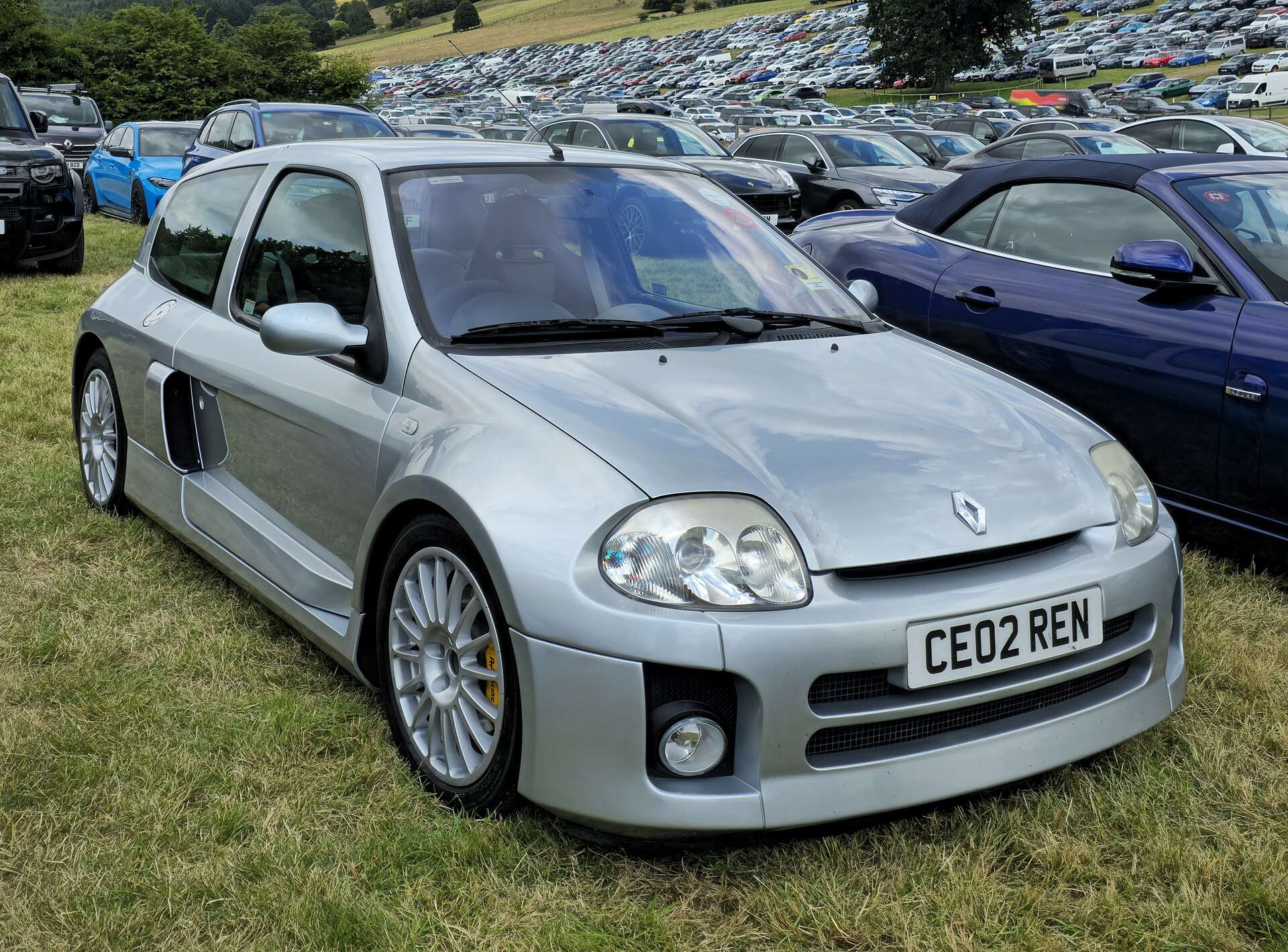
The Renault Clio V6 looks like an exaggerated hot hatch, but its mid-mounted naturally aspirated V6, rear-wheel drive and two-seat layout make it a very different purchase from a Clio 172 or 182. It is now a specialist enthusiast car with collector interest, scarce body components and servicing costs that cannot be inferred from its small external dimensions. This guide explains how to assess both phases without confusing spectacle with condition.
Our buying verdict
Buy on provenance, structural condition and specialist maintenance evidence. A clearly documented belt service, healthy cooling system, correct tyres and properly assessed geometry matter more than a rare colour. Choose Phase 1 or Phase 2 for its character and condition, then arrange an inspection with someone who knows the V6 installation. An ordinary Clio inspection is not enough.

Phase 1 or Phase 2?
Renault’s own historical account describes the road-going Clio V6 arriving in 2001 after the 1998 concept and the V6 Trophy programme. The engine occupies the space normally used for rear seats, and drive goes to the rear wheels through a six-speed manual gearbox. This is a two-seat specialist car, not a four-seat hatchback with a larger engine.
The manufacturer quotes 230 metric horsepower for Phase 1 and 255 for Phase 2. Its history records Phase 1 production by TWR in Sweden and the later car’s production at Dieppe. Phase 2 changes extend beyond styling to engine and chassis development, so it should not be described as a cosmetic facelift alone.
| Version | Appeal | Buying emphasis |
|---|---|---|
| Phase 1 | Original concept-like styling and early-model character. | Correct identity, geometry, servicing evidence and complete specialist bodywork. |
| Phase 2 / V6 255 | Later styling and substantial development. | Authentic specification, engine and chassis condition, options and original parts. |
| Rare colour / collector example | Distinctive appearance and provenance appeal. | Factory colour evidence, paint quality, mileage history and actual condition. |
| Modified car | Potential specialist improvements for a buyer who wants that setup. | Documented hardware, geometry, software and insurance acceptance; cost of reversal. |
Do not assume that every car’s current tyres, wheels or suspension still match the factory arrangement. Check the actual phase, build information and component records. Replacement bumpers and cosmetic conversions can blur appearance, while a numbered plaque is not sufficient authentication.
Think carefully about use. There is no rear-seat practicality to recover, storage is limited and the wide body makes ordinary parking more demanding. Sit in the car, assess access and visibility, and plan where it will be stored and serviced before paying a collector-oriented price.
Prices: distinguish exceptional asks from sold results
A PistonHeads check on 4 November 2026 showed a 2002 Phase 1 advertised at £75,000 with 2,456 miles. That is an exceptional low-mileage asking example, not a sensible price anchor for every V6. Its seller description and condition have not been independently verified.
The platform also reported a 2002 V6 sale at £36,448 on 10 September 2026 with 39,514 miles, another 2002 car at £40,468 on 31 July 2026 with 81,101 miles, and a 2004 Phase 2 at £46,257 on 11 June 2026 with 41,996 miles. These are platform-reported historical results, with differing cars, terms and condition; check fees and the original sale description before comparison.
The results do not form a mileage formula, and rare paint can attract a premium of its own. Compare the same phase, steering position, provenance and maintenance quality. Establish whether a belt service is genuinely current and what body repairs have been carried out before deciding an asking price is attractive.
Keep a reserve for both servicing and specialist repairs. A small saving can vanish if the car needs tyres, a comprehensive belt job, damaged panel replacement and suspension correction. Independent inspection is part of the purchase budget, not an optional luxury after negotiation.
Body panels, structure and previous damage
Inspect the car dry in daylight and on a suitable lift. Compare gaps, paint texture, panel alignment and fasteners. Look at the wide rear quarters, side intakes, sills, bumpers and their mounting points for repairs or missing components. The cost of a cosmetic issue is governed by the correct part and repair method, not by how small it appears in a photograph.
Inspect the underlying structure, suspension mounting areas, underbody and front and rear impact regions. Ask for photographs and invoices for previous work, including damage described as minor. A clear history report cannot guarantee that a car has never been repaired or that its geometry is correct.

Look for grounding, damaged shields, corroded fixings and poor underbody repairs. Check jacking areas and evidence of careless lifting. Ask an experienced specialist to assess parts that appear modified or reconstructed rather than assuming a fresh coating proves a sound underside.
Inspect boot and cabin seals, damp carpets and the areas around the engine cover. Check the cover’s condition and fixings, appropriate heat protection and any missing trim. The fact that some cabin pieces resemble an ordinary Clio does not mean every surrounding panel or seal is easily replaced.
Engine and service-access checks
Cold start and the history behind it
Arrange a genuinely cold start. Check oil and coolant safely before running, then watch for persistent smoke, misfire, abnormal mechanical noise and warnings. Ask about oil use, overheating, long storage and engine work. A seller warming the car before you arrive has not demonstrated its cold behaviour.
Read invoices for the actual V6 engine and servicing scope. A routine oil service, a cambelt job and an engine-out overhaul are different records. Ask who maintained the car and whether the workshop regularly works on this model. Specialist familiarity matters when access, parts identification and timing procedures are involved.
During a complete warm test, assess clean response, stable temperature and consistent operation without aggressive demonstrations. A V6 soundtrack can disguise noises in a hurried viewing. If symptoms or history justify it, obtain appropriate pressure, compression or leak-down tests and a written interpretation.
Cambelt evidence: a central buying requirement
The V6 uses a timing belt. Demand an invoice showing date, mileage, kit components and the workshop’s scope. Confirm the applicable Renault schedule for the exact car with a Clio V6 specialist. Low mileage does not stop a belt, tensioner or seal ageing.
K-Tec’s Powergrip application identifies a V6-specific belt, tensioner and pulleys, with a separate belt-and-water-pump option. This is not the same kit as the four-cylinder Renaultsport cars. Compare the complete appropriate job rather than the price of a bare belt.
Ask the quoting workshop to explain its access method, what will be inspected while dismantled and which additional seals, bolts, fluids or accessory-drive parts are included. Do not assume every quoted “belt service” has the same contents. A fitted bill can be substantially larger than the kit allowance because skilled access and correct timing work matter.
If the evidence is missing, inconsistent or old, make the belt job part of the immediate purchase plan. A handwritten note with no supporting detail is not equivalent to an identifiable specialist invoice. Do not let a rare colour persuade you to postpone required maintenance.
Cooling, ignition and ancillaries
Inspect the cooling system from the front heat exchangers through accessible pipework to the engine installation. Look for residue, leaks, damaged hoses and poor repairs. Check fan operation, warm-up and stable temperature, then recheck after the drive. Repeated topping-up or an overheating history requires a proper investigation.
Check ignition coils, plug-service evidence, engine mounts, accessible oil leaks and exhaust condition. A misfire needs diagnosis, not an automatic assumption that one inexpensive coil will fix it. Access, corroded fasteners and the need to remove surrounding components can make small jobs disproportionately costly.
Inspect heat shields and exhaust supports, including any aftermarket installation. Check that modifications have not compromised hoses, wiring or clearances. A loud exhaust does not establish extra power and may be tiring in a two-seat cabin close to the engine.
Clutch, six-speed gearbox and rear driveline
Test clean selection of every gear cold and warm, including reverse and ordinary low-speed operation. Investigate baulking, crunching, whine or a tendency to jump out of gear. Check clutch take-up and slipping under sensible warm load without launch demonstrations.
Inspect mounts, driveshafts, boots and leaks on a lift. A clutch estimate should identify release components, seals, flywheel assessment and labour scope. A used gearbox or clutch-related claim needs invoices and current testing, not just a seller’s account that it was replaced years ago.
Ask about any altered differential or gearing rather than inferring the installed arrangement from online summaries. A road car modified for competition may suit a specialist buyer while being a poor match for ordinary touring.
Tyres, geometry and suspension
Renault’s historical account describes different front and rear tyre sizes on Phase 1 and larger wheels on Phase 2. Match the actual phase and wheel specification, including suitable ratings and compatibility. Do not fit four identical tyres merely because the body looks like a hatchback.
Have suspension joints, bushes, dampers, springs, bearings and mounting areas inspected. Check geometry and tyre wear carefully, especially after repairs or lowering. A test drive should be sensible and conducted in suitable conditions; it is not an opportunity to explore the car’s limits.

Inspect discs, pads, calipers, pipes and fluid history. Confirm phase-specific hardware and any conversion before ordering parts. Investigate uneven braking, vibration and warning lights. A large brake setup or expensive dampers cannot compensate for a compromised shell or unsuitable alignment.
Cabin, covers and electrical equipment
Test windows, mirrors, locking, lights, wipers, instruments, heater, air conditioning and both keys. Examine seat bolsters, rails, belts and mounting security. Check any audio, alarm or tracker wiring for competent installation and obtain the information needed to support it.
Inspect engine-cover trim, sound and heat insulation and all supplied storage pieces. Missing model-specific items may be difficult to source even where basic controls are ordinary Renault parts. Interior condition should be assessed against history, while remembering that a carefully retrimmed cabin is not proof of original mileage.
Maintenance and practical parts allowances
Use a model-experienced workshop to plan servicing from the VIN, phase, records and inspection. Compare complete fitted estimates, particularly for jobs with substantial access. The searches below are for V6-specific components and still require exact part-number verification.
These are editorial UK parts-only budgeting allowances, not live offers or fitted quotes. Brand, VAT treatment, exchange surcharges and availability can change the total. Obtain a written fitted quote and check part numbers against your VIN, engine and modifications.
Affiliate disclosure: we may earn a commission from qualifying eBay purchases, at no extra cost to you. The links open vehicle-specific searches; they do not certify the suitability or quality of individual listings. Check seller, fitment, warranty and returns.
| Maintenance item | Parts allowance | What to check |
|---|---|---|
| Oil and filter service parts | £65–£120 | Confirm the correct approval, quantity and filter. |
| Cambelt kit | £300–£480 | Compare complete V6 kits; access, timing work and ancillary parts add substantially. |
| Water pump | £60–£150 | Check compatibility and whether already included in the belt quote. |
| Accessory-drive components | £70–£190 | Identify the actual drive and all worn parts. |
| Spark plugs | £45–£100 | Labour and access are separate from the six-plug cost. |
| Ignition coils | £25–£65 each | Diagnose the fault first; compare correct quality and application. |
| Alternator | £150–£350 | Check output and fitment; access and exchange terms affect the total. |
| Starter motor | £110–£260 | Rule out battery, connections and earth faults. |
| Clutch components | £250–£550 | Confirm release, flywheel and labour scope with a V6 specialist. |
| Front brake discs and pads | £220–£450 | Match phase and installed hardware before ordering. |
| Cooling hoses | £30–£150 per component | Inspect the full system; one hose allowance is not a cooling overhaul. |
Hidden ownership costs
Service access: belt, clutch and ancillary repairs can have significant labour and supporting-parts costs. Obtain a written scope rather than assuming the car’s size means ordinary small-car bills.
Model-specific bodywork: damaged wide panels, intakes, bumpers and fixings may be difficult or expensive to replace correctly. Check availability before agreeing to fix cosmetic damage after purchase.
Tyres and geometry: staggered fitment and phase differences make correct selection essential. Budget for a complete suitable set and specialist alignment, particularly after suspension work or a previous repair.
Storage and low mileage: old tyres, belts, fluids, seals and seized brakes can accompany an exceptionally low reading. A preserved car needs recommissioning evidence before a long celebratory drive.
Insurance and recovery: obtain a quote for the exact phase, steering position, storage and modifications. Ask about valuation, security and suitable recovery arrangements. Specialist workshop distance and downtime belong in the ownership plan.
Originality and paint: returning modified suspension, exhaust or cabin components to original condition can become a project. Rare paint and previous repairs deserve expert assessment; an unusual colour alone is no reason to overlook the basics.

Eight checks before purchase
- Authenticate phase, VIN, steering position, colour and original specification.
- Read chronological specialist service invoices and complete cambelt evidence.
- Inspect shell, model-specific panels, mounting points and previous repairs on a lift.
- Assess cold start, oil history, coolant loss, warm running and diagnostic faults.
- Test six-speed gearbox and clutch, then inspect rear driveline and mounts.
- Verify staggered tyres, phase-correct wheels, suspension condition and geometry.
- Test all electrical equipment and inventory covers, insulation and missing trim.
- Obtain fitted repair estimates, insurance and an ownership reserve before payment.
Frequently asked questions
Is the Clio V6 just a more powerful Clio 182?
No. Its engine is mid-mounted, drive goes to the rear wheels and the cabin has two seats. Parts, access and chassis advice differ substantially.
Is Phase 2 only a cosmetic update?
No. Renault documents engine and chassis development as well as styling changes and a move in production. Evaluate the actual phase and condition.
Does low mileage remove the need for belt work?
No. Time matters as well as distance. Obtain a detailed invoice and confirm the applicable schedule with a V6 specialist.
Can ordinary Clio parts be used everywhere?
No. Some cabin and service items may be shared, but the engine installation, chassis and wide body contain specialist components. Verify part numbers and actual fitment.
What should I prioritise over a rare colour?
Structural condition, documented maintenance, sound cooling, correct tyres and geometry. A premium colour does not reduce the cost of neglected essentials.
Research and sources
Renault’s historical account establishes the model’s layout and phase development. Specialist parts documentation establishes kit scope, not a universal fitted price or service interval. Market examples are dated and should be read with their original terms.
- Renault Group: history of the Clio: original manufacturer account of the V6’s layout, production and Phase 1/Phase 2 development.
- K-Tec Racing: Powergrip Clio V6 cambelt kits: V6-specific belt, tensioner and pulley scope, with pump-kit option.
- PistonHeads Clio V6 listings and reported results: the dated asking example and historical sales discussed above.