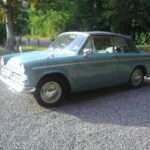
The Hillman Super Minx was Rootes Group’s larger and more sophisticated companion to the familiar Minx. Sold in Britain from 1961, it combined transatlantic-influenced styling with conventional rear-wheel-drive engineering and appeared as a saloon, estate and particularly attractive convertible. It was once an ordinary middle-class family car; today every version is scarce, while surviving convertibles and estates are especially desirable.
At a glance
- UK production: 1961–1967
- Body styles: four-door saloon, five-door estate and two-door convertible
- Engines: 1592cc and later 1725cc Rootes overhead-valve fours
- Layout: front engine, rear-wheel drive
- Gearboxes: four-speed manual, optional overdrive and Borg-Warner automatic
- Successor: Hillman Hunter and the wider Rootes Arrow family
Why Rootes created the Super Minx
Rootes originally intended the new car to replace the Audax-generation Hillman Minx. During development it grew larger and more expensive than planned, leaving room for both models. The Super Minx therefore arrived in autumn 1961 as a separate model positioned above the Minx, following the closely related Singer Vogue into showrooms.
The structure was a unitary steel shell with MacPherson-strut front suspension and a live rear axle on leaf springs. Early cars used the established 1592cc engine, driving through a four-speed gearbox. The result was not a sports saloon, but it offered the space, equipment and relaxed road manners expected of a substantial British family car.
Four generations
The Mk I established the shape with a large wraparound rear window and restrained tailfins. The Mk II brought detail improvements, while the 1964 Mk III adopted a flatter rear window and a six-light side profile. Its wood-trimmed dashboard, reclining seats and improved gearbox made it feel more upmarket.
The final Mk IV arrived for 1965 with the larger 1725cc engine and optional overdrive. The saloon and convertible ended when the Hillman Hunter appeared in 1966; the useful estate continued into 1967. Badge-engineered relatives included the Singer Vogue and, in more luxurious form, the Humber Sceptre.
Saloon, estate and convertible
The saloon was the volume model and best represents the Super Minx’s character: roomy, softly sprung and capable of sustained cruising. The estate added a broad load platform and remains one of the rarest practical Rootes classics. The convertible, converted by specialist coachbuilders, traded some structural stiffness for elegant open-air motoring and is now the version most likely to command a premium.
UK specifications
| Version | Engine | Typical output | Character |
|---|---|---|---|
| Mk I–III | 1592cc OHV four | About 62bhp | Smooth, steady family-car performance |
| Mk IV | 1725cc OHV four | About 65bhp | More torque and easier cruising |
| Manual | Four-speed | Overdrive optional | Best choice for regular touring |
| Automatic | Borg-Warner | Selected versions | Relaxed but noticeably slower |
Exact figures vary by year, carburettor and market. A prospective buyer should check the engine number and specification rather than assuming that every surviving car retains its original unit.
What is it like to drive?
A sound Super Minx feels comfortable and unhurried. The steering is light once moving, the ride copes well with imperfect roads and the cabin has generous glass area. The 1592cc engine needs patience on gradients, whereas the 1725cc unit is more flexible. Overdrive transforms motorway cruising by reducing engine speed and noise.
Body roll and modest braking performance encourage a measured approach. The convertible can exhibit more scuttle shake than the saloon, particularly if corrosion has weakened the structure. None should feel dangerously vague: excessive wandering, clonks or steering play indicate wear.
Hillman Super Minx buying guide
Rust and structure
Corrosion is the decisive issue. Inspect the inner and outer sills, front suspension turrets, chassis rails, floor edges, door pillars, wheelarches, boot floor and rear spring mountings. Check beneath carpets and around both screens. Estates require close examination of the tailgate and rear quarters. On convertibles, sill and floor strength is critical because the roof cannot contribute to rigidity.
Engine and cooling
The Rootes four-cylinder engines are durable when maintained, but worn examples can display low oil pressure, timing-chain noise, heavy breathing and blue exhaust smoke. Look for coolant loss, blocked radiators and evidence of overheating. Oil leaks are common; a minor seep is less concerning than poor pressure or contaminated coolant.
Gearbox, overdrive and axle
Listen for gearbox bearing noise and jumping out of gear. Overdrive should engage and disengage cleanly once warm; electrical faults are common, but slipping under load may mean an overhaul. Check the propshaft joints and listen for differential whine. Automatic cars should select promptly without excessive flare.
Trim and identity
Mechanical service parts are easier to find than model-specific brightwork, lamps, dashboards and upholstery. Confirm that a car is the version claimed, especially when paying extra for a convertible or late Mk IV. A complete, structurally sound car is normally a better purchase than an apparently cheap restoration.
Ownership and values
The Super Minx has excellent club support and straightforward mechanicals, but restoration economics are unforgiving. Professional body repairs can exceed the value of an average saloon. Convertibles attract the strongest prices, followed by sound estates and exceptional late saloons. Cars with overdrive, documented history and intact original trim are especially appealing.
Why the Super Minx matters
The Super Minx captures Rootes at its most characteristic: careful engineering, extensive model sharing and a talent for giving a practical car a touch of distinction. Its separate identity, three body styles and place between the Audax Minx and Arrow-era Hunter make it much more than an enlarged Minx derivative.