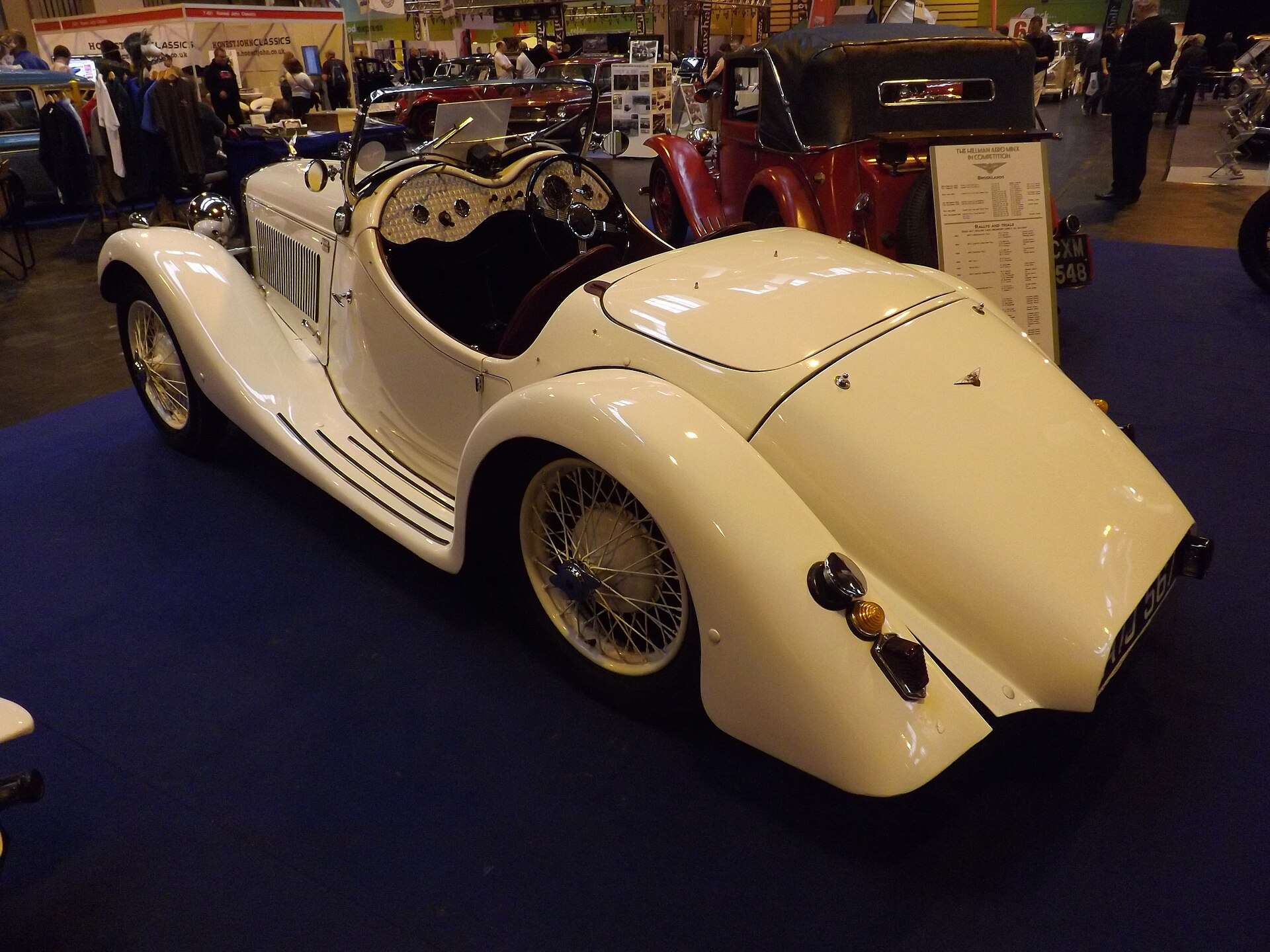
The Hillman Aero Minx was Rootes’ sporting interpretation of the early Minx: lower, lighter and far more glamorous than the ordinary family saloon. Introduced for the British market in the early 1930s, it combined familiar Hillman mechanical parts with a specially lowered chassis and a remarkable choice of open and closed bodies. Surviving cars are scarce, but the Aero Minx remains one of the most interesting small sporting cars made in pre-war Britain.
At a glance
- UK production: 1933–1935
- Engine: 1185cc side-valve four-cylinder
- Transmission: four-speed manual
- Layout: front engine, rear-wheel drive
- Body styles: roadster, tourer, coupé and streamlined saloon
- Production: approximately 650 cars according to surviving Rootes records
A sporting Minx for a new decade
Hillman announced the Aero Minx around the 1932 London Motor Show as a more adventurous companion to its dependable small saloon. Britain’s motor industry was embracing streamlining, lower rooflines and sporting bodywork, yet many buyers still wanted inexpensive, proven mechanical parts. The Aero Minx answered both demands.
Although the name suggested little more than a tuned Minx, the car was significantly different beneath its coachwork. Its chassis was lowered and underslung at the rear, the driving position sat closer to the road and the bodywork was produced in several distinctive forms. It was a genuine British-market model rather than a later special assembled from standard Minx parts.
Design and coachwork
The best-known Aero Minxes are the open two-seaters and tourers, but buyers could also choose elegant coupés and a streamlined saloon. Bodies came from specialist firms including Carbodies, March and Salmons, whose Tickford name appeared on clever drophead designs. This variety gives surviving cars considerable individuality, though it also makes missing trim and body fittings difficult to replace.
The streamlined saloon is especially striking, with a flowing roof and fast rear body that anticipated the more aerodynamic family cars of the later 1930s. Open cars used cut-down doors, folding windscreens and simple weather equipment. Even the closed models retained a compact, purposeful stance quite unlike the upright standard Minx.
Engine and specifications
| Item | Specification |
|---|---|
| Engine | 1185cc side-valve inline four |
| Fuel system | Single carburettor |
| Gearbox | Four-speed manual |
| Brakes | Mechanical drums |
| Electrical system | 6 volt when new |
| Chassis | Lowered ladder frame, underslung rear |
Power output was modest, but the lighter body and lower profile made better use of the 1185cc engine than the family saloon. Period performance depended heavily on body style and gearing. The appeal was not outright speed so much as lively responses, good visibility and the sense of occasion created by the low seating position.
Competition and touring
Small British sporting cars were expected to prove themselves in trials, rallies and long-distance events, and Aero Minxes appeared in club competition during the 1930s. Their combination of ordinary Hillman components and specialist bodywork made them practical enough for touring while still looking at home beside more expensive sports cars.
Today, an Aero Minx is best enjoyed at the pace for which it was designed. The steering is direct, the suspension firm by contemporary Hillman standards and the engine happiest when momentum is conserved. Mechanical brakes demand planning and careful adjustment, while the non-synchromesh gearbox rewards deliberate double-declutching.
Hillman Aero Minx buying guide
Chassis and body frame
Begin with the chassis. Check the side rails, cross-members, spring mountings and the underslung rear section for corrosion, cracking and old repairs. Many bodies use timber framing beneath aluminium or steel panels. Soft or distorted wood can allow doors to drop and panels to move even when the paint looks presentable.
Coachbuilt identity
Establish exactly which body is fitted and compare it with period photographs and club records. A rare coachbuilt car is valued for its identity, so unexplained alterations, replacement bodies or missing chassis plates require careful investigation. Unique windscreens, hood frames, handles, hinges and mouldings can be much harder to source than mechanical components.
Engine and cooling
Check for low oil pressure, piston slap, excessive smoke and coolant loss. Long periods out of use may leave the fuel system, radiator and water passages contaminated. The side-valve engine is straightforward, but a complete rebuild can still be costly and correct period ancillaries matter on an otherwise original car.
Gearbox, axle and brakes
Listen for gearbox and final-drive noise and confirm that all four ratios select cleanly. Mechanical brake cables, cross-shafts and drums must be correctly adjusted; a car that pulls badly may need more than a simple adjustment. Inspect steering joints, kingpins, springs and dampers for wear.
Completeness
Buy the most complete example possible. Instruments, lamps, hood hardware, windscreen frames and coachbuilder-specific interior fittings can take years to find. A basket-case project may appear inexpensive, but the cost of recreating missing one-off parts soon exceeds the value of a finished car.
Ownership, rarity and values
The Aero Minx benefits from the knowledge of Rootes and pre-war Hillman specialists, and several service items can be rebuilt rather than replaced. Nevertheless, it is not a simple entry-level classic: body restoration requires traditional coachbuilding skills and historical research is essential. Values vary sharply by body style, provenance, originality and the quality of past work.
Why the Aero Minx matters
The Aero Minx shows that Hillman was capable of much more than sensible saloons. It brought coachbuilt style and sporting character to buyers who wanted dependable mass-produced mechanicals, and its streamlined variants capture a brief, optimistic period of British design. Rarity alone makes it important; the breadth of its body range makes it genuinely fascinating.