Few cars define the classic hot hatch quite like the Peugeot 205 GTI. Yet the badge covered two noticeably different cars: the light, eager 1.6 and the faster, more muscular 1.9. Their rivalry still divides enthusiasts decades later—and their history contains more surprises than the familiar “best hot hatch ever” story suggests.
_(55083142495).jpg?width=1400)
1. The GTI arrived only a year after the ordinary 205
The five-door Peugeot 205 was launched in February 1983, but the sporting three-door body and the first GTI followed in 1984. That original model used a 1,580cc four-cylinder engine with Bosch electronic fuel injection and produced 105hp.
Its timing was crucial. The Volkswagen Golf GTI had already established the hot-hatch formula, but Peugeot’s smaller and lighter newcomer gave buyers something more delicate and playful. The 205 GTI quickly became the halo car for a range that would eventually exceed 5.4 million examples of all types.
2. The 1.6 came in two different power outputs
Not every 1.6 is the same. The 1984 original produced 105hp, while an uprated 115hp version joined it in 1986. Peugeot kept the 105hp car on sale only until 1987.
The change was subtle from the outside. One small clue was the speedometer: the more powerful car’s scale extended from 200 to 220km/h. Underneath, the extra output made the already light GTI keener without changing its rev-hungry character.

3. The 1.9 was much more than a bored-out 1.6
The 1,905cc GTI made its debut at the 1986 Paris Motor Show with 130hp. Peugeot quoted 0–100km/h in 7.8 seconds and a maximum speed of 206km/h—serious figures for a small family hatchback in the mid-1980s.
More capacity brought much stronger torque, but Peugeot also altered the gearbox, driveshafts, brakes, wheel bearings, dampers and track. The 1.9’s track was widened by 11mm. It was a more substantial engineering package, not simply the same car with a larger engine.
4. The 1.6 and 1.9 deliver their speed differently
Peugeot itself describes the 1.6 as the engine whose performance is found through revs, while the 1.9 feels more relaxed and relies on torque. The later 115hp 1.6 reached 62mph in about 8.7 seconds; the 130hp 1.9 could do it in 7.8.
That difference explains why the argument has never disappeared. The 1.9 is plainly faster, but many drivers prefer the lighter 1.6’s need to be worked harder. Choosing between them is as much about temperament as statistics.
Love cars you don’t see every day?
Get forgotten cars, surprising motoring stories and the most interesting finds from Unusual Cars by email.
Free to join. No spam. Unsubscribe whenever you like. See our Privacy Policy.
5. The 1.6 is lighter than many modern city cars
The earliest 1.6 tipped the scales at just 848kg. Even the better-equipped 1.9 weighed only about 910kg, giving it roughly 142hp per tonne. For comparison, the contemporary Golf GTI weighed more than a tonne and had around 20hp per tonne less.
Low mass was the 205’s secret weapon. It sharpened acceleration, braking and direction changes while allowing Peugeot to use modest tyre widths and naturally aspirated engines. It also helped official combined fuel figures reach 39.2mpg for the 1.6 and 36.2mpg for the 1.9.

6. The wheels reveal which version you are looking at
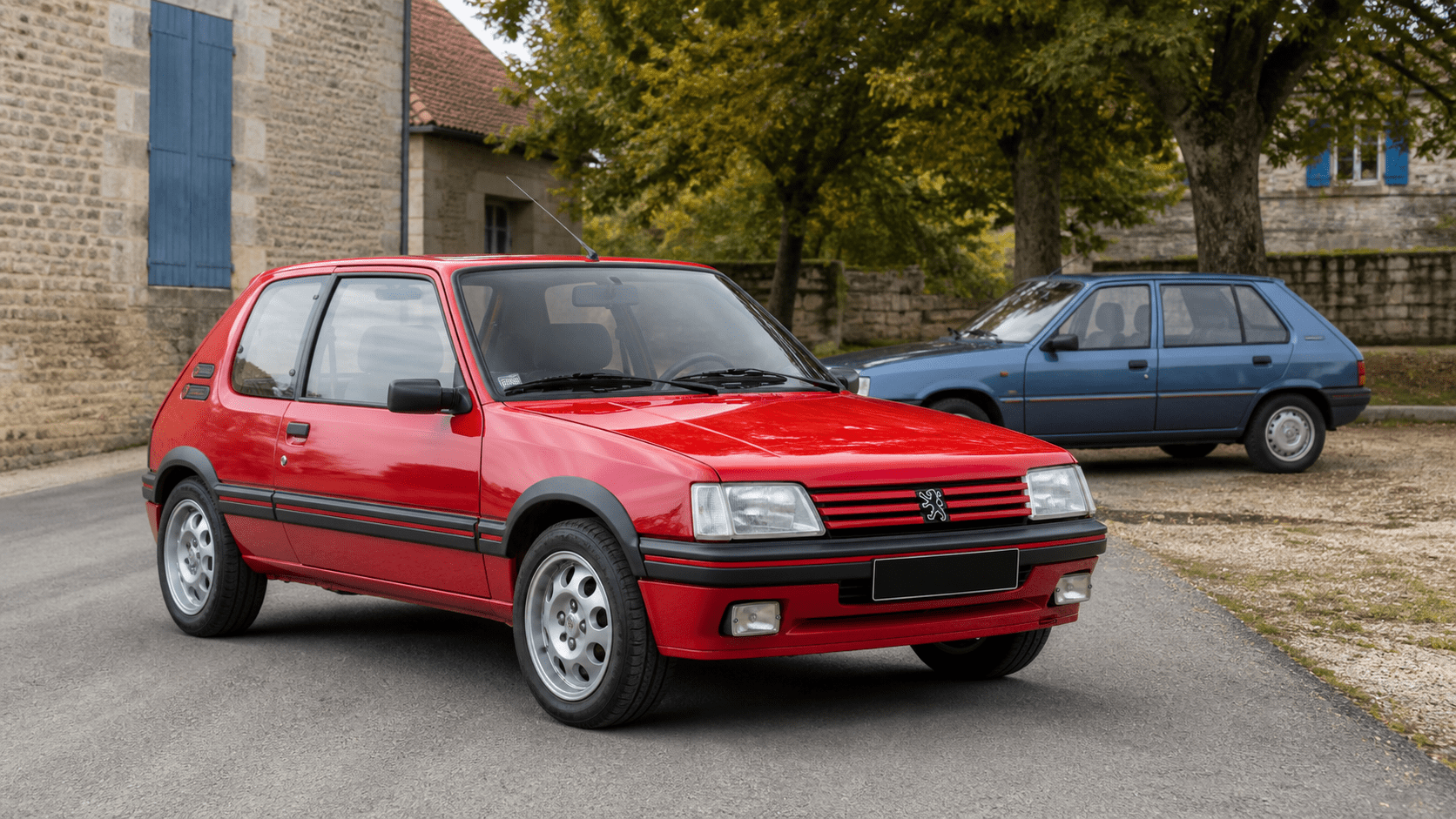
The 1.6 wears distinctive 14-inch “pepperpot” alloy wheels. The 1.9 received larger 15-inch Speedlines with wider openings, and those holes were functional as well as stylish: they helped cool the more powerful model’s larger braking system.
Look behind them and another difference appears. The 1.6 uses front discs and rear drums, whereas the 1.9 has disc brakes at all four corners. The 1.9’s half-leather trim also separated it from the predominantly cloth-trimmed 1.6 on many markets.
7. Pininfarina did not design the hatchback
The 205’s clean shape is frequently attributed to Pininfarina, but the hatchback was designed inside Peugeot by Gérard Welter and his team. Pininfarina’s major production contribution was the open 205 CTI, which began with the 1.6 engine and later gained the 1.9.
The GTI’s changes were brilliantly restrained: broader black mouldings linked by a red stripe, discreet wheelarch extensions, a small tailgate spoiler and driving lamps. The fuel cap hidden in the C-pillar trim remains one of its cleverest details.

8. Its famous handling came from simple, fully independent suspension
The 205 used MacPherson struts at the front and trailing arms with transverse torsion bars at the rear. All four wheels were independently suspended, while the unassisted rack-and-pinion steering delivered the detailed feedback that enthusiasts still praise.
That responsive chassis could also punish clumsy inputs. Lifting the throttle abruptly in a fast bend transfers weight forward and can make the rear rotate. In skilled hands it helps point the car into a corner; treated carelessly, it is the source of the 205’s lively reputation.
9. Peugeot offered an official 125hp kit for the early 1.6
Before the factory 1.9 arrived, Peugeot Talbot Sport offered a little-known “PTS 125” conversion for the 105hp 1.6. Developed with the French specialist Danielson, it was sold in 1985 and 1986 and had to be installed by an approved workshop.
A modified cylinder head, camshaft, larger valves, higher compression and reworked inlet and exhaust passages raised output to 125hp at 6,900rpm. Peugeot quoted 140Nm, 0–100km/h in 8.5 seconds and 205km/h. Plans reportedly allowed for 18,000 kits, but nobody appears to know how many were actually made.

10. Britain received a 25-car GTI linked to Radio 1
One of the rarest UK-market 205s was the 1992 1FM edition, created for BBC Radio 1FM’s 25th anniversary. Just 25 individually numbered black 1.9 GTIs were produced, with part of the £17,000 price supporting the Nordoff Robbins music-therapy charity.
The specification was extraordinary for a 205: air conditioning, power steering, ABS, full black leather with green stitching and an elaborate Clarion system with a boot-mounted six-disc CD changer. Each car carried its own brass numbered plaque—making an authentic, complete 1FM particularly collectible today.
Love cars you don’t see every day?
Get forgotten cars, surprising motoring stories and the most interesting finds from Unusual Cars by email.
Free to join. No spam. Unsubscribe whenever you like. See our Privacy Policy.

So, 1.6 or 1.9?
The 1.9 wins the numbers contest: it is quicker, torquier and better braked. The 1.6 counters with less weight, smaller wheels and an engine that rewards revs. That is why there is no universal answer. They are two interpretations of the same wonderfully direct idea, and either one explains why the 205 GTI still sets the standard for involvement.
Continue the hot-hatch story with our 10 surprising facts about the Mk1 Volkswagen Golf and 10 facts about the Mk1 Vauxhall Astra GTE. You can also browse more cars in the Peugeot archive.
Sources
- Peugeot/Stellantis: 10 reasons why the 205 GTI is the greatest hot hatch ever
- Peugeot/Stellantis: 40 years of the 205 GTI
- Peugeot/Stellantis: the 205 GTI PTS 125 kit
- Peugeot/Stellantis: 205 GTI 40th anniversary history
- 205 GTI 1FM register: history of the 1FM edition
- Wikimedia Commons: Peugeot 205 GTI images