UNUSUAL CARS MODEL GUIDE
The Nissan Figaro is a Japanese-market two-door convertible built for 1991. It used Micra/March K10 mechanical foundations beneath deliberately nostalgic bodywork, a fixed rear roof section and a fabric centre roof that folds into the rear deck. It belongs to Nissan’s Pike series alongside the Be-1, Pao and S-Cargo.
From concept to Pike Factory production
Nissan displayed the Figaro concept at the 1989 Tokyo Motor Show under the theme “Back to the Future”. Demand exceeded the planned supply, and allocation in Japan used a lottery. Production took place in 1991 through Nissan’s specialist Pike programme.

The styling combined rounded 1950s references with modern small-car packaging. Chrome-look details, a body-coloured dashboard, white leather-style upholstery and retro instruments were coordinated rather than assembled as an accessory exercise. The mechanism retained fixed side frames and rear structure, so it is better described as a fixed-profile convertible than a completely open roadster.
Specification and colours
| Item | Nissan Figaro |
|---|---|
| Production | 1991, Japanese domestic market |
| Platform | FK10, related to the K10 March/Micra |
| Engine | MA10ET 987 cc turbocharged inline-four |
| Transmission | Three-speed automatic; front-wheel drive |
| Roof | Fabric centre section with fixed side frames and rear structure |
| Original palette | Topaz Mist, Emerald Green, Pale Aqua and Lapis Grey |

Specialist registries commonly record 20,073 cars, slightly above the frequently repeated planned total of 20,000. Because production totals can be counted by allocation or completed chassis, describe the figure as approximately 20,000 unless citing a specific registry.
Love cars you don’t see every day?
Get forgotten cars, surprising motoring stories and the most interesting finds from Unusual Cars by email.
Free to join. No spam. Unsubscribe whenever you like. See our privacy policy.
MA10ET engine and automatic gearbox
The turbocharged 987 cc engine is related to K10 Micra/March units, but Figaro-specific installation and control parts require care. Start from cold, listen for mechanical knock and check for blue smoke, coolant staining, unstable idle and oil leaks. Confirm service evidence for ignition, belts, fluids and cooling components.

Overheating can damage the engine and cylinder head. Inspect the radiator, fan, hoses, thermostat history and coolant quality. The three-speed automatic should engage promptly, change smoothly and kick down without flare. Burnt fluid, delayed engagement or vibration needs diagnosis before purchase.
Roof, seals and water leaks
Operate the roof fully rather than accepting a demonstration of only the latch. The fabric should fold evenly, the frame should not bind and the rear deck should close correctly. Examine seals around the windscreen, side rails and rear section. Damp carpets, stained trim or condensation can indicate long-standing leaks.

Replacement covers and seals are available through specialists, but alignment and drainage matter as much as fabric condition. Check the rear shelf, boot floor and spare-wheel area for trapped water and corrosion.
Bodywork and corrosion
Inspect sills, floor edges, jacking points, front wings, inner arches, suspension towers, door bottoms, rear arches, boot floor and the structure supporting the roof. Look beneath sill covers and around screen seals. Poor previous repairs may use filler where shaped steel is required.
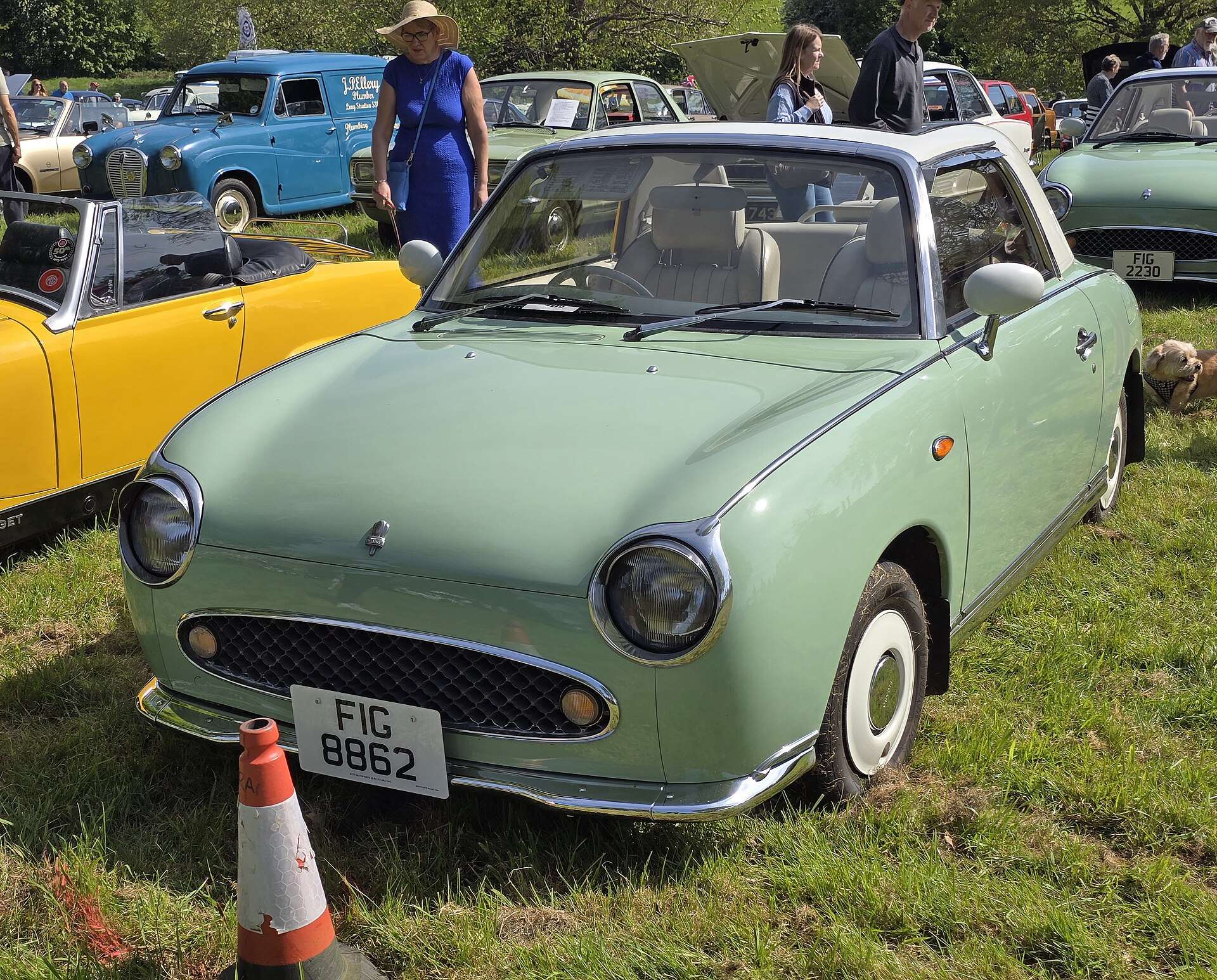
The bumpers, grille, lamps, mirrors and bright trim define the car’s appearance and can be expensive to replace correctly. Panel fit around the long doors and rear deck helps reveal accident damage or weakened structure. Confirm that drainage holes remain open after restoration.
Interior, instruments and air conditioning
Figaro cabins mix model-specific pieces with Nissan hardware. Check the white seat coverings, piping, dashboard finish, gauges, radio, switchgear, cup holder, carpets and door trims. Retrimming is possible, but an incomplete cabin quickly becomes expensive.

Test electric windows, heater fan, gauges and air conditioning. Many systems have been converted to later refrigerant; invoices should identify the work. Old alarms and aftermarket audio equipment can damage an otherwise tidy wiring loom.
UK imports and choosing a Figaro
All Figaros began as Japanese-market right-hand-drive cars, and Britain became a major second home. Match the FK10 chassis number to import and registration documents, confirm the recorded year and inspect any mileage conversion. A kilometre odometer with a later mph face can confuse history.
Choose a structurally sound, watertight and complete car over one with fresh paint and unknown metalwork. A specialist pre-purchase inspection should include the roof drains, corrosion points, cooling system and automatic gearbox. Clubs and parts specialists make ownership practical, but rarity of trim still rewards buying the best example first.
Sources and further reading
- Nissan Heritage: Figaro
- Nissan Motor official Figaro press release archive
- Nissan Global: Pike series context
- JDM Registry: Figaro production overview
Continue the Nissan story
The Figaro shares its K10 family roots with the Micra and March, but turns them into one of Nissan’s most distinctive design statements. Explore the complete Nissan hub and read the Nissan Micra K10 guide.
Frequently asked questions
How many Nissan Figaros were made?
Specialist registries commonly record 20,073 completed cars, so the safest rounded description is approximately 20,000.
What engine does a Nissan Figaro use?
It uses Nissan’s MA10ET, a 987 cc turbocharged four-cylinder engine, with a three-speed automatic gearbox and front-wheel drive.
Is the Nissan Figaro a full convertible?
It has a folding fabric centre roof, but the side frames and rear body structure remain fixed, making it a fixed-profile convertible.
What are the four original Figaro colours?
The standard seasonal colours are Topaz Mist, Emerald Green, Pale Aqua and Lapis Grey.
Where does a Nissan Figaro rust?
Check the sills, floor edges, jacking points, wings, inner arches, suspension towers, door bottoms, rear arches, boot floor and roof-supporting structure.