UNUSUAL CARS MODEL GUIDE
The original Mazda MX-5 is the lightweight two-seat roadster launched in 1989 and identified by enthusiasts as the NA generation. Sold in Japan as the Eunos Roadster and in North America as the Mazda MX-5 Miata, it revived a simple front-engined, rear-wheel-drive format with modern reliability, careful ergonomics and unusually low mass.
Quick answer: MX-5, Miata and Eunos Roadster are market names for closely related versions of the same NA-generation car. The best purchase is not automatically the lowest-mileage or most original-looking example: structural rust, water ingress and previous repairs decide whether the car’s simplicity remains an asset.
The idea behind the original MX-5
The project grew from Mazda’s American operations, where planners argued that the affordable lightweight sports car had disappeared even though demand for its character remained. Competing proposals included front- and mid-engined layouts, but the selected concept was a compact front-engine, rear-drive roadster.
Mazda tested public reaction with a full-size prototype in the United States during 1987. The production car debuted at the Chicago Auto Show in February 1989 and went on sale in North America that spring, followed by Japan in September. The Japanese-market Eunos name came from Mazda’s new dealer-channel structure, not from a different manufacturer.
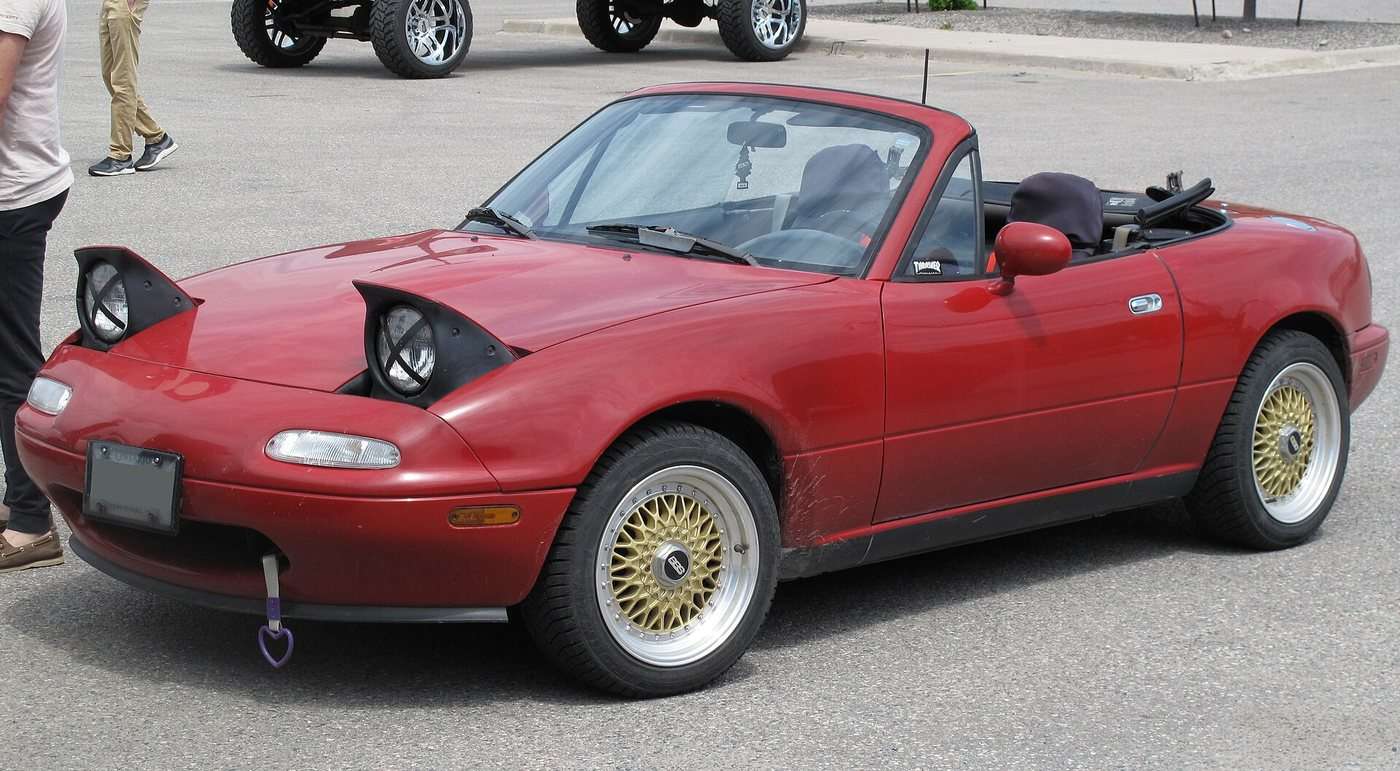
Jinba Ittai and a deliberately simple layout
Mazda describes the MX-5 philosophy as Jinba Ittai: rider and horse moving as one. In engineering terms that meant keeping the driver close to the car’s centre, controlling weight and inertia, and making steering, pedals and gearshift respond naturally rather than chasing headline output.
The NA uses double-wishbone suspension at each corner, a five-speed manual gearbox on most enthusiast cars and a manually operated soft top light enough to raise from the seat. Mazda resisted proposals for a 2+2 cabin and heavier roof mechanisms. Early 1.6-litre cars typically weighed around a tonne, depending on market and equipment.
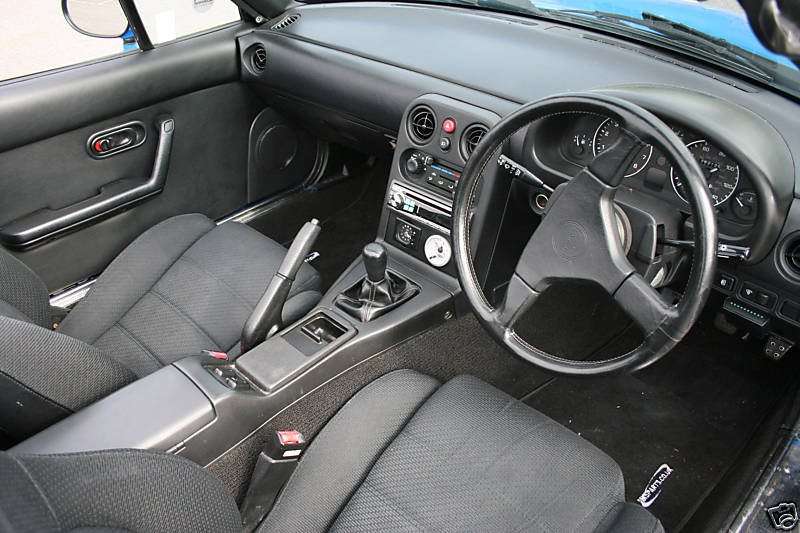
1.6 and 1.8-litre NA models
The launch engine was the fuel-injected 1,598cc B6 four-cylinder. Output differed by market and emissions specification, but the important point was its willingness to rev and the car’s modest mass. A 1,839cc BP engine arrived later, bringing more torque and changes to the driveline and body specification.
Britain received official Mazda-badged cars, while many Eunos Roadsters were imported from Japan. Japanese specifications included a wide range of limited editions, differential choices and equipment combinations. Do not assume that a colour, badge or wooden steering wheel proves a particular edition; compare the chassis number and factory specification.
| Version | Typical period | Key distinction |
|---|---|---|
| 1.6-litre NA | 1989 onward; market-dependent | Original lighter specification and B6 engine |
| 1.8-litre NA | From 1993/94 depending on market | BP engine, more torque and associated chassis/driveline revisions |
| Eunos Roadster | Japanese market | Same NA platform under Mazda’s Eunos sales channel, with Japan-specific grades |
| MX-5 Miata | North America | North American naming and federal-market equipment |

Hardtops, special editions and sensible modifications
A removable hardtop adds security and winter refinement without changing the car’s basic structure. Original tops, catches and heated-glass wiring have value, so examine fit and rear-deck damage. Numerous special editions combined paint, upholstery and equipment, but mechanical differences were often modest.
The NA also became one of the world’s most modified sports cars. Better dampers, refreshed bushes and careful alignment can improve a tired example; extreme lowering, oversized wheels and poorly planned turbo conversions can overwhelm the standard cooling, brakes and structure. The engine-bay photograph below shows an aftermarket turbo installation and is included as an example of the kind of non-standard work that must be assessed on its own merits.

Why the NA mattered
The original MX-5 proved that a modestly powered sports car could succeed through balance, feedback and usability. Mazda says more than half a million MX-5s had been produced by the end of October 1999, earning the model a Guinness record for two-seat open sports-car production. Its success encouraged other manufacturers to return to compact roadsters during the 1990s.

Love cars you don’t see every day?
Get forgotten cars, surprising motoring stories and the most interesting finds from Unusual Cars by email.
Free to join. No spam. Unsubscribe whenever you like. See our privacy policy.
Mazda MX-5 NA buying guide
Rust is the first decision
Inspect the sills internally and externally, rear wheelarches, floor, front chassis areas, suspension mounting points and seams around the boot. Blocked roof drains allow water into the sill structure, so shiny paint can conceal corrosion from the inside out. Poor patch repairs may cost more to rectify than buying a stronger shell.
Water ingress and roof condition
Check the soft top, rain rail, drains, door seals and carpets. Damp behind the seats or in the boot can damage trim and accelerate corrosion. A cloudy or split plastic rear window and torn hood are visible costs; a badly fitted rain rail is less obvious.
Engine, cooling and transmission
Start from cold, watch for persistent smoke and listen for more than a brief hydraulic-tappet rattle. Check coolant condition, radiator, hoses, water pump and cambelt history. The five-speed shift should be clean once warm; assess clutch engagement, differential noise and oil leaks rather than assuming these cars are indestructible.
Suspension, brakes and tyres
Ageing dampers and bushes can make an MX-5 feel imprecise without producing dramatic noises. Check seized brake calipers, wheel bearings and uneven tyre wear. Matching tyres and a specialist alignment are essential to the light steering and predictable balance.
Identity and modifications
Verify whether the car is an official UK Mazda or Japanese Eunos import, then confirm engine, differential, equipment and limited-edition claims. Look for cut springs, damaged jacking points, amateur wiring and roll bars attached only to thin body panels. Quality modifications should have invoices and a coherent purpose.
Research sources
- Mazda: MX-5 development, chapter one
- Mazda: Jinba Ittai engineering decisions
- Mazda: prototype, launch and production record
- Classic & Sports Car: MX-5 NA buyer’s guide
Continue the Mazda story
Explore the Rare & Performance Mazdas hub, then read about the RX-7 FD or the 323 GTX and GT-R.
Frequently asked questions
What does NA mean on a Mazda MX-5?
NA is the enthusiast designation for the first MX-5 generation, sold from 1989 and recognisable by its pop-up headlamps.
Is a Eunos Roadster the same as an MX-5?
It is the Japanese-market version of the NA MX-5, sold through Mazda’s Eunos dealer channel. Equipment, engine and limited-edition specifications can differ from UK cars.
Did the original MX-5 have 1.6 and 1.8-litre engines?
Yes. The NA launched with a 1.6-litre B6 engine and later gained the 1.8-litre BP; introduction dates and outputs varied by market.
Where does a Mazda MX-5 NA rust?
Priority areas include the sills, rear wheelarches, floor, suspension mounting points and seams around the boot. Blocked soft-top drains can cause the sills to corrode internally.
What should be checked on a modified MX-5?
Check the quality and documentation of suspension, wheel, brake, forced-induction, electrical and roll-bar work, and confirm that alignment, cooling and tyre specification remain appropriate.