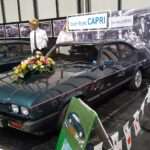
The Tickford Capri was not simply another turbo conversion. It was an attempt to turn Ford’s familiar fastback into a hand-finished British grand tourer: quicker, more stable, more luxurious and much rarer than the Capri 2.8 Injection on which it was based.
Developed by Aston Martin Tickford with input from former Lotus Formula 1 driver and respected development engineer John Miles, it combined a turbocharged Cologne V6 with rear disc brakes, revised suspension, a limited-slip differential, an aerodynamic body kit and a bespoke cabin. The result was one of the most ambitious fast Fords of the 1980s—and one of the least understood.
- Base car: Ford Capri 2.8 Injection
- Engine: 2.8-litre Cologne V6 with turbocharger and intercooler
- Power: approximately 205 bhp
- Performance: 0–60 mph in about 6.5–6.7 seconds; around 137–140 mph
- Production: commonly quoted as 85–100 cars, depending on how completed and registered examples are counted
- Price: roughly £15,000 when new
Where the Tickford Capri came from
The story begins with John Miles. After his Formula 1 career, Miles became an unusually analytical road tester and development driver. In 1981 he bought a 3.0-litre Capri from Ford’s press fleet and used it as a rolling laboratory, covering more than 25,000 miles while experimenting with engine and chassis improvements.
Miles believed the Capri still had untapped potential. Conversations involving Aston Martin chairman Victor Gauntlett, Ford executives including John Waddell and Bob Lutz, and tyre specialist Tom Northey helped turn that conviction into a serious programme. Tickford and Ford initially shared prototype costs, creating a car that could sit above the standard 2.8 Injection rather than merely compete with aftermarket turbo kits.

From Capri 2.8 Injection to coachbuilt flagship
The donor car mattered. Ford’s Capri 2.8 Injection already used the fuel-injected 2.8-litre Cologne V6 and had been developed by Ford’s Special Vehicle Engineering division as the most sophisticated mainstream Capri. In standard form it produced about 160 bhp. Tickford did not simply bolt on a turbo and turn up the boost.
Period descriptions list an IHI turbocharger, Garrett intercooler, revised electronic ignition and fuel management, stronger transmission components and extensive under-bonnet re-engineering. Output rose to approximately 205 bhp. That figure may appear modest beside a modern hot hatch, but in the early 1980s it placed the Tickford in genuinely serious company.
Independent period testing and marque histories generally place 0–60 mph between 6.5 and 6.7 seconds, with a top speed between 137 and 140 mph. More important than the numbers was the manner of delivery: the turbo gave the long-bonnet Capri the effortless mid-range pace expected of a much more expensive GT.

A chassis developed to use the extra power
The standard Capri’s live rear axle and ageing platform could not simply be ignored. Tickford added rear disc brakes, a limited-slip differential and significant suspension revisions. Contemporary reports also describe a rear axle locating A-frame, stiffer components and carefully chosen tyres. The goal was not to make a stripped-out competition car, but to give the Capri the control and high-speed confidence its new performance demanded.
This is an important distinction. Turbo Technics and other specialists also offered rapid Capris, but the Tickford was conceived as a complete vehicle. Engine, brakes, chassis, aerodynamics and interior were developed as one package, with each completed car requiring substantial hand work.
Love cars you don’t see every day?
Get forgotten cars, surprising motoring stories and the most interesting finds from Unusual Cars by email.
Free to join. No spam. Unsubscribe whenever you like.
The styling was part of the engineering
The Tickford Capri is instantly recognisable. Its blanked-off, colour-coded grille, deeper front valance, side skirts, enlarged rear spoiler and smoothed bumpers were far removed from the pepperpot-wheel subtlety of a standard 2.8 Injection. Simon Saunders—later the creator of the Ariel Atom—is widely credited with the distinctive body treatment.
The appearance remains divisive, which is precisely why the car is so memorable. It was not intended to look like a Capri wearing a collection of accessories. The kit reduced lift and helped give the car a coherent, bespoke identity. On a white or black example, the result can look remarkably modern for a design whose basic proportions dated back to the late 1970s.
An interior closer to a grand tourer
Tickford’s coachbuilding background showed most clearly inside. Buyers could specify tailored trim, leather, Wilton carpeting and extensive cabin refinishing. Wood veneer, retrimmed seats and upgraded materials moved the experience away from mass-produced Ford territory and towards the bespoke atmosphere associated with Aston Martin.
No two survivors should automatically be assumed identical. Tickford offered considerable choice, while later restoration and modification can blur the line between factory specification and sympathetic improvement. That individuality is part of the car’s appeal, but it also explains why accurate documentation matters.

Why Ford stepped away
A prototype appeared at the 1982 NEC Motor Show and generated considerable attention. The production version followed in 1983, but the project’s commercial position was difficult. At around £15,000, a Tickford cost dramatically more than a standard Capri 2.8 Injection and entered the territory of specialist sports cars.
Ford withdrew direct support in early 1984, leaving Tickford to continue the programme independently. That decision did not make the car unofficial or improvised; it simply changed the commercial relationship after development was already well advanced. Production continued in tiny numbers into the final years of Capri manufacture.
How many Tickford Capris were built?
This is where confident internet claims become risky. Some sources state that 100 cars were commissioned or sold, while respected histories quote 85, 86 or 88 completed examples. The difference appears to come from whether donor cars, partly completed conversions and fully finished customer cars are counted in the same way.
The safest conclusion is that approximately 100 were planned and fewer than that were completed to full Tickford specification. Even the highest credible figure makes it exceptionally rare. Surviving genuine cars are far scarcer than ordinary Capri 2.8 Injections, and period-correct replicas have added further confusion.
Tickford Capri versus Turbo Technics Capri
The two names are sometimes used as if they describe the same car. They do not. Turbo Technics produced respected turbo conversions for the Capri, including versions associated with Ford dealers late in the model’s life. A Tickford Capri was a much broader coachbuilt programme with its own bodywork, cabin, braking and chassis specification.
Both are significant fast Fords, but their identities should remain separate. A turbocharged Capri is not automatically a Tickford, just as a Tickford-style body kit does not establish provenance.
Why the Tickford Capri matters
The Tickford arrived when the Capri was nearing the end of its life and Ford’s performance attention was moving towards the Sierra. Instead of quietly fading away, the old coupé received one final engineering statement—one that connected Ford, Aston Martin, specialist British coachbuilding and the booming 1980s appetite for turbocharging.
It also anticipated the modern idea of a manufacturer-linked restomod. The underlying car remained recognisable, but almost every part of the experience was reconsidered. The Tickford was faster and more capable, certainly, yet its significance lies equally in the craftsmanship and confidence required to sell a hand-finished Capri for almost exotic-car money.
Frequently asked questions
Was the Tickford Capri built by Aston Martin?
It was developed and converted by Aston Martin Tickford, the engineering subsidiary created by Aston Martin in 1981. It was based on a Ford Capri 2.8 Injection rather than being an Aston Martin model.
How powerful was the Tickford Capri?
Most reliable period and marque sources quote approximately 205 bhp from the turbocharged 2.8-litre Cologne V6.
How many were made?
Figures vary from the mid-80s to 100. Approximately 100 appears to have been the intended run, with fewer cars completed to full specification.
Is every turbocharged Capri a Tickford?
No. Turbo Technics, Janspeed and other specialists produced separate conversions. A genuine Tickford has a distinct package and should be supported by convincing history and identifying details.
Continue the Ford story
Browse the Rare & Performance Fords hub, discover the final-production Lotus Cortina story, or explore the Sierra Sapphire RS Cosworth 4×4.
Research note: Development history and performance figures were checked against the Tickford Owners Club, Capri Club International, contemporary Motor Sport coverage and established Ford Capri histories. Production totals vary between sources, so the uncertainty is stated rather than concealed.