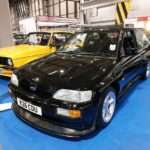
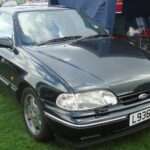
The Ford Sierra Sapphire RS Cosworth 4×4 was the most complete road-going Sierra Cosworth. It combined the discreet four-door Sapphire body with the turbocharged Cosworth YB engine and an all-wheel-drive system developed to make Ford competitive on loose-surface rallies. The result was a 1990s performance saloon that could look almost ordinary while delivering extraordinary pace.

From winged three-door to discreet Sapphire
The original 1986 Sierra RS Cosworth was created as a homologation special and announced its intent with a towering rear wing. For 1988 Ford transferred the formula to the four-door Sapphire saloon. The first Sapphire Cosworth retained rear-wheel drive, giving customers much of the original car’s performance in a more practical, less conspicuous shape.
Rallying was moving decisively towards four-wheel drive, however. Ford had experience with the XR4x4 transmission and the turbocharged Cosworth engine, so combining those ingredients was logical even if the engineering was far from simple. The Sierra RS Cosworth 4×4 arrived in 1990, built at Genk in Belgium and homologated for Group A competition.
The Cosworth YB heart
Under the bonnet sat a 1,993cc twin-cam, 16-valve Cosworth YB engine. In road trim the 4×4 produced about 220PS, with strong mid-range torque and a character defined by the Garrett turbocharger. It was an evolution of the unit that had made the earlier Sierra Cosworth famous, revised for the four-wheel-drive installation and identified in many production cars by the later YBG or YBJ specification.

A five-speed manual gearbox and Ferguson-type centre coupling distributed torque to both axles, with the rear receiving the larger share. This rear-biased balance preserved the Sierra’s adjustable character while adding traction in poor conditions. Period tests recorded 0–60mph in roughly six seconds and a top speed around 150mph—serious figures for a family-shaped saloon in 1990.
Why four-wheel drive mattered
The original rear-drive Cosworth was formidable on circuits and tarmac, but rally rivals from Lancia and Toyota demonstrated the advantage of driving all four wheels. Ford’s 4×4 system gave the Sierra better traction out of slow corners and greater stability on gravel, snow and wet surfaces. The road car benefited from the same thinking: its performance became easier to use without losing the sense that power was being sent primarily towards the rear.
Love cars you don’t see every day?
Get forgotten cars, surprising motoring stories and the most interesting finds from Unusual Cars by email.
Free to join. No spam. Unsubscribe whenever you like. See our Privacy Policy.
A rally car hiding in a business suit
The Sapphire 4×4 competed in the World Rally Championship from 1990. Drivers including François Delecour, Massimo Biasion, Malcolm Wilson and Pentti Airikkala demonstrated its speed, although the Sierra faced purpose-developed opposition and never achieved the title success Ford wanted. Its competition life was still valuable: it bridged the gap between Ford’s rear-drive Sierra programme and the Escort RS Cosworth that followed.

Subtle exterior, serious engineering
Compared with the three-door, the Sapphire was restrained. Bonnet vents, discreet spoilers, deeper bumpers, side skirts and distinctive alloy wheels marked it out, but it remained recognisably a practical Sierra saloon. That dual identity is central to its appeal: adults and luggage could travel in comfort while the driver had access to a competition-bred engine and drivetrain.
The cabin was similarly understated, with supportive Recaro seats, a leather steering wheel and clear instruments rather than theatrical decoration. It was an everyday fast Ford at a time when rivals often demanded more compromise.
Production and its place in the lineage
Most published histories place 4×4 production at approximately 12,250 cars between 1990 and 1992. It replaced the rear-wheel-drive Sapphire Cosworth and became the mechanical foundation for the Escort RS Cosworth, whose platform and four-wheel-drive system were derived from Sierra components beneath a smaller-looking Escort body.
This makes the Sapphire 4×4 much more than a late Sierra derivative. It represents the mature form of Ford’s YB-powered saloon and the engineering bridge to the next RS generation.
Why enthusiasts still value it
The Sapphire Cosworth 4×4 combines rarity, usability and enormous tuning potential. Many cars were modified heavily because the YB engine responds exceptionally well to careful upgrades. That history makes standard, correctly maintained examples especially desirable. Originality matters not because modifications are automatically undesirable, but because factory specification is increasingly difficult to reconstruct.
Its reputation also survives because the fundamentals remain compelling: compact dimensions, excellent visibility, a manual gearbox, rear-biased four-wheel drive and a turbo engine with genuine competition ancestry. Modern performance cars may be faster, but few communicate their purpose so clearly.
The ultimate all-weather Sierra
The Sierra Sapphire RS Cosworth 4×4 turned a practical saloon into an all-weather performance machine without erasing its character. It was quick enough to challenge exotic cars, useful enough for daily life and important enough to underpin Ford’s next homologation hero. Among Sierra Cosworths it may be the least flamboyant, but it is arguably the most rounded.
Continue the Ford story
Browse the Rare & Performance Fords hub, read about the Sierra XR4i, or explore the Mondeo ST200 and ST220.
Research note: Dates, engine specifications and model history were checked against Ford heritage material and the FIA Group A homologation record for the Sierra Cosworth 4×4.