The Ford Capri 2.8 Injection restored serious performance to Europe’s long-bonnet coupé—and the Capri 280 Brooklands gave the story one of the most memorable endings in Ford history. Together they represent the mature, fastest and most collectible factory-developed versions of the everyday Capri formula.
Why Ford needed the Capri 2.8 Injection
By the beginning of the 1980s, the Capri was already more than a decade old. The Mk3’s quad headlamps, black grille and aerodynamic detailing had modernised its appearance, but Ford needed a flagship with enough performance to keep the coupé credible against newer rivals.
The answer came from Ford’s Special Vehicle Engineering operation. Introduced in January 1981, the 2.8 Injection replaced the familiar three-litre V6 flagship and was positioned as a spiritual successor to the Capri RS 2600. The change was not simply a larger badge or trim package: it brought a fuel-injected 2.8-litre Cologne V6 and meaningful chassis changes.

The 2.8-litre injected V6
Ford quoted 160PS from the Bosch-injected V6. Contemporary Ford material records a top speed of 210km/h and 0–100km/h in roughly eight seconds. Just as important was the engine’s delivery: the Cologne V6 gave the Capri a broad, muscular character suited to rapid road driving rather than demanding constant revs.
A modified S suspension setup, reinforced anti-roll bars, 205/60 VR13 tyres on seven-inch alloy wheels and a rear brake-pressure regulating valve supported the extra pace. In August 1981 the initially special 2.8 Injection became a regular production model as Ford simplified the Capri range.
| Feature | Capri 2.8 Injection | Capri 280 |
|---|---|---|
| Engine | 2.8-litre fuel-injected Cologne V6 | 2.8-litre fuel-injected Cologne V6 |
| Power | 160PS | 160PS |
| Identity | Performance flagship from 1981 | Final Brooklands Green edition |
| Distinctive equipment | Sports suspension and seven-inch alloys | Leather Recaros, 15-inch wheels and limited-slip differential |
Love cars you don’t see every day?
Get forgotten cars, surprising motoring stories and the most interesting finds from Unusual Cars by email.
Free to join. No spam. Unsubscribe whenever you like. See our privacy policy.

How the Injection evolved
The 2.8 Injection’s life covered several detail changes and increasingly well-equipped derivatives. The Injection Special brought extra desirability through equipment including a limited-slip differential, while Ford continued refining trim and presentation as the Capri moved from current performance car towards enthusiast icon.
That gradual evolution matters because not every injected Capri is the same. Original wheel designs, interiors, decals, spoilers and mechanical specifications are central to each version’s identity. Decades of modification and restoration mean surviving cars should be understood through their individual build details and documentation.
The Capri 280 Brooklands
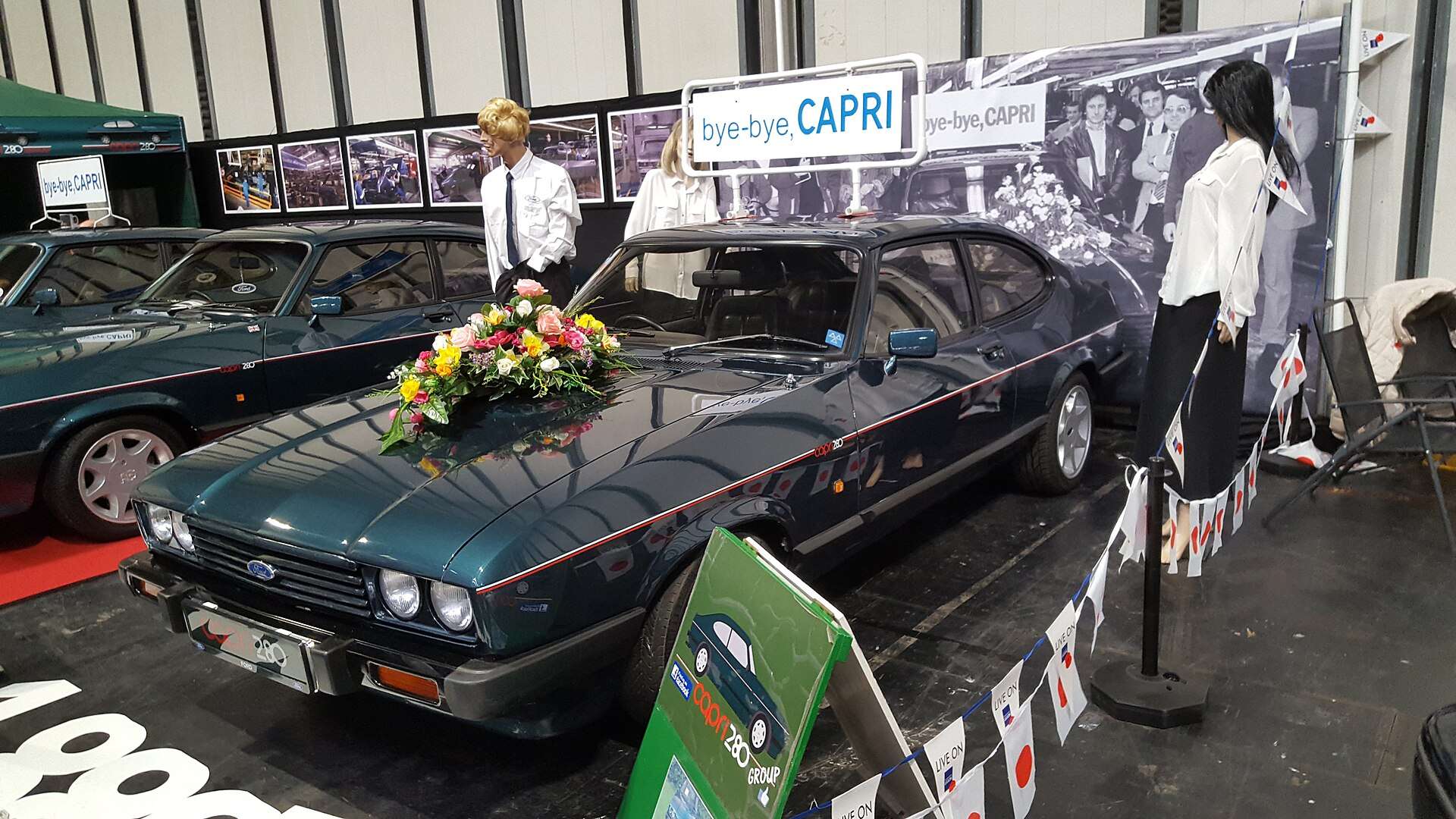
Ford marked the end of Capri production with the 280. The name is inseparable from Brooklands Green, the colour worn by every example. Ford’s own historical material states that just over 1,000 were made; the widely documented production total is 1,038.

The 280 combined its green paint with full leather Recaro seats, 15-inch seven-spoke alloy wheels and a limited-slip differential. It was developed from the 2.8i formula rather than becoming an unrelated mechanical special, but its role as the final Capri gave those details enormous emotional weight.
Ford’s heritage account identifies the 280 as a Ford Special Engineering development at Dunton. The final Capri left the Cologne line in December 1986, closing a production story that had begun in 1969 and totalled about 1.9 million cars.

Why the Capri still feels different
The Capri’s basic layout remained traditional: a front-mounted engine, rear-wheel drive and a live rear axle. By 1980s standards that architecture was hardly revolutionary, yet it created the long-bonnet stance and accessible rear-wheel-drive character that defined the car.
The 2.8 Injection is not a modern sports coupé in disguise. Its steering, brakes and chassis ask the driver to respect age, tyres and conditions. That is precisely why it remains involving. The V6 soundtrack, compact cabin and view down the bonnet turn an ordinary journey into an event.
The difference between a 2.8 Injection and a 280
A Capri 280 is a specific final-edition development of the injected V6 Capri, not a separate engine family. Its Brooklands Green finish, leather Recaro interior, 15-inch wheels and limited-slip differential create the visual and equipment distinction. A standard or Special 2.8 Injection can be equally rewarding, but the 280 carries the significance—and scarcity—of the final production run.
Why these Capris matter
The Capri 2.8 Injection proved Ford could keep an ageing platform relevant through intelligent engineering. The 280 then transformed the end of production into a celebration rather than a quiet withdrawal. Today the pair connects Ford’s affordable coupé idea with the specialist engineering culture that also produced cars such as the XR2, RS models and later Racing Puma.
Explore more cars in our Rare & Performance Fords hub, including the Fiesta XR2 and XR2i.
Frequently asked questions
When did the Capri 2.8 Injection launch?
Ford introduced it in January 1981, initially as a special model before adding it to the regular range later that year.
How many Capri 280s were built?
Ford describes the run as just over 1,000 cars; the accepted detailed total is 1,038.
Were all Capri 280s green?
Yes. The final edition was finished in Brooklands Green, the colour that gave the model its familiar unofficial “Brooklands” name.
Research sources
- Ford Europe Capri historical timeline
- Ford Media: Capri history and 2.8 Injection engineering
- Ford Heritage collection: Capri 280
Production details and specifications can differ by market and build date. Individual cars should be identified from their documentation and original equipment.
Continue the Ford story
Browse the Rare & Performance Fords hub, move into the 1980s with the Sierra XR4i, or explore the Escort RS Cosworth.