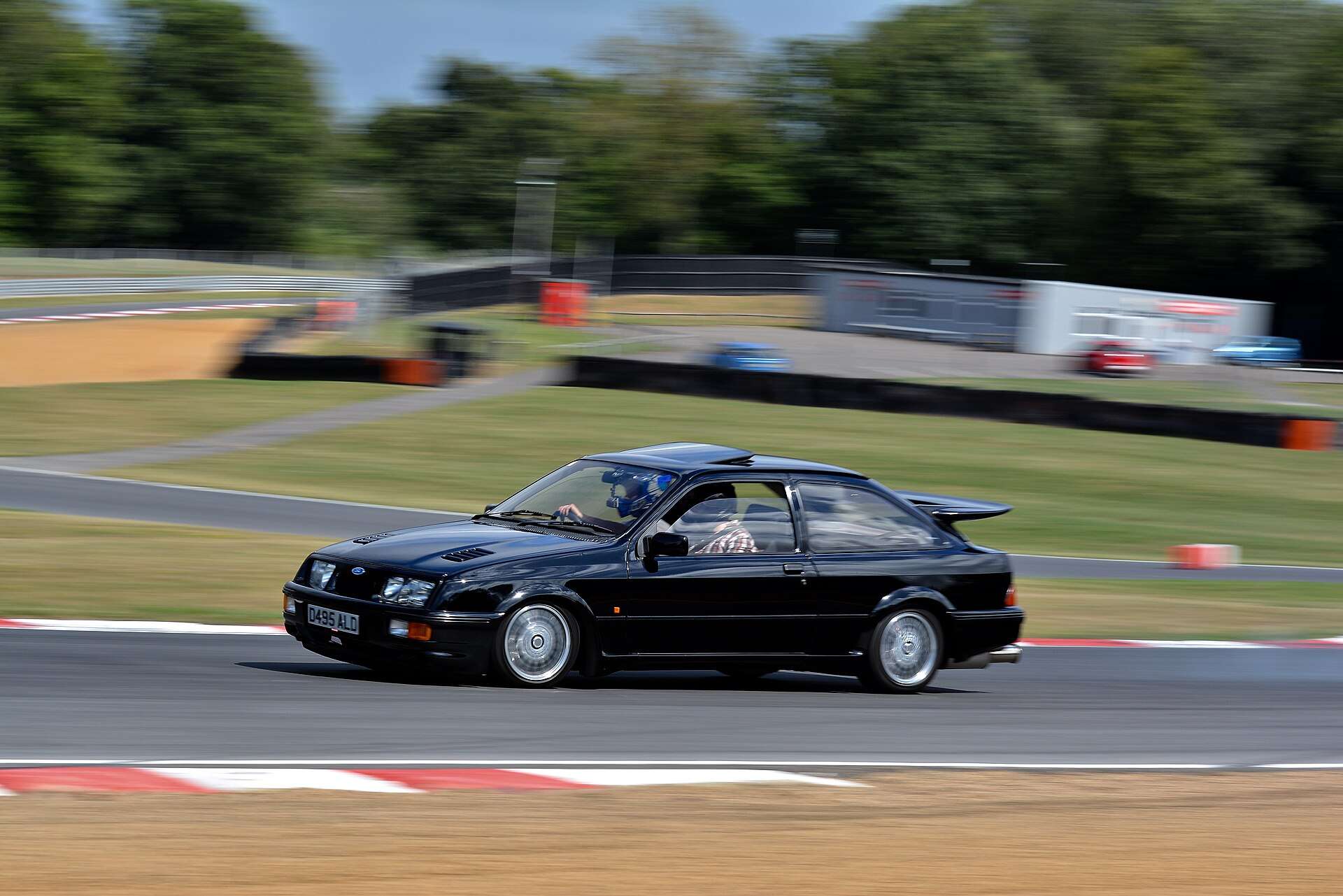
The Ford Sierra RS Cosworth turned an aerodynamic family hatchback into one of the defining performance cars of the 1980s. Its enormous rear wing became a symbol of the era, but almost every dramatic detail had a functional reason.

1. Ford built it to win under Group A rules
Ford’s Special Vehicle Engineering team needed a competitive touring car and rally car. Group A demanded 5,000 road versions, so the Sierra’s practical shell became the basis of a genuine homologation programme.
2. Cosworth originally aimed beyond Ford’s request
The engine began with Ford’s robust Pinto block and a new Cosworth 16-valve aluminium cylinder head. Ford initially wanted around 180 bhp; the production car arrived with 204 PS, giving engineers a stronger foundation for racing.
3. The giant rear wing was developed in a wind tunnel
The biplane-style spoiler was not decorative. Ford spent roughly 200 hours refining the Sierra’s aerodynamic package, using the wing to reduce rear lift and improve high-speed stability.

4. It remained rear-wheel drive
While many performance cars were moving to front-wheel drive, the three-door Sierra sent power to the rear wheels through a Borg-Warner five-speed gearbox and limited-slip differential. That layout became central to its reputation.
Love cars you don’t see every day?
Get forgotten cars, surprising motoring stories and the most interesting finds from Unusual Cars by email.
Free to join. No spam. Unsubscribe whenever you like. See our Privacy Policy.
5. The RS500 really was limited to 500 cars
To homologate further racing changes, 500 completed Sierra RS Cosworths were converted by Tickford in 1987. These RS500s gained a larger turbo, revised fuel and cooling systems, extra aerodynamic pieces and provision for a second set of injectors.
6. Road-going RS500s were deliberately restrained
Ford rated the production RS500 at about 224 bhp, only a modest increase over the standard car. In competition specification, however, the same package could produce more than twice that figure.
7. Most three-door Cosworths were not RS500s
Ford produced 5,545 three-door Sierra RS Cosworths including the 500 RS500 conversions. The standard homologation car is therefore much more numerous, although both are now highly prized.

8. Touring-car racing made it a global legend
Sierra Cosworths won major touring-car races and championships across Europe, Australia, New Zealand and Japan. The RS500’s combination of low weight, rear-wheel drive and immense turbocharged power made it the car to beat.
9. Rally success came after the four-wheel-drive era began
The rear-drive Sierra competed against increasingly sophisticated four-wheel-drive machinery, yet remained spectacular and effective. Didier Auriol won the 1988 Tour de Corse in one, and the model helped Ford finish second in that year’s manufacturers’ championship.
10. Its image almost became a liability
Huge demand, theft and high insurance costs turned the Cosworth into a tabloid symbol as well as a performance icon. Many were modified or crashed, which is why original cars with documented history command such attention today.
Love cars you don’t see every day?
Get forgotten cars, surprising motoring stories and the most interesting finds from Unusual Cars by email.
Free to join. No spam. Unsubscribe whenever you like. See our Privacy Policy.
More fast Fords
Read our Ford Escort XR3i facts and explore the Ford archive.
Sources
Continue the Ford story
Browse the Rare & Performance Fords hub, meet the earlier Sierra XR4i, or read the full Escort RS Cosworth story.