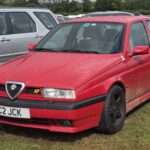
The Alfa Romeo SZ was a hand-built, composite-bodied coupé that turned the Alfa 75’s transaxle engineering into one of the strangest and most purposeful road cars of the late 1980s. Known internally as ES30, it was styled through the Fiat design organisation, developed with Alfa Romeo and assembled by Zagato.

ES30: an experimental sports car
The project name meant Experimental Sportscar 3.0-litre. Although Zagato built the car and its badge appears on the body, the angular form emerged from a broader Fiat/Alfa design programme. The dramatic wedge, high beltline and triple headlamps were intended to be uncompromising.
Alfa 75 foundations
Beneath the composite panels sat a steel structure and a heavily developed version of the Alfa 75 transaxle platform. The front-mounted 3.0-litre Busso V6 drove through a rear-mounted gearbox and De Dion axle, giving the SZ a direct link to Alfa’s final pre-Fiat rear-drive saloon.

Performance and handling
Stellantis Heritage records 207PS and a 245km/h maximum speed. The chassis was tuned for high cornering forces rather than softness, and the short, wide body made the car feel more like a road-going competition project than a conventional grand tourer.
Love cars you don’t see every day?
Get forgotten cars, surprising motoring stories and the most interesting finds from Unusual Cars by email.
Free to join. No spam. Unsubscribe whenever you like. See our privacy policy.
Production and the RZ roadster
Official heritage material describes approximately 1,000 SZ coupés built from late 1989 to 1991. The open RZ followed in even smaller numbers. Most SZs were red with a contrasting dark roof, while the roadster appeared in a broader colour range.

Why the styling matters
The SZ is often discussed as ugly or beautiful, but that misses its intent. Its blunt surfaces and unusual glazing rejected the smooth, anonymous shapes becoming common at the time. It was a limited-production statement about Alfa’s engineering and design confidence.

Its place in Alfa history
The SZ and RZ were the last new rear-wheel-drive Alfa Romeos before the modern Giulia, and the final specialised road cars based on the classic transaxle family. They therefore close the same chapter represented by the Alfa 75 while pointing toward the low-volume collector cars Alfa would later revisit.

Frequently asked questions
What does SZ stand for?
Sprint Zagato. The internal project designation was ES30, meaning Experimental Sportscar 3.0-litre.
Is the SZ based on the Alfa 75?
Yes. Its steel structure, transaxle layout, De Dion rear suspension and 3.0 V6 were developed from Alfa 75 architecture.
How many Alfa SZs were built?
Stellantis Heritage describes a production run of approximately 1,000 coupés between late 1989 and 1991.
What is the Alfa RZ?
The RZ is the open roadster derivative of the SZ, produced in even smaller numbers.
Did Zagato design the SZ?
Zagato assembled it and contributed to the project, but the styling emerged from the Fiat design organisation working with Alfa Romeo rather than from a conventional independent Zagato commission.
Research sources
- Stellantis Heritage: Alfa Romeo SZ
- Alfa Romeo: 30 years of the SZ
- Wikimedia Commons records linked beneath each image.
Continue the Alfa Romeo story
Browse the Rare & Performance Alfa Romeo hub for more model histories, engineering stories and connected guides.