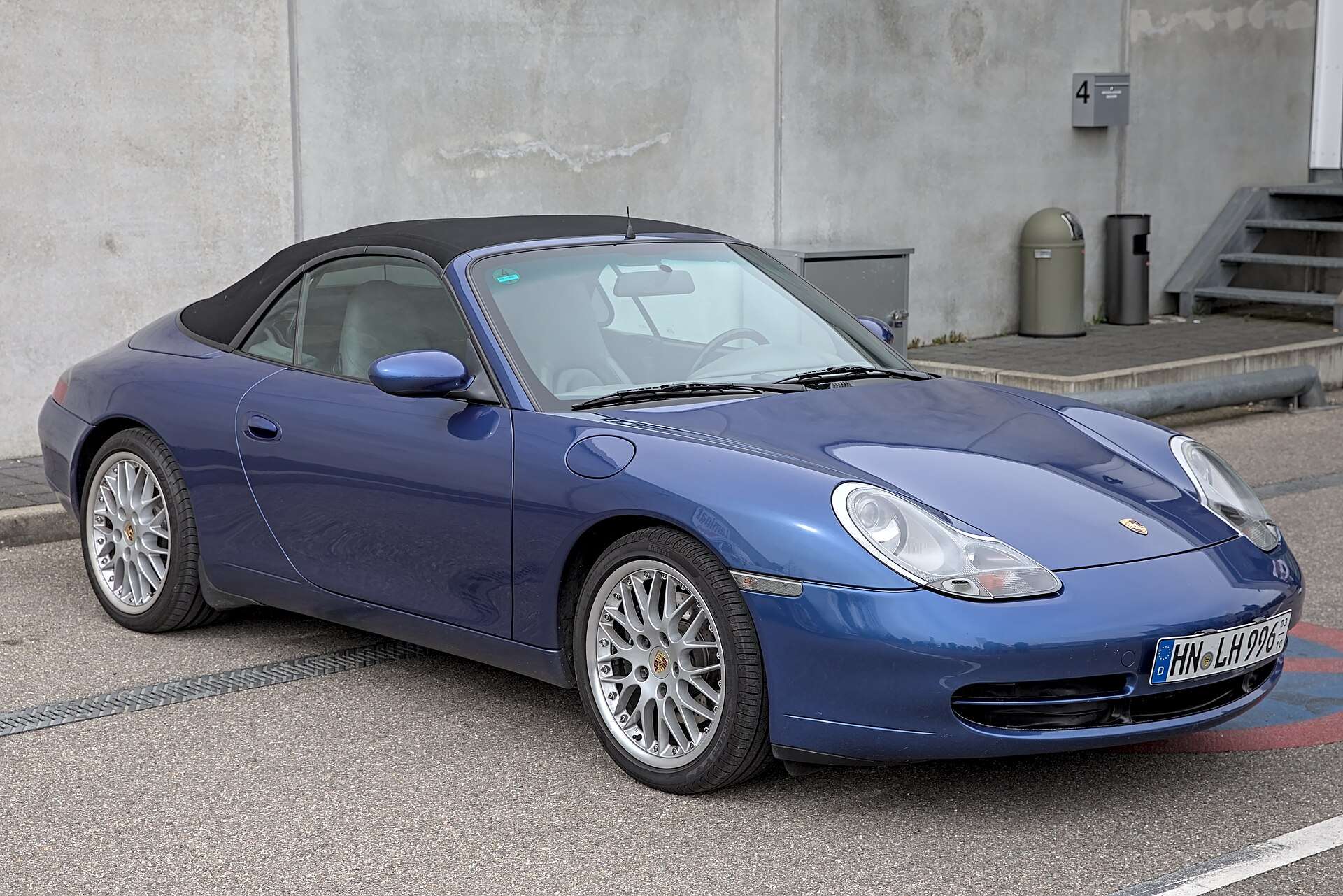
The Porsche 911 Type 996 offers a recognisable 911 experience at prices that can tempt buyers away from much newer cars. Its appeal is real, but so is the difference between an affordable asking price and affordable ownership. This guide concentrates on the normally aspirated Carrera family: how to assess engine evidence, choose the right body and gearbox, and budget for the cooling, suspension and age-related work that a short test drive can miss.
Our buying verdict
Buy the best-inspected Carrera you can afford and retain a substantial maintenance reserve. A documented engine rebuild can add confidence when its scope is clear. An “IMS done” advert alone cannot establish the condition of the cylinder bores or the rest of the engine. Choose manual, Tiptronic, coupe or convertible for your use, then judge condition rather than searching for the cheapest entry ticket to a 911.

Which Porsche 996 is this guide for?
Porsche introduced the 996 Carrera in 1997 as a completely redesigned, water-cooled 911. Early Carrera models use a 3.4-litre flat-six; the later facelift Carrera family uses a 3.6-litre. The rear-wheel-drive Carrera, four-wheel-drive Carrera 4 and wider-bodied Carrera 4S are related buying propositions, but specification, appearance and market premiums differ.
The Turbo, GT2 and GT3 use a different engine architecture and deserve their own technical assessment. Do not apply a Carrera IMS retrofit recommendation indiscriminately to those cars. Equally, Carrera body styling that resembles a Turbo does not establish a Turbo engine or specification.
| Choice | Why buy it? | Inspection emphasis |
|---|---|---|
| Early 3.4 Carrera | Original 996 appearance and a comparatively simple specification. | Engine condition, early-car history, cooling system and age-related chassis work. |
| Later 3.6 Carrera | Facelift styling and different engine specification. | Bore condition, cooling, service history and the actual engine identity. |
| Carrera 4 / 4S | Four-wheel drive; 4S adds its own wide-body appeal. | Additional driveline inspection, tyre compatibility and verified model identity. |
| Cabriolet | Open-air use and a different touring experience. | Roof operation, fabric, window, seals, drains and moisture beneath carpets. |
| Targa | Sliding glass roof and opening rear glass. | Complete roof operation, seals, blind, hatch hardware and water ingress. |
| Manual / Tiptronic S | Distinct driving experiences with different maintenance needs. | Manual clutch and shift quality versus automatic operation, leaks and service evidence. |
Porsche’s history identifies the 996 Targa as arriving in December 2001 with an electrically operated glass roof and opening rear window. It is not simply a Cabriolet with a different cover. Test the mechanism and luggage access in person, and make sure its practicality suits you before accepting additional complexity.
Confirm engine number, build information and replacement-engine history with a Porsche specialist. Registration year alone may not settle which engine or bearing arrangement is now installed. Desirable options are useful only if functional; a basic sound car is often more satisfying than a heavily equipped example with several deferred repairs.
Prices: do not blend unlike cars
On 4 November 2026, PistonHeads advertised a 1998 manual 3.4 Carrera coupe at £14,995 with 101,000 miles, a 2002 3.6 Tiptronic Carrera 2 at £14,900 with 94,000 miles, and a 2002 Tiptronic Targa at £19,500 with 33,000 miles. A 2004 Carrera 4S Tiptronic was advertised at £34,990 with 78,000 miles and a seller claim of an engine rebuild. These are asking prices and unverified seller accounts, not completed-sale valuations.
The spread illustrates why a single price range is inadequate. Body style, gearbox, model, provenance and major work all matter. Establish what an engine rebuild actually included before assigning it a premium. A receipt total is not the same thing as a current condition report or a transferable guarantee.
Compare several similar cars, then price immediate repairs independently. A cheap 996 needing tyres, suspension, cooling work and engine investigation may be the expensive choice. Buy within a budget that leaves room for a properly diagnosed fault and for the maintenance an older sports car inevitably requires.
Body, underside and water ingress
Inspect the car dry in daylight and on a lift. Look at sill ends, jacking points, wheelarches, chassis legs, suspension mounting areas and the underside of previous repairs. Inspect brake pipes, fixings and exhaust hardware for corrosion. Galvanised body construction does not mean every component underneath is protected indefinitely.
Compare panel gaps, paint texture and fasteners. Check the front cooling openings and surrounding structure for impact damage, and examine the rear quarters and engine-area repair evidence. Ask for photographs of bodywork before paint. A history check can identify some recorded events, but it cannot prove that all damage was recorded or all repairs were done well.

Check dampness beneath carpets, around the rear seating area and in the luggage compartment. Roof and body drains must function, but clearing a drain is not a complete diagnosis of water-damaged electronics. Ask whether carpets have recently been lifted and why. A car that smells heavily perfumed deserves a closer moisture inspection.
On a Cabriolet, inspect fabric wear, window condition, tension, alignment and the complete powered cycle. Check any hardtop, stand and fixings included with the car. On a Targa, test the sliding glass, blind and rear hatch. Obtain a specialist assessment of a noisy or hesitant mechanism rather than assuming lubrication will solve it.
Carrera engine checks: IMS is only one part
Inspect the engine before discussing an upgrade
Hartech identifies several distinct repair categories in these engines, including intermediate-shaft bearing problems, cylinder damage, bearing failures and timing-chain issues. Its rebuild approach is to strip and assess the engine, then agree a scope. That is a useful reminder that one universal “engine rebuild” description can conceal very different work.
Arrange a cold start, a full warm drive and an independent Porsche inspection. Ask for examination of leaks, coolant condition, oil-consumption history, misfires and abnormal noises. Persistent knocking, oil-pressure warnings, heavy smoke or metal contamination needs diagnosis before purchase. A short puff on start-up should be interpreted in context by a specialist, not declared harmless or catastrophic from a phone video.
IMS history: identify the exact engine and component
For a claimed IMS replacement, request the invoice, date, mileage, product identity, installer and applicable inspection or renewal requirements. Establish which bearing arrangement the actual engine uses, especially after an engine replacement. Do not assume that registration year alone settles every detail.
LN Engineering’s pre-qualification guidance explicitly warns against fitting a retrofit to an engine that is already unhealthy. It calls for engine assessment and cylinder inspection, rather than treating bearing replacement as a cure for all risks. Its workshop figures describe its own programme; they should not be turned into a universal failure percentage for every 996.
An old invoice should be read against the product’s own maintenance requirements and the mileage since installation. “Lifetime” language in an advert needs checking against the actual product and warranty terms. The original design, an aftermarket retrofit and a differently engineered solution are not interchangeable descriptions.
Cylinder bores and rebuild evidence
Ask the inspector for a properly documented bore inspection where appropriate, including images and an explanation of which areas were examined. LN’s guidance explains that inspection technique matters and that a limited view can miss the relevant area. A single attractive screenshot is less useful than a complete report interpreted by an experienced engine specialist.
Do not claim that every 3.6 has scored bores or that every 3.4 is immune from expensive engine trouble. The condition of the individual engine, symptoms and inspection evidence matter more than an internet rule of thumb. Likewise, an IMS invoice cannot certify healthy bores.
For a rebuilt engine, identify the original problem, the cylinders and pistons addressed, bearing and intermediate-shaft work, cooling changes, ancillary components and warranty. Ask who carried out the work and whether records can be confirmed. A recent rebuild with a coherent scope may justify a premium; an undocumented replacement engine adds questions.
Cooling, lubrication and ancillary equipment
Inspect the front radiators and air-conditioning condensers for trapped debris, corrosion and leaks. Check fans, hoses, expansion tank and water-pump condition. Watch temperature behaviour under a normal road test and inspect again afterwards. Repeated coolant loss is not a routine characteristic to accept without investigation.
Check the lower engine and bellhousing for leaks and have the source identified. A rear-main-seal diagnosis should not be assumed from every oil trace in that area. Inspect the air-oil separator system where symptoms suggest it, along with ignition coils, plugs, exhaust joints and engine mounts. Components that are inexpensive individually can become costly when access and corroded fixings add labour.
The Carrera camshafts are chain-driven. Accessory-belt servicing remains relevant, but a generic timing-belt kit is not the scheduled maintenance purchase. Have the specialist identify abnormal chain or tensioner noise rather than buying internal parts speculatively.
Manual, Tiptronic and four-wheel drive
Test manual shift quality, clutch engagement and slipping under reasonable load once warm. Listen for abnormal gearbox noise and check transmission mounts and linkages. A clutch job may sensibly prompt discussion of adjacent items, but the estimate must distinguish necessary work from optional preventive work.
Tiptronic S is a conventional automatic, not the later PDK dual-clutch gearbox. Test selection, reverse, changes and kickdown at appropriate speeds both cold and hot. Ask for servicing evidence and investigate leaks, flare, shudder or delayed engagement with the right diagnostic equipment.
On a Carrera 4 or 4S, have the additional driveline inspected. Check tyre dimensions, matching suitability and wear, along with driveshaft boots and leaks. A 4S body premium does not remove the need for the same careful Carrera engine assessment.

Suspension and brakes
Inspect control arms, ball joints, bushes, dampers, springs and wheel bearings. A car can feel superficially firm while running worn joints or an unsuitable alignment. Budget for correcting the complete geometry after relevant repairs. Check wheels for damage and tyres for age as well as tread depth.
Inspect discs, pads, caliper condition, brake pipes and parking-brake operation. Check ABS and stability-control warnings according to the equipment fitted. An impressive aftermarket brake setup requires its own parts identification and service plan; it should not automatically command a premium.
Cabin, electrics and usable equipment
Test climate control, air conditioning, windows, locks, mirrors, seat motors, lights, audio and both keys. Check window drop and sealing when opening doors. Inspect the instrument display and warning-light self-test; a seller clearing faults before you arrive is a reason to ask for a longer diagnostic assessment.
Older navigation and phone systems may no longer match current expectations. Check what works today and inspect aftermarket wiring for a tidy, reversible installation. A modern screen cannot compensate for damp control units, faulty locks or a non-functioning roof.
Maintenance and practical parts budgets
Use service invoices, inspection results and the correct Porsche specifications to plan servicing. Low annual mileage does not prevent fluids, seals, rubber and tyres ageing. Record the exact oil and coolant products used, and obtain a written explanation of any engine work proposed.
These are editorial UK parts-only budgeting allowances, not live offers or fitted quotes. Brand, VAT treatment, exchange surcharges and availability can change the total. Obtain a written fitted quote and check part numbers against your VIN, engine and modifications.
Affiliate disclosure: we may earn a commission from qualifying eBay purchases, at no extra cost to you. The links open vehicle-specific searches; they do not certify the suitability or quality of individual listings. Check seller, fitment, warranty and returns.
| Maintenance item | Parts allowance | What to check |
|---|---|---|
| Oil and filter service parts | £90–£170 | Confirm the correct approval and quantity for the actual engine. |
| Spark plugs and ignition coils | £180–£400 | Coil and plug scope varies; compare complete sets carefully. |
| Alternator | £170–£380 | Check application, output, exchange terms and charging diagnosis. |
| Starter motor | £120–£280 | Test battery, leads and connections before replacement. |
| Accessory belt and rollers | £70–£190 | Not a camshaft timing-belt service. |
| Water pump and thermostat | £150–£320 | Correct quality and fitment matter; fitting and coolant are additional. |
| Radiator | £120–£260 each | Check side and actual cooling configuration. |
| Air-conditioning condenser | £70–£160 each | Leak testing, refrigerant and labour are additional. |
| Manual clutch kit | £250–£500 | Flywheel, hydraulics and nearby engine work require separate estimates. |
| Front brake discs and pads | £180–£380 | Match Carrera variant, dimensions and any upgrades. |
| Suspension control arm | £80–£190 each | Identify the worn component; alignment adds to the repair. |
Hidden ownership costs
Engine reserve: a major engine fault can be disproportionate to a low purchase price. Obtain specialist advice on the car you are considering and retain a meaningful reserve. A parts search cannot provide a reliable fixed rebuild price before the engine’s condition and repair scope are known.
Cooling-pack labour: cleaning, corroded fixings, condensers, radiators, fans and hoses may all feature in a front-end service. Compare complete fitted estimates rather than the price of one radiator.
Suspension refresh and tyres: replacing one noisy arm may reveal several tired components. Price an appropriate set of tyres and geometry for the actual wheels. Do not mistake old low-mileage tyres for a saving.
Roof and water damage: roof mechanisms, seals and damp electronics can generate separate costs. A bargain Targa or Cabriolet should leave room for specialist diagnosis, not just engine maintenance.
Tax and insurance: current charges depend on registration details, use and policy terms. Obtain quotes for the individual car, including modifications and any agreed-value arrangement. Historic brochure running costs are not a current quotation.
Stored-car recommissioning: batteries, fluids, tyres and seized components can age while the odometer barely moves. A low-mileage car deserves a baseline assessment before a long journey. Parts availability and workshop lead times also make alternative transport worth considering.

Eight-point inspection checklist
- Confirm Carrera variant, engine identity, gearbox and any replacement-engine history.
- Read the complete service chronology and detailed IMS or rebuild invoices.
- Commission a cold-and-warm engine assessment with appropriate cylinder inspection and a written report.
- Inspect front radiators, condensers, hoses, fans and coolant-loss evidence.
- Inspect shell, underside, corroded fixings, brake pipes and previous repairs on a lift.
- Test manual or Tiptronic behaviour, drivetrain, brakes, suspension and tyre condition.
- Cycle Cabriolet or Targa equipment and inspect for moisture beneath carpets.
- Obtain repair estimates, insurance acceptance and a maintenance reserve before payment.
Frequently asked questions
Does an IMS replacement solve every Carrera engine risk?
No. It addresses a specific component and does not establish healthy cylinders, bearings, cooling or lubrication. Confirm the exact product, installation evidence and ongoing requirements.
Is the 3.4 automatically safer than the 3.6?
No simple rule can certify an individual engine. Their histories, symptoms and specialist inspection findings matter. Avoid turning a relative risk discussion into a guarantee.
Is Tiptronic the same as PDK?
No. The 996 Tiptronic S is a conventional automatic. Assess its own operation, leaks and servicing evidence rather than applying later dual-clutch advice.
Do Turbo and GT3 cars need the same engine assessment?
They use a different engine architecture. This guide concentrates on Carrera models; a Turbo, GT2 or GT3 needs model-specific specialist checks.
Is a rebuilt engine a reason to pay more?
Potentially, when the original fault, repair scope, workshop, supporting records and warranty are clear. The word “rebuilt” without that detail is insufficient.
Research and sources
Factory history establishes model context. Specialist sources explain their own repair and inspection approaches; they do not provide a representative failure rate for every car. The advertisements are dated examples, not cars we have inspected.
- Porsche Newsroom: history of the 911 Targa: 996 introduction, water cooling and Targa design and launch timing.
- Hartech: introduction to engine repairs: distinct engine-failure categories and the importance of an assessed rebuild scope.
- LN Engineering: IMS retrofit pre-qualification: engine assessment and cylinder-inspection requirements before a retrofit.
- PistonHeads 996 Carrera advertisements: dated asking-price sample; availability and seller claims can change.