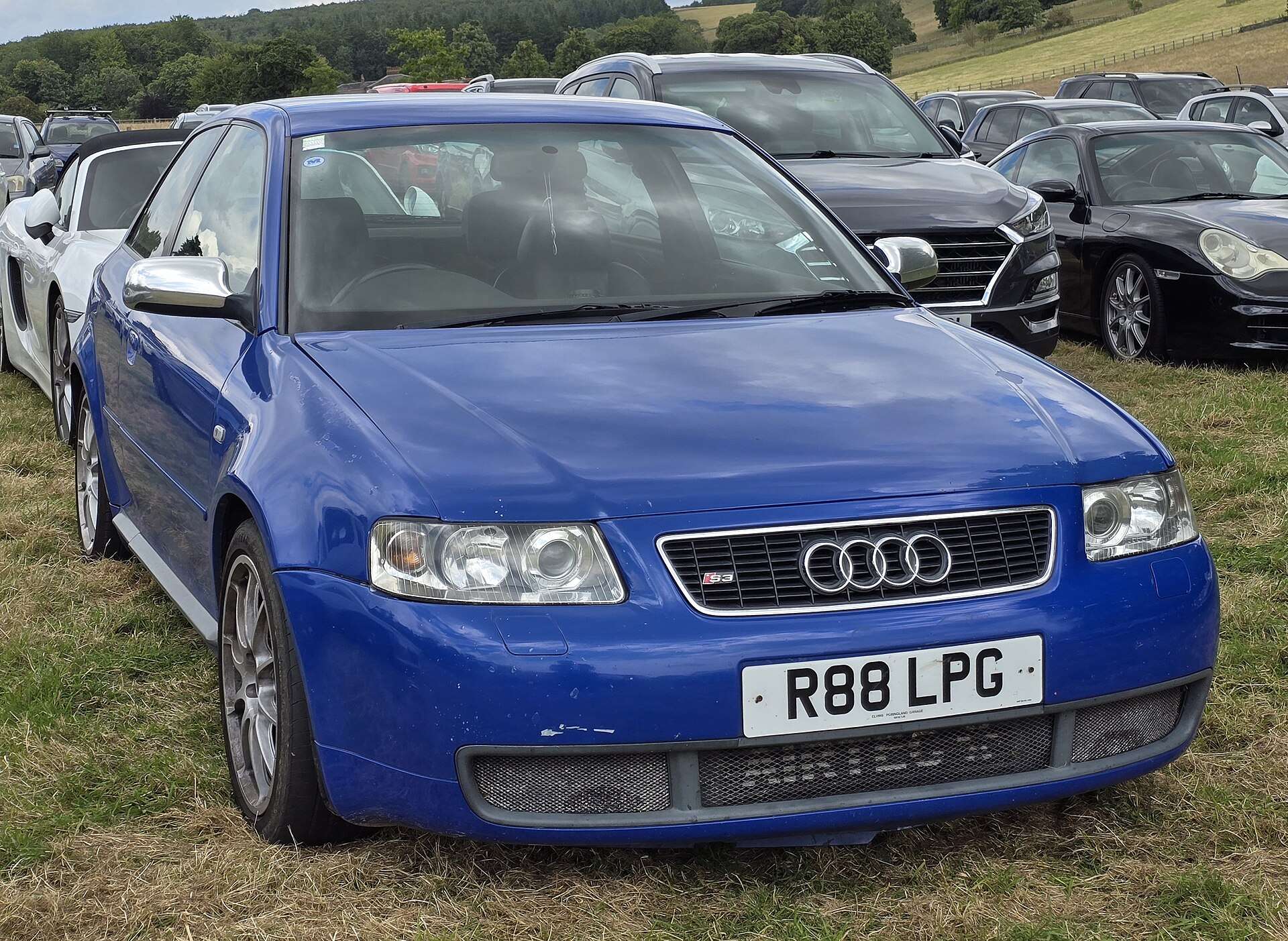
The original Audi S3 packages turbocharged performance and four-wheel-drive traction in a compact, discreet three-door body. It can be a satisfying modern classic, provided the purchase is based on the condition of the whole car. A freshly polished engine cover, an S3 badge and a claimed remap do not establish the health of the oil system, timing drive or Haldex coupling. This guide covers the 1999–2003 8L-generation 1.8T; later 2.0-litre S3s need a different assessment.
Our buying verdict
Choose a genuine, structurally sound 8L with convincing oil-service records, a complete timing-belt invoice and separately documented Haldex maintenance. Require a cold start, warm road test and an inspection by a specialist who knows the older 1.8T. A tidy, well maintained 210 can be a better purchase than a tired 225. If oil pressure, identity or structural repairs remain unexplained, resolve them before buying rather than relying on a discount.

Versions and specifications: 210 or 225?
Audi’s own UK archive identifies the original S3 as a 1.8-litre turbocharged model with 210PS, later 225PS, sold from 1999 to 2003. These are metric PS figures, not an invitation to copy the same numbers as bhp. The modest difference in factory output is less important to most purchases than body condition, maintenance and how the car has been altered since new.
Establish engine and build identity from the vehicle’s original data and invoices, particularly if an engine, turbo or ECU has been changed. Registration year, facelift appearance and seller shorthand do not reliably identify every component. Cars can have later lamps, replacement bumpers or a different engine, and an older remap may have been applied to hardware which is no longer installed.
| Choice | Why buyers consider it | What matters before purchase |
|---|---|---|
| Original 210PS specification | An appealing early S3 without requiring the later output badge | Genuine identity, engine code, timing and oil history, body condition |
| Later 225PS specification | Desirable factory specification for many enthusiasts | Verify build and engine rather than using registration alone |
| Largely standard example | A clearer starting point for road use and originality | Standard appearance is not proof of gentle use or complete maintenance |
| Modified example | May contain useful specialist work | Hardware, calibration, invoices, emissions equipment, insurance and current mechanical condition |
| Later 2.0 S3, S tronic or Sportback | A separate generation and buying decision | Do not transfer DSG, engine or Haldex-generation advice blindly to the original 8L |
The original car’s six-speed manual and Haldex-based quattro arrangement are central to this guide. It is not the same four-wheel-drive layout as every longitudinal-engine Audi, and the quattro badge does not mean there is no rear-drive service requirement. Nor does a specification list establish that the coupling currently works.
Choose your ownership aim before valuing upgrades. A restrained road car, an original collector example and a heavily modified performance project require different standards and budgets. A large turbo, hard mounts and a competition-style clutch may be costly additions but offer little value if you want a quiet weekend road car.
Prices and market evidence
Directly read Car & Classic advertisements on 4 November 2026 included these UK 8L asking examples. Advertised condition descriptions remain seller claims, and mileage and provenance need checking against the physical car and records.
| Advertised example | Displayed mileage | Asking price |
|---|---|---|
| 2003 S3 8L | 147,000 miles | £5,995 |
| 2001 S3 8L | 126,000 miles | £6,000 |
| 2002 S3 8L | 78,200 miles | £7,650 |
| 2003 S3 8L | 93,600 miles | £9,995 |
| 2000 S3 8L advertised as one-owner | 34,000 miles | £24,500 |
These figures are selected asking prices, not completed transactions or a representative national value range. The low-mileage advertisement illustrates how a provenance premium can separate one car from ordinary used examples; it does not establish that the premium will be achieved. Check long-term storage, recommissioning and the evidence behind an ownership claim as carefully as the odometer reading.
The wider S3 results contain later generations, automatic transmissions, different engines and overseas examples. Exclude them when comparing a UK 8L manual. An attractive price on a 2.0-litre later S3 says little about the value of an original 1.8T, and a euro-priced left-hand-drive advertisement is not a direct UK retail comparison.
Build a total-purchase figure including belts, tyres, Haldex servicing, corrosion repairs and diagnosis of any fault. Do not offset a worrying engine symptom against the price of a cheap sensor. A seller who agrees to an independent inspection and provides detailed records gives you a much stronger basis for negotiation than a confident description of “bulletproof” mechanicals.

Rust, identity and accident repairs
Match VIN and registration details, then read the MOT history for mileage progression and repeated corrosion or suspension advisories. Check finance and recorded insurance damage through suitable services. History databases can be useful, but unrecorded repairs and the present condition still require inspection. A newly issued MOT does not certify the engine or Haldex system.
Arrange a lift inspection of sills, jacking points, floor seams, subframes, suspension mounts, brake pipes and the rear underside. Check wheelarch edges, lower doors and the tailgate area. A reputation for corrosion protection does not make a twenty-year-old shell immune, particularly after accidents, poor lifting or previous body repairs.
Ask for photographs of corrosion repairs before fresh coating was applied. Establish whether work involved sound preparation, appropriate metal replacement and protection, rather than a cover over damaged material. Differentiate a replaceable corroded component from a weakened mounting area or shell. A specialist body assessment is preferable to a vague assurance that welding is inexpensive.
Inspect panel gaps and paint in daylight. Look for inconsistent texture, overspray on seals, disturbed fasteners and irregular repairs around structural seams. Check behind accessible boot trim and under the carpet with permission. A repainted bumper is not necessarily a problem, but distorted alignment, unexplained welding or a car which cannot be set up correctly on the road deserves much closer scrutiny.
Examine headlamp condition, bumper fittings, correct trim and wheel damage. Genuine-looking S3 presentation can be costly to restore if parts are missing. On a modified or lowered example, look for ground contact, damaged exhaust sections, strained hoses and poorly supported wiring. A smart stance can hide expensive geometry or underbody problems.
Timing belt, oil pressure, turbo and quattro checks
Timing belt and the rest of the timing system
The 1.8T has a main timing belt, and the engine also contains a short camshaft coupling chain. A belt receipt does not establish that every source of top-end noise has been addressed. Have a specialist identify any unusual noise and distinguish belt-drive components, the camshaft chain/tensioning arrangement and unrelated engine or accessory faults.
Request the full dated belt invoice with mileage. Confirm the belt, tensioning components, rollers, water pump, coolant and associated fasteners as applicable to the exact engine. Check current VIN-specific calendar and mileage requirements with Audi or a specialist using the correct technical information. This guide does not invent a single interval for every 8L or substitute a schedule from a later S3.
Awesome GTI’s ECS 1.8T ultimate timing-kit page displayed a £360.17–£442.67 parts range, with a selectable belt upgrade. The listed contents include belt, tensioning components, water pump, accessory belt, thermostat and housing, mounting bolts and seals. It explicitly excludes coolant. Confirm current tax treatment, the selected option and exact engine compatibility before comparing it with another quote.
That is not a fitted repair price. A package with more components is not automatically necessary for every car, and the supplier’s “ultimate” name is not an independent quality assessment. Ask the workshop to specify the job and ensure that the actual fasteners, coolant and parts suit the vehicle. If the belt history cannot be proved, allow for properly completed work before normal use.
Oil pressure and neglected lubrication
Read the oil-service record for specification, dates, mileage and repairs. Check the level correctly, look for leaks and investigate oil-consumption claims. Oil which looks clean today cannot establish that the engine was maintained correctly for the previous decade. Repeated long gaps, unexplained oil-pressure warnings or a rebuilt turbo without lubrication investigation deserve attention.
Meksta’s own 1.8T engine-rebuilding discussion identifies sludge, a restricted oil pickup and lubrication-related bearing or turbo damage as inspection concerns. It covers the broader engine family, including other installations, so it is context for a specialist assessment rather than a model-specific failure-rate study or an S3 repair procedure.
If an oil-pressure warning appears, stop safely and shut the engine down; arrange diagnosis rather than driving on to see whether it clears. Establish actual pressure with appropriate workshop testing and investigate the cause. A switch, wiring fault, restriction, pump problem or internal wear cannot be distinguished from a seller’s reassurance alone. A new pressure switch does not prove the pressure is healthy.
Ask whether sump or pickup work has been done, why it was needed and what inspection followed. Replacing one part after oil starvation does not automatically repair bearings or a damaged turbo. Similarly, a preventive inspection is different from evidence that an engine has already failed. Judge the records and test findings together, without treating every older 1.8T as condemned.
Cold start, boost leaks and misfires
Arrange a genuinely cold start and observe warning-lamp behaviour, idle, smoke and unusual noises. Repeat the assessment fully warm. Investigate persistent smoke, coolant loss, overheating or substantial oil use. Never open a hot pressurised cooling system. A clean driveway or a recent bottle of coolant is not a diagnosis.
Inspect the cooling system, hoses, flanges and connections for staining or deterioration. Have leaks pressure-tested where appropriate. Check the charge-air and vacuum plumbing, crankcase-breather arrangement and the quality of any replacement pipework. Old rubber, improvised tees and badly supported aftermarket hoses can make fault-finding unnecessarily difficult.
On a lawful warm road test, power should be consistent without repeated hesitation, misfire or warning lights. A boost leak, ignition fault, airflow problem, control issue or fuel fault can produce overlapping symptoms. Ask for a diagnostic scan and suitable live-data or pressure testing before accepting that the cure is “just a coil” or “just a MAF”.
Check turbo condition in the context of the whole engine, including oil supply and return, smoke and operating behaviour. A little mist at a hose joint is not, on its own, proof of a failed turbocharger. An old rolling-road sheet is not proof that the engine currently produces the claimed output safely.
For a tuned car, request the named tuner, calibration, fuel requirement, supporting hardware and dated invoices. Establish what remains fitted now. Generic tuning-stage labels have no universal meaning, and this guide does not publish a supposedly safe power limit for every original engine or rod set. Condition, calibration and usage matter.
Manual gearbox, clutch and flywheel
Try all six gears gently cold and hot, listening for abnormal whine or rumble and noting difficult selection or crunching. Check clutch engagement, slip under normal load, hydraulic operation and vibration. A high bite point is not a measurement of remaining life, and a difficult shift can involve more than a worn clutch disc.
Ask about flywheel conversions, clutch specification and mounts. A very abrupt clutch or additional noise may reflect a deliberate modification which does not suit you. Obtain a full fitted quote covering the required flywheel, hydraulics, seals, fasteners and fluids rather than pricing only an advertised clutch kit.
Inspect driveshaft joints and boots, leaks and the condition of the propshaft and rear driveline through a competent workshop. Interpret vibration and road-speed noise carefully: tyres, wheels, bearings and transmission components can overlap. A seller blaming every vibration on firm suspension is not a substitute for diagnosis.
Haldex Generation 1: service and function
Awesome GTI identifies the S3 8L as a Generation 1 Haldex application. Its workshop recommendation is oil and filter servicing every 20,000 miles, using parts and fluid matched to the generation. Treat that as an attributed preventive recommendation and confirm the correct current vehicle-specific plan, including calendar age, with your specialist.
The Haldex coupling and rear final-drive differential are different lubrication systems. A receipt for rear differential oil does not automatically show that the coupling oil and filter were changed. Likewise, an annual engine service may contain no four-wheel-drive maintenance. Ask for the itemised invoice and the actual parts fitted.
Inspect for leaks, scan the relevant systems and have rear-drive operation confirmed safely by a specialist. A lack of warning lamps is not proof that the pump, controls and coupling work correctly. Do not provoke wheelspin or unstable behaviour on a public road to demonstrate the system. An oil service is preventive work, not a guaranteed repair for a failed pump or control fault.
Suspension, brakes and tyres
Inspect springs, dampers, bushes, joints, mounts and steering components, then read tyre wear as part of the same assessment. Suitable matching tyres, straight wheels and correct alignment are especially valuable on a car bought for its all-weather composure. Four-wheel drive does not compensate for old or inappropriate rubber.
Check discs on both faces, pad wear, caliper function, brake hoses, fluid and the parking brake. A pull, vibration or noise needs investigation. On upgraded brakes, verify the complete installation, component specification and availability of replacement consumables. A large caliper does not automatically indicate a well balanced or well maintained system.

Interior and electrical checks
Test the seat adjustment, bolsters, frames, heating where fitted and seatbelts. Inspect the instrument display for missing information and confirm normal airbag, ABS and engine-warning behaviour from ignition-on to running. A lamp that never illuminates can be as concerning as one that stays on. Investigate alterations to safety-system wiring.
Run the climate control, blower and air conditioning, checking both temperature control and airflow. Test windows, mirrors, locking, both keys, wipers, lamps, audio and displays. Small faults accumulate, and an older premium-car cabin can take time to restore properly. An assertion that a display or lock is a simple repair needs a diagnosis and price.
Look for damp under mats and in the boot, and inspect any aftermarket alarm or stereo wiring. Electrical faults alongside water ingress should not be priced independently before their cause is found. Ask whether modules have been repaired or replaced and whether coding or key matching was completed correctly.
Check that your driving position, rear access and luggage needs suit the three-door body. Unusual seats, lowered suspension and a loud exhaust can change the everyday experience considerably. A short test on smooth roads is not enough to decide whether a heavily modified example suits normal use.
Maintenance costs and useful parts
Affiliate disclosure: This guide contains eBay affiliate links. We may earn a commission from qualifying purchases. These links open relevant searches, not vetted products or guaranteed fitments. Match VIN, engine, gearbox, original part numbers and modifications before ordering; availability and prices change.
The checked £360.17–£442.67 ECS timing-kit range is a supplier parts display with a selectable upgrade, not a complete installed job; tax, delivery, final selection and fitment need confirmation. Coolant is expressly excluded. The relevant search is S3 8L timing-belt and water-pump kits on eBay.
No directly verified current all-inclusive S3 belt or major repair quote was available in the sources used here. Obtain a written estimate showing inspection, labour, VAT, fluids and required extra parts. The maintenance table below is a buying and budgeting checklist rather than a claim that every listed part needs replacement.
| Item | What to check before spending | Relevant eBay search |
|---|---|---|
| Timing-belt system | Verify engine code, complete scope, pump, coolant and correct fasteners | Timing-belt system searches |
| Camshaft-chain parts | Diagnose noise; a main belt change does not prove this system was repaired | Camshaft-chain parts searches |
| Alternator | Test battery, charging, wiring and belt drive before ordering | Alternator searches |
| Oil-service parts | Use the correct approved oil and retain dated mileage records | Oil-service parts searches |
| Oil pickup and pump | Buy only after lubrication-system assessment; a warning is not a parts diagnosis | Oil pickup and pump searches |
| Ignition components | Read faults and diagnose misfire before replacing plugs or coils | Ignition components searches |
| Haldex Gen 1 | Correct coupling oil/filter; separate from final-drive lubricant | Haldex Gen 1 searches |
| Clutch and flywheel | Check transmission application, hydraulics, bolts, seals and labour | Clutch and flywheel searches |
| Cooling and breather parts | Locate the failed hose, flange or valve and match the installed engine | Cooling and breather parts searches |
| Brake and suspension parts | Match actual standard or upgraded system and assess wear first | Brake and suspension parts searches |
Turn the inspection into a service plan
Ask for an itemised quotation showing parts, labour, VAT, fluids, diagnostic work and any refundable exchange surcharge. A complete fitted job and a parts-only listing answer different questions. Establish which associated seals, fasteners, tensioners or alignment work are included, and agree how the garage will handle additional faults found during dismantling. Confirm whether it will fit customer-supplied parts and what warranty applies.
Prioritise safety, overdue scheduled maintenance and defects that could cause further damage. Start a dated record at purchase, with mileage, component specifications and invoices. Cosmetic changes can wait until the car has a trustworthy mechanical baseline. Service stamps are useful, but an invoice explaining the actual work carries more information than a tick in a book.

Hidden ownership costs
The first-year budget needs more than purchase price and an oil change. Price the work identified on this particular car before agreeing a deal. Keep immediate repairs, recurring running costs and discretionary improvements separate; do not treat an unspent repair reserve as permission to ignore a fault.
- Lubrication aftermath: replacing a pickup or pressure switch does not establish that previous oil starvation left no internal damage. Diagnosis can matter more than the small component price.
- Several service systems: engine oil, timing belt, camshaft-chain condition, Haldex and final drive need distinct evidence and may need attention together.
- Age-related rubber: cooling, vacuum, boost and breather hoses can create a series of smaller leaks after one obvious fault has been repaired.
- Original trim: seats, lamps, bumpers and correct interior finishes can make a complete car preferable to an inexpensive restoration project.
- Modified-car compromises: returning suspension, exhaust, clutch or safety equipment to a suitable road specification can consume the apparent saving.
- Collection and diagnosis: an oil-pressure warning, overheating or serious drivetrain fault may require recovery. Budget for safe transport and independent assessment.
Obtain insurance quotations using the registration and declare modifications, including software changes. Check the actual vehicle’s tax and local emissions-zone treatment through the relevant official services rather than assuming every version is identical. Include storage, recovery or transport if specialist repairs will take the car off the road. An inexpensive used component is not a saving if its condition is unknown and you must pay the labour twice.
Viewing and test-drive checklist
Before travelling
Request registration, VIN details, ownership history, service invoices and photographs of the underside. Read the MOT history for repeated advisories, mileage inconsistencies and long gaps in use. Confirm that the engine will be cold and that a lift inspection and sensible test drive are permitted. Ask directly about accident repairs, overheating and modifications, then compare the answers with the records.
- Before travelling, request VIN, engine and gearbox information, timing invoice, oil history, Haldex records and all modifications. Check MOT chronology and obtain insurance.
- Inspect cold in daylight. Match identity and records, examine paint repairs, trim and water ingress, and inspect the underside on a lift.
- Observe cold and warm running, warning lamps, timing noises, fluids and smoke. Have any oil-pressure concern tested properly before further use.
- Road-test warm at legal speeds, checking consistent boost, misfire, clutch, all gears, steering, vibration and brakes. Read faults alongside symptoms.
- Inspect Gen 1 Haldex service evidence and confirm rear-drive function safely. Do not confuse differential oil with coupling oil/filter work.
- Check tyre condition and matching specification, wheel damage, suspension wear and geometry. Test all fitted cabin equipment and both keys.
- Price required work in writing with labour, tax and full parts scope. Proceed when condition and records agree; investigate unresolved major symptoms and reject concealed identity or serious unexplained structural problems.
Make the decision from evidence
Proceed when identity and history are consistent, the structure and major systems pass inspection and immediate work has been priced. Investigate an isolated, diagnosable issue with a written repair scope and enough budget. Walk away from unexplained identity conflicts, unsafe structural repairs, overheating, serious unresolved engine symptoms or a seller who refuses reasonable inspection. There will be another car; a cheap asking price does not put a ceiling on repair costs.
Buying questions answered
Is the 225PS S3 always the better buy?
No. Verify the factory specification and present engine identity, then compare condition and history. A sound, well maintained 210PS car can be a better purchase than a neglected later example.
Does the S3 8L use a timing belt or chain?
It has a main timing belt and a short camshaft coupling chain. A belt-service invoice does not prove the camshaft-chain system is healthy. Confirm the correct service requirements and diagnose noises for the exact engine.
What should I do about an oil-pressure warning?
Stop safely and shut the engine down, then arrange proper pressure testing and diagnosis. Do not keep driving or assume a new switch will resolve it. Lubrication restrictions, pump faults and internal wear require different repairs.
Does quattro servicing mean rear differential oil only?
No. The 8L uses a Gen 1 Haldex coupling with its own oil/filter maintenance, separate from the rear final drive. Look for itemised invoices and have operation confirmed safely.
How much should I budget for a timing-belt change?
The checked ECS kit displayed £360.17–£442.67 for parts depending on selection, explicitly excluding coolant. That is not a fitted quote. Confirm fitment, VAT, delivery and an itemised workshop price for the complete job.
Sources and research method
Independently written desk research by Unusual Cars UK, checked on 4 November 2026. We have not inspected or road-tested the illustrated cars or authenticated sellers’ claims. Recommendations and inspection priorities are editorial assessments. Prices below are dated evidence, not guaranteed quotations or predictions of appreciation.
- Audi UK archive: S3 from 1999 to 2003 — Primary manufacturer evidence for the original 1.8 turbo model and 210/225PS distinction.
- Awesome GTI: ECS 1.8T timing-belt kit — Dated supplier price range, listed contents, option and coolant exclusion; no installed price or blanket fitment claimed.
- Awesome GTI: Haldex servicing — Gen 1 S3 8L application, separate final-drive lubrication and attributed workshop service recommendation.
- Meksta: 1.8T 20v engine rebuilding — Primary engine-rebuilder discussion used for lubrication and pickup concerns. Broader engine-family context; overseas labour prices, torque tables and tuning claims are not used as S3 instructions or UK cost evidence.
- Car & Classic: Audi S3 advertisements — Directly read dated UK 8L asking examples; later generations, overseas cars and unchecked sale-summary cards excluded.
- GOV.UK used-car checks and MOT history — verify documents, identity and test records.
Images illustrate the model and buying themes; they are not the advertised cars discussed in the price section. Credits and licence links accompany each image. No endorsement by a photographer, owner, manufacturer or specialist is implied. Confirm workshop information against the actual vehicle.
Compare alternatives in the Buying Guides hub.