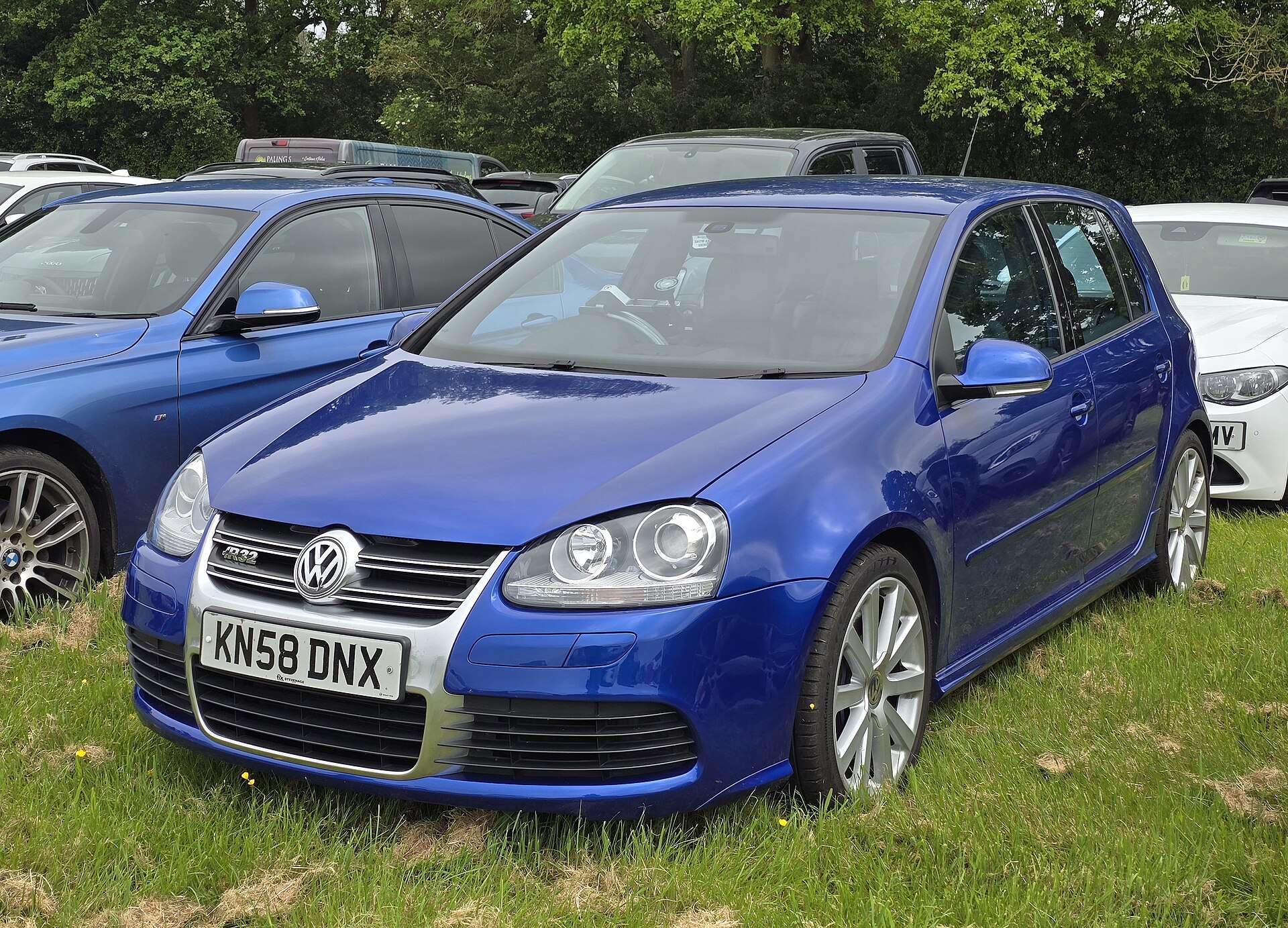
The Mk5 Golf R32 offers something increasingly unusual: a naturally aspirated six-cylinder engine in a usable hatchback, with four-wheel drive and a choice of manual or DSG transmission. The appeal is its character and completeness rather than a cheap route to a big turbo power figure. Buying one demands a similarly complete inspection. Timing chains, the gearbox and the Haldex coupling are separate systems, each with its own evidence to check.
Our buying verdict
Buy on body condition, original identity and documented maintenance across the whole drivetrain. A properly assessed higher-mileage car can make more sense than a low-mileage example with unexplained chain noise and no Haldex invoices. Choose manual or DSG for the way you will use the car, then inspect that gearbox properly. Leave room in the budget for tyres, servicing and diagnosis; the R32 badge does not make twenty-year-old components new.

Versions and specifications: manual or DSG?
Volkswagen’s September 2005 UK release describes a 3.2-litre narrow-angle V6 producing 250PS and Haldex-based 4MOTION four-wheel drive. The narrow-angle engine is commonly called a VR6. It is not the later turbocharged four-cylinder Golf R, and it is not the earlier Mk4 R32. Both three- and five-door bodies, with manual or DSG gearboxes, appear in the UK launch specification.
The factory release also lists bi-xenon headlamps, dual-zone climate control, sports suspension, 18-inch wheels and sports seats, with racing-style Recaro buckets offered as an option. Optional seats can be desirable, but do not assume that every R32 should have them or that a seat swap authenticates the vehicle. Check the original build information, not just an equipment list copied into an advertisement.
| Version | Why it appeals | Main purchase checks |
|---|---|---|
| Six-speed manual | Direct driver involvement and a simpler shifting interface | Clutch, flywheel, hydraulics, synchro behaviour, bearings and leaks |
| Six-speed DSG | Easy daily use and rapid automated shifts | Correct servicing, cold and hot behaviour, fault scan, clutch and control-system diagnosis |
| Three-door | A distinctive shape and broad enthusiast appeal | Door access, seat mechanisms, body condition and originality |
| Five-door | Better rear access without losing the core drivetrain | The same mechanical checks; do not assume practical use means gentle use |
| Turbocharged or supercharged conversion | Potentially substantial specialist performance | Engineering documentation, engine/transmission condition, legal equipment and insurance; separate from a standard-car valuation |
A manual is not automatically inexpensive to maintain, and a DSG is not automatically a bad purchase. An overdue clutch and flywheel can be substantial work; a well maintained DSG can suit a buyer very well. Start with your intended use, then compare cars with equally convincing histories. Do not let a preference for a particular gearbox excuse rust or missing drivetrain records.
Check VIN, engine and gearbox identity where appropriate, especially on a modified car. R32 bumpers, central exhaust exits and badges can be fitted to other Golfs. Replacement engines or gearboxes need dated invoices and a credible specification trail. An interesting conversion should be valued as that conversion, not described as an untouched original.
Prices and market evidence
Car & Classic advertisements directly read on 4 November 2026 included the following UK asking examples. These are selected listings, not completed sales, an inspection report or a representative valuation survey.
| Advertised example | Displayed mileage | Asking price |
|---|---|---|
| 2008 Mk5 R32 automatic | 122,000 miles | £6,995 |
| 2006 Mk5 R32 automatic | 96,800 miles | £7,749 |
| 2007 Mk5 R32 DSG five-door | 89,000 miles | £8,995 |
| 2006 R32 three-door manual | 75,000 miles | £12,995 |
| 2007 R32 manual | 48,000 miles | £19,990 |
The results also contained Mk4 cars, overseas vehicles priced in euros, unusually low-mileage examples and an active auction showing a current bid. Those should not be combined as if they were ordinary Mk5 UK sale prices. In particular, a live auction bid is not a completed transaction or a dealer asking price. The spread above shows why gearbox, mileage, provenance and condition must be compared together.
Before agreeing a price, assemble current comparables and add due work to each asking figure. A cheaper car with undocumented chains, no Haldex servicing and four poor tyres can be more expensive to make dependable than a better maintained example. Conversely, a premium advertisement does not establish that the mechanical work has been completed correctly.
If originality or low mileage drives a large premium, commission an independent inspection and verify the complete history. Compare wear on the seats, steering wheel, pedals and body with the recorded mileage. Long periods off the road can leave corrosion, aged fluids, flat-spotted tyres and seized brakes even where the odometer reading is attractive.

Rust, identity and bodywork
Read the MOT history for repeated corrosion, tyre, spring and brake-pipe advisories. Then inspect the actual metal on a lift. Check sills, jacking points, subframes, suspension mounts, floor seams, brake pipes and the rear underside. Establish whether corrosion involves a serviceable component or the structure of the shell. New paint or coating needs an explanation, particularly if it coincides with disappearing advisories.
Inspect front wings and wheelarch edges, door bottoms, the tailgate and areas around external trim. Check beneath accessible boot trim for moisture and evidence of accident repairs. A clean upper body does not mean the subframes and mounting areas are equally sound. Ask for photographs of properly completed repairs rather than accepting a receipt for an unspecified welding job.
Look along both sides in daylight for ripples, colour differences and inconsistent gaps. Examine disturbed fasteners, overspray, repaired seams and the fit of lamps and bumpers. R32-specific trim can make a minor accident expensive to finish correctly. A cosmetic repair need not rule out a car, but unexplained structural work or persistent alignment trouble needs specialist assessment.
Check wheel condition inside as well as outside. Four tyres should be appropriate, with sensible matching specifications and similar wear; assess suitability for the four-wheel-drive system with a specialist rather than guessing an acceptable mismatch. Severe inner-edge wear, different ride heights or a steering wheel that sits off-centre can point to unresolved suspension or geometry issues.
For lowered cars, establish the springs, dampers, alignment and clearance. An attractive stance is not evidence of a good road setup. Scraped exhaust parts, crushed jacking points and repeated underbody impacts can add repair work even where the car drives acceptably on a short test.
Timing chains, DSG and Haldex problems
Timing chains: condition matters more than a magic mileage
The R32 uses timing chains rather than a routine cambelt. That does not make the timing system maintenance-free for life. Vagtech’s first-hand 3.2 V6 repair information describes chain wear, noises, camshaft/crankshaft correlation faults and cases involving worn sprockets. It reports seeing problems on both low-mileage well-kept cars and higher-mileage examples. There is no defensible universal mileage at which every chain fails.
Insist on a cold start. Listen before background noise or a warm engine makes assessment harder, and have unexplained rattling investigated. Read fault codes and use appropriate diagnostic data interpreted by a specialist. A short recording, an isolated adaptation number or an extinguished warning light should not be treated as a complete certificate of chain health.
Ask the inspector to assess the full timing system and related causes, not merely approve the cheapest chain kit found online. Vagtech recommends upper and lower chains, sprockets, guides and associated parts for its repair work, with camshaft adjusters assessed separately because they can add significant cost. That is one experienced workshop’s repair approach, not evidence that every R32 requires all those parts immediately.
Access and labour make the completed job very different from the price of a box of chains. Obtain an itemised vehicle-specific quote covering diagnosis, dismantling, chains, guides, tensioning parts, seals, fluids and any additional worn components. No directly verified current fitted chain price was published on the checked workshop page, so this guide does not invent a nationwide figure.
Oil, cooling, misfires and exhaust condition
Read oil-service records for the correct specification, dates and mileage. Check level and leaks, then look for coolant staining, deteriorated hoses and evidence of overheating. A pressure test and proper investigation are more useful than repeatedly topping up an unexplained loss. Never open a hot pressurised cooling system.
Observe idle and normal warm running. A misfire can involve ignition, fuelling, air leaks, wiring or engine condition; “just a coil” remains unproven without diagnosis. Scan engine faults and assess warning-lamp behaviour. Investigate unexplained code clearing or a seller who will not allow the car to be tested from cold.
Inspect the exhaust, catalysts, hangers and any non-standard system. A louder car is not necessarily a healthier one, and returning missing emissions equipment to an acceptable road specification can be expensive. Confirm the legality and insurance implications of modifications for your intended use rather than relying on the fact that a previous MOT was passed.
DSG: test cold, hot and at low speed
The Mk5 R32’s six-speed wet-clutch DSG needs the correct servicing. Awesome GTI identifies the DQ250 family as typically on a 40,000-mile service schedule. Verify the exact gearbox, current vehicle-specific requirements and invoice scope, including suitable fluid and filter. An engine oil-service stamp does not establish that the DSG was serviced at the same visit.
Try reverse engagement, gentle pull-away, low-speed manoeuvring, normal upshifts and downshifts, and manual selection where appropriate. Repeat once fully hot. Persistent delay, shuddering, harsh engagement, warning indications or loss of drive warrants specialist diagnosis. A seller calling every problem an adaptation issue is not enough.
A service is preventive maintenance, not a guaranteed cure for a worn clutch pack, control-system fault or internal mechanical damage. Have gearbox fault codes read and interpret them alongside the symptoms and history. Quotes should identify what will actually be repaired and what warranty applies. Do not transfer a fluid, quantity or service procedure from a different DSG family.
Manual gearbox, clutch and flywheel
On a manual, check all gears cold and hot, listening for abnormal bearing noise and noting crunching or a reluctance to select. Do not force the lever to produce a demonstration. Assess clutch engagement, slip under normal load, hydraulic operation and vibration, distinguishing flywheel or mount symptoms from unrelated engine running faults.
Check whether a non-standard clutch or flywheel has been fitted and whether the result suits you. An abrupt pedal, extra noise or harsh low-speed behaviour can be an intentional compromise rather than a benefit. Ask for component details and a fitted quote for any remedial work before using “manual simplicity” to dismiss a substantial bill.
Haldex coupling: separate from the rear differential
Awesome GTI and PSC both identify the Golf Mk5 R32 as a Generation 2 Haldex application. The coupling and rear final-drive differential are related physically but use different lubrication systems. A receipt for “rear diff oil” does not necessarily prove that the Haldex coupling oil and filter were renewed, and a DSG oil change does not service either rear component.
The checked specialists give their own preventive schedules: Awesome recommends Haldex oil and filter every 20,000 miles, while PSC’s page describes oil at 20,000 and filter at 40,000 miles. These are attributed workshop recommendations, not a single quoted factory schedule. Agree the appropriate calendar and mileage plan for the actual Gen 2 installation with your specialist and verify current manufacturer requirements.
Inspect for leaks and scan the four-wheel-drive system. Ask a specialist to confirm rear-drive operation through an appropriate safe test. Absence of a dashboard warning is not proof that the coupling and pump work correctly. Do not attempt a public-road wheelspin test or deliberately provoke instability as a diagnostic shortcut.
PSC’s shared Haldex service page displayed £84.50, but covers several generations and configurations. Treat that as a displayed starting example requiring confirmation of Gen 2 scope, filter, labour and VAT, not a promised final R32 invoice. If rear drive is already absent, diagnosis and possible pump or control repairs are separate from an oil-and-filter service.

Interior and electrics
Test climate control on both sides, blower speeds, heated seats if fitted, windows, mirrors, locking and both keys. Check the bi-xenon lighting, levelling behaviour and washers as applicable to the car’s equipment. Damaged or malfunctioning lamps can be costly, so do not count every dashboard electrical complaint as a minor convenience fault.
Inspect seat bolsters, frames, adjustment, belt operation and warning lamps. If aftermarket seats or steering parts are installed, establish that the safety systems remain properly configured. An airbag light that never illuminates at ignition-on is a reason to investigate, not reassurance.
Check carpets, boot floor and accessible recesses for damp. Water and intermittent electrical faults deserve diagnosis before purchase. Test the rear wiper, boot release, stereo and displays, then inspect the quality of aftermarket alarm, audio or gauge wiring. A specialist scan across the relevant modules can reveal more than an engine-only code reader.
Use the cabin to decide whether the body style suits your actual life. Three-door rear access and optional bucket seats can be awkward for some owners. A usable car with complete trim and a quiet, working climate system can be worth more to you than an ostensibly rarer example requiring weeks of parts hunting.
Maintenance costs and useful parts
Affiliate disclosure: This guide contains eBay affiliate links. We may earn a commission from qualifying purchases. These links open relevant searches, not vetted products or guaranteed fitments. Match VIN, engine, gearbox, original part numbers and modifications before ordering; availability and prices change.
Budget for engine service, DSG service where fitted, and Gen 2 Haldex service as distinct entries. The checked pages provide service information but not enough confirmed vehicle-specific fitted prices to manufacture a complete annual budget. Ask for a quote itemising VAT, labour, fluids, filters, diagnostic work and any additional parts. PSC’s £84.50 shared Haldex display needs exact R32 applicability and tax confirmation.
For timing components, compare R32 timing-chain kits on eBay, then have the workshop specify what the individual engine needs. A kit listing is not a replacement for diagnosis, a fitting procedure or a labour estimate. Alternators, filters and brakes should likewise be matched to VIN and component numbers.
| Item | What to check before spending | Relevant eBay search |
|---|---|---|
| Timing-system parts | Chains, guides, tensioners and associated components after diagnosis; not a routine belt kit | Timing-system parts searches |
| Alternator | Check battery, charging output, wiring and exact application first | Alternator searches |
| Engine service | Use appropriate approved oil, filters and documented intervals | Engine service searches |
| Ignition components | Diagnose the misfire and confirm plug and coil application | Ignition components searches |
| DSG servicing | Match the six-speed gearbox and required fluid/filter; follow the workshop procedure | DSG servicing searches |
| Haldex servicing | Gen 2 coupling oil/filter, distinct from rear final-drive oil | Haldex servicing searches |
| Manual clutch parts | Check flywheel, hydraulics, bolts and labour in the full quote | Manual clutch parts searches |
| Brakes | Use the actual R32 brake application, inspect calipers and fluid | Brakes searches |
| Cooling parts | Confirm the leak, thermostat or pump fault before ordering | Cooling parts searches |
Turn the inspection into a service plan
Ask for an itemised quotation showing parts, labour, VAT, fluids, diagnostic work and any refundable exchange surcharge. A complete fitted job and a parts-only listing answer different questions. Establish which associated seals, fasteners, tensioners or alignment work are included, and agree how the garage will handle additional faults found during dismantling. Confirm whether it will fit customer-supplied parts and what warranty applies.
Prioritise safety, overdue scheduled maintenance and defects that could cause further damage. Start a dated record at purchase, with mileage, component specifications and invoices. Cosmetic changes can wait until the car has a trustworthy mechanical baseline. Service stamps are useful, but an invoice explaining the actual work carries more information than a tick in a book.

Hidden ownership costs
The first-year budget needs more than purchase price and an oil change. Price the work identified on this particular car before agreeing a deal. Keep immediate repairs, recurring running costs and discretionary improvements separate; do not treat an unspent repair reserve as permission to ignore a fault.
- Multiple fluid systems: engine, DSG, Haldex and final drive are not interchangeable service descriptions. Catch-up work can arrive together.
- Timing-system labour: access, seals and related worn components can dominate a chain job. An online kit price is not the repair budget.
- Tax and fuel: check the exact registration’s current vehicle-tax liability and your own realistic fuel use; year and registration details matter.
- Tyres and geometry: appropriate matching tyres, straight wheels and suspension repairs are part of maintaining the four-wheel-drive package.
- Special interior and lighting: optional seats, correct trim and bi-xenon components can make a tidy original car preferable to a cosmetically cheap project.
- Modified-car reversals: restoring the exhaust, emissions equipment, suspension or forced-induction conversion can consume a substantial budget.
Obtain insurance quotations using the registration and declare modifications, including software changes. Check the actual vehicle’s tax and local emissions-zone treatment through the relevant official services rather than assuming every version is identical. Include storage, recovery or transport if specialist repairs will take the car off the road. An inexpensive used component is not a saving if its condition is unknown and you must pay the labour twice.
Viewing and test-drive checklist
Before travelling
Request registration, VIN details, ownership history, service invoices and photographs of the underside. Read the MOT history for repeated advisories, mileage inconsistencies and long gaps in use. Confirm that the engine will be cold and that a lift inspection and sensible test drive are permitted. Ask directly about accident repairs, overheating and modifications, then compare the answers with the records.
- Before travelling, obtain VIN, gearbox identity, engine-service invoices, DSG records if applicable, and separate Haldex documentation. Check MOT history and insurance.
- Inspect cold in daylight. Match identity, check body repairs and corrosion, then assess the underside on a lift.
- Observe cold-start timing noises, idle, warning lights, fluids and coolant condition. Have correlation faults or unexplained rattles assessed by an R32 specialist.
- Test the selected gearbox cold and fully warm. On DSG include gentle manoeuvring and reverse; on manual assess shifts, clutch and flywheel symptoms.
- Inspect and scan the Haldex system; ask for safe confirmation of rear-drive operation. Separate coupling service evidence from differential oil receipts.
- Check tyres, suspension, brakes and steering together, then test all cabin equipment and both keys.
- Obtain itemised fitted quotes for due work and any fault. Proceed on clear evidence, investigate unresolved symptoms, and walk away from concealed identity, serious structural concerns or denied inspection.
Make the decision from evidence
Proceed when identity and history are consistent, the structure and major systems pass inspection and immediate work has been priced. Investigate an isolated, diagnosable issue with a written repair scope and enough budget. Walk away from unexplained identity conflicts, unsafe structural repairs, overheating, serious unresolved engine symptoms or a seller who refuses reasonable inspection. There will be another car; a cheap asking price does not put a ceiling on repair costs.
Buying questions answered
Does a Mk5 R32 have a cambelt?
Its engine timing uses chains. Chains and associated parts can still wear and require expensive work. Cold-start assessment, fault diagnosis and history matter more than treating the system as guaranteed for life.
Should I choose manual or DSG?
Choose the driving experience you want, then inspect that gearbox. DSG needs correct fluid/filter servicing and fault assessment; manuals still have clutch, flywheel, hydraulic and internal gearbox costs. Neither choice excuses poor history.
Is Haldex service the same as rear differential oil?
No. The Haldex coupling and rear final drive are separate lubrication systems. Check exactly what the invoice covers. The Mk5 R32 is a Gen 2 application, so later-generation service assumptions should not be copied across blindly.
How often should the DSG be serviced?
Awesome GTI identifies the DQ250 family as typically requiring service every 40,000 miles. Confirm the exact gearbox and current manufacturer requirements with a specialist, and look for invoices showing the correct fluid and filter.
What is a Mk5 R32 worth?
Checked UK asking examples ranged widely with mileage, gearbox and presentation. They are not completed sales or a universal valuation. Compare like-for-like current cars and add the cost of immediately due work before deciding what an individual example is worth to you.
Sources and research method
Independently written desk research by Unusual Cars UK, checked on 4 November 2026. We have not inspected or road-tested the illustrated cars or authenticated sellers’ claims. Recommendations and inspection priorities are editorial assessments. Prices below are dated evidence, not guaranteed quotations or predictions of appreciation.
- Volkswagen UK: pricing and specification confirmed for Golf R32, September 2005 — Primary manufacturer specification for 250PS narrow-angle V6, Haldex, body styles, gearboxes and equipment.
- Vagtech: 3.2 V6 timing-chain replacement — First-hand workshop discussion of correlation faults, noises, sprockets and repair scope; no current fitted price assumed.
- Awesome GTI: Haldex servicing — Gen 2 application, separate final-drive lubrication and attributed preventive recommendation.
- Awesome GTI: DSG transmission service — DQ250 service discussion; different gearbox families and schedules distinguished.
- PSC Autocentre: Haldex oil and filter service — Shared £84.50 display, Gen 2 applicability and separate coupling/final-drive explanation; exact scope and tax to be confirmed.
- Car & Classic: Golf R32 advertisements — Dated UK Mk5 asking examples; Mk4, overseas and live-auction results excluded from like-for-like comparisons.
- GOV.UK used-car checks and MOT history — verify documents, identity and test records.
Images illustrate the model and buying themes; they are not the advertised cars discussed in the price section. Credits and licence links accompany each image. No endorsement by a photographer, owner, manufacturer or specialist is implied. Confirm workshop information against the actual vehicle.
Compare alternatives in the Buying Guides hub.