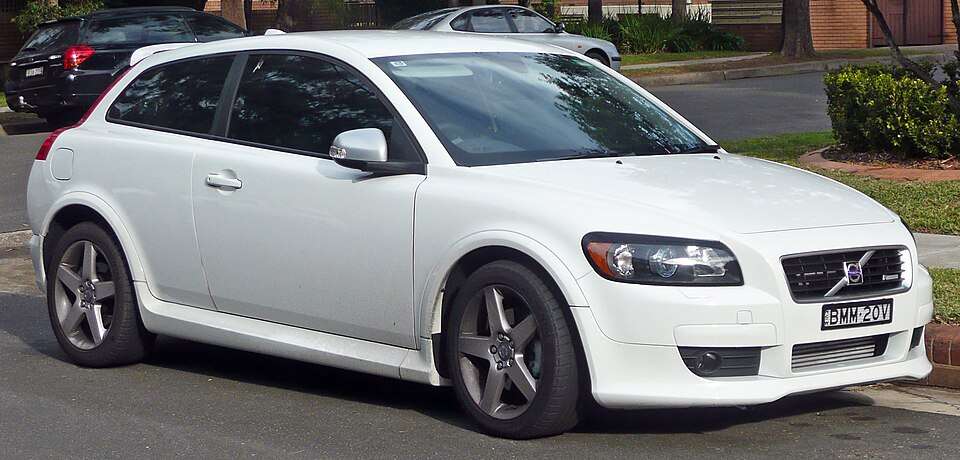
The Volvo C30 T5 is a compact four-seater with a turbocharged five-cylinder engine and a glass tailgate that still looks distinctive. It suits someone who wants performance with a quieter visual presence than many hot hatches. Its used price can disguise the expense of neglected belts, cooling, crankcase ventilation or an automatic gearbox. This guide focuses on the petrol T5, rather than mixing in the very different diesel and four-cylinder C30 maintenance requirements.
Our buying verdict
Start with a standard or carefully documented T5 whose timing-belt history, cooling system and gearbox can be independently checked. The manual suits an involved drive; Geartronic can make a relaxed everyday car if its operation and maintenance are sound. Buy the best condition and documentation you can afford, then choose trim and facelift appearance. R-Design badges and claimed tuning power should never outrank a dry cabin and a healthy engine.

Which Volvo C30 T5 should you buy?
The C30 went on sale in the UK in 2007, with later styling and equipment changes during its production life. The T5 uses a 2,521cc turbocharged five-cylinder petrol engine driving the front wheels. At launch Volvo quoted 220PS and 320Nm, with a six-speed manual as standard or an optional five-speed Geartronic automatic. These period figures should not be confused with US horsepower figures or later model-year specifications.
| Choice | Why consider it | What to verify |
|---|---|---|
| Early T5 | Original nose and often a lower entry price | Engine identity, belt dates, age-related cooling and suspension work. |
| Later / facelift T5 | Revised appearance and different equipment combinations | Actual build specification; later registration is not proof of better maintenance. |
| Six-speed manual | Direct control and a simpler buying proposition to assess on a test drive | Clutch, dual-mass flywheel, selection and driveshaft behaviour. |
| Five-speed Geartronic | Relaxed automatic driving with manual selection available | Cold and hot shift quality, fluid history and specialist diagnosis of any flare or shunt. |
| Sport / R-Design appearance | Body styling and wheel choices can make it more desirable | Factory build record, ride comfort and condition of expensive trim pieces. |
R-Design is not a unique engine specification across every C30. Four-cylinder and diesel cars can carry similar styling, so search results for “C30 R-Design” are not T5 market evidence. Confirm displacement, fuel type and the actual engine before comparing values or buying parts. Likewise, the T5 Geartronic is not the Powershift gearbox fitted to some other Volvo combinations.
Treat Polestar claims and aftermarket remaps as paperwork questions. Ask who supplied the software, which hardware was changed, whether the insurer knows and whether invoices remain with the car. A blue badge, a printed power figure or a seller’s statement that it is “the same as a Focus” does not establish engine health, compatibility or an approved specification.
For a road car, sensible wheels, good tyres and functioning climate control can add more everyday value than a large turbo conversion. Sit in both rear seats and try access through the long front doors. This is a four-seat car, not a five-seat family hatchback, and the luggage opening deserves a practical trial with your own typical load.
UK prices: a small T5 sample needs careful interpretation
Research snapshot: 4 November 2026. PistonHeads showed ten petrol C30 adverts on the page checked, but only one was a T5: a 2011 T5 R-Design Geartronic advertised at £7,990 with 83,000 miles. This is an asking price for one seller’s car, not a sold value, a national price range or evidence that all T5s are worth that amount.
The same page included much cheaper four-cylinder petrol cars, which should not be used to suggest that a sound T5 can routinely be bought for their prices. A limited sample is useful evidence of how hard it can be to compare like with like, but it cannot establish demand, sales speed or future appreciation. Broaden your search over time and record genuine T5 examples with the same transmission and comparable history.
Compare the purchase price plus the work required immediately. An overdue belt package, worn tyres and an automatic fault can absorb a tempting discount very quickly. A more expensive car with invoices for correctly completed work can be the better purchase, but a stack of old receipts does not remove the need to assess its current condition.
Ask for the registration and VIN before travelling, read the MOT sequence and obtain insurance terms for the exact car. Check import history and recorded specification when relevant. Agree an inspection arrangement before paying a deposit and have any substantial claimed repair identified in writing. If the seller has already warmed the engine or cannot explain missing belt evidence, pause the valuation until the uncertainty is resolved.
Body, glass tailgate and water-ingress checks
Inspect the bonnet, wings, door gaps, front structure and boot floor for repair evidence, inconsistent paint and disturbed fixings. Long doors are vulnerable to car-park knocks and worn hinges or catches. Check sills, jacking points, arch edges and the underside on a lift; a good-looking plastic bodykit can make it harder to see what sits behind it.
The glass tailgate is a defining feature and a reason to be thorough. Look for chips, damaged edges, poor sealing, a reluctant latch, weak struts and a non-working rear wiper or heated glass. Open and close it repeatedly with the seller, then inspect the surrounding seals and luggage area for dampness. Price a specific replacement or repair before accepting damage to a model-specific glass or trim part.
Check the windscreen perimeter, headlining, front footwells and under the luggage floor for water marks, damp insulation or a musty smell. Where a leak is suspected, ask a specialist to identify the entry point and assess affected wiring and modules. Wet carpets plus intermittent electrical faults should not be dismissed as a minor seal job without investigation.
Inspect headlights, fog lamps, bumper grilles, wheel-arch liners and undertrays. Different bumpers and facelift parts can complicate second-hand sourcing. Confirm that parking sensors and headlamp levelling work where fitted, and check for repaired lamp mountings. A small cosmetic list can become expensive if the correct colour, trim or glass is hard to find.

Five-cylinder engine, timing belt, PCV and gearbox checks
Insist on a cold start and watch the engine settle to idle. Listen for persistent whistles, misfires and unusual mechanical noises, then inspect for oil and coolant leakage before and after a fully warm drive. The five-cylinder character should not be an excuse for rough running. A warning light that has recently been cleared requires diagnosis, including a scan of relevant control modules and a check of emissions readiness where appropriate.
The T5 has a timing belt. Ask for an invoice giving the replacement date, mileage and scope, not merely a handwritten sticker or a seller’s recollection. Have a Volvo specialist confirm the time-and-mileage schedule for the VIN and engine. If evidence is missing or the car is due on either measure, price the work as immediately required. This guide deliberately avoids applying a single diesel or overseas service interval to every UK T5.
A proper belt estimate should identify the belt, tensioner and idler components, the water-pump decision, seals requiring attention, coolant and labour. FCP Euro’s own five-cylinder repair material demonstrates how access, camshaft sealing and related work can expand the task. A belt-only parts price is not the fitted cost of renewing and resealing the system. Incorrect timing work can be far more costly than paying an experienced specialist to do it correctly.
Check the crankcase ventilation system. On the relevant P1 five-cylinder engine the PCV arrangement is integrated with the oil-filter housing. FCP Euro’s repair description identifies whistling, abnormal oil-cap suction and camshaft-seal oil leakage as symptoms worth investigating. These observations are reasons for a proper pressure/ventilation assessment, not a universal diagnosis from a noise alone. An inexpensive diaphragm offered online may not resolve blocked passages, damaged hoses or existing seal damage.
Inspect the coolant reservoir, hose connections, radiator area and evidence of overheating. Ask whether the car loses coolant between services and pressure-test unexplained loss. A modified engine with boost increases, cooling changes or a history of overheating deserves additional investigation. If a seller mentions cylinder-liner work or a “block mod”, request detailed invoices and have a specialist assess the current engine; the phrase alone is neither a health certificate nor proof that every standard T5 needs that work.
Check intake and boost hoses, turbo oil leaks, smoke under appropriate test conditions and whether power delivery is smooth. A fault code does not automatically identify the failed part. Misfires can involve ignition, air leaks, fuel delivery or a more serious mechanical problem, so budget only after diagnosis. Ask for compression or leak-down testing if the inspecting specialist considers the symptoms or tuning history justify it.
For a manual, test all six gears from cold, clutch engagement, reverse and acceleration without abusing the car. Look for slipping, clutch judder and flywheel-related noises. Vibration under load needs driveshaft and mounting checks as well as wheel balance. A clutch-kit allowance does not cover a flywheel, hydraulic problem or labour by default.
For Geartronic, test engagement into drive and reverse, light-throttle upshifts, kickdown and hot operation after a proper drive. Delayed engagement, flare between gears, harsh shifts or transmission warnings need specialist diagnosis. Ask what fluid work was performed and which specification was used. Do not assume that a fluid change will cure a worn gearbox, and do not use a Powershift service quotation for this five-speed automatic.
On a lift, check front arm bushes and joints, rear suspension links, dampers, springs, wheel bearings, brake pipes and caliper operation. Uneven tyre wear or a steering pull needs the cause identified before alignment. Volvo’s launch specification gave the T5 larger front brakes than some basic C30 models, so order by actual brake specification rather than choosing the first generic C30 disc set.
Cabin, electrics and four-seat practicality
The slim centre console and comfortable seating are central to the C30’s appeal. Check every climate-control function, fan speed, air-conditioning output, stereo source and steering-wheel control. Audio equipment and connectivity differ considerably across years and markets. Test your phone rather than assuming that an auxiliary socket or Bluetooth badge provides the functions you want.
Look for broken console trim, worn seat bolsters, failing seat adjustment and a front seat that will not tilt and return properly for rear access. Try both rear positions and their belts. A small family may manage with the layout, but regular rear passengers will have different priorities from an owner who usually drives alone. Confirm that the luggage cover is present and suits how you use the boot.
Test both keys, central locking, mirrors, windows, alarm and all warning-lamp self-checks. Investigate intermittent faults alongside any evidence of moisture. Ask the specialist to use suitable Volvo-capable diagnostics rather than relying exclusively on a basic engine-code reader. Battery or charging problems need a measured diagnosis before replacing an alternator or control module.
During the road test, listen for cabin rattles and suspension knocks on an uneven road, then assess motorway refinement and steering stability at legal speeds. Large wheels and lowered suspension can change the car’s character significantly. Ensure that the actual car still offers the comfortable, discreet everyday performance that attracted you to a C30.

Maintenance costs, timing kits and parts searches
The figures below are editorial planning allowances for parts only, unless a fitted service is explicitly identified. They are not live eBay quotes: brand, specification, availability, delivery and VAT treatment vary. Obtain a registration/VIN-matched written estimate before committing to a repair. Cheap search results can include incompatible parts, deposits or single components rather than a complete kit.
Affiliate disclosure: the parts searches below use our eBay affiliate campaign. We may earn a commission if you buy, at no additional cost to you. Search results are not a recommendation of every seller or product; verify fitment, maker, returns and warranty.
| Maintenance item | Parts allowance / search | What to check |
|---|---|---|
| Timing-belt kit | £90–£190 | Check engine code and included tensioner/idler parts; fitting is extra. |
| Water pump | £50–£110 | Confirm whether included in a belt package and obtain a complete fitted scope. |
| Auxiliary belt and tensioner parts | £50–£140 | A separate belt system; inspect pulleys and condition during servicing. |
| Oil and filter service parts | £50–£95 | Correct oil specification, quantity and filter matter. |
| Five spark plugs | £35–£75 | Do not order a four-cylinder kit; tuning may alter the required specification. |
| Ignition coils | £100–£250 | Check unit versus full-set pricing and diagnose misfires first. |
| Alternator | £140–£290 | Match output, connections and part number; exchange deposits can apply. |
| PCV/oil-filter housing | £100–£230 | Verify the complete assembly, seals and hose condition; diaphragm-only adverts differ. |
| Front discs and pads | £110–£240 | 300mm is the launch T5 specification; confirm the brakes actually fitted. |
| Manual clutch parts | £180–£350 | Flywheel, hydraulics and fitting excluded unless explicitly quoted. |
These are parts planning allowances, not a fixed workshop tariff. Ask for a written Volvo-specialist estimate for belts, transmission work and diagnosis. Identify VAT, coolant, seals, disposal, labour and any related work separately; a cheaper component search is not evidence that the complete repair will be cheap.
Keep a dated maintenance record covering oil and filters, belt work, plugs, brake fluid, coolant assessment and gearbox requirements. Age matters as well as mileage. When buying, distinguish recently serviced from fully caught up: a fresh oil change does not prove that the timing belt, tyres or transmission have received the attention they need.
Hidden ownership costs: more than the engine note
Fuel is a recurring expense that can outweigh an occasional small repair. Volvo’s original T5 figures were laboratory-cycle results, not a promise for a modern commute in an ageing car. Price your annual mileage using a realistic consumption assumption and current fuel costs. Short journeys, traffic, enthusiastic use and tuning can all change the result considerably.
Get an insurance quote before buying, including declared software, exhaust, wheel and suspension changes. Check current road tax using the actual registration and emissions record; gearbox, year and imported specification can matter. Do not copy a diesel C30’s running-cost figure into a T5 budget. A car that looks restrained can still have performance-car insurance and consumable costs.
Model-specific bodykit parts, glass, lamps, trim and audio repairs can cost time as well as money. Some mechanical consumables have broad specialist support, but that does not make every visible C30 part readily interchangeable with another Volvo or Ford. Ask for availability and lead time before discounting a damaged tailgate or missing trim as an easy weekend fix.
A sequence of suspension arms, dampers, tyres and brakes can exceed the apparent cost of one dramatic engine-bay component. Price alignment after suspension work and consider seized fasteners. Keep a repair reserve after purchase and prioritise structural, braking, steering and cooling issues before cosmetic upgrades. A cheap modified example becomes expensive if you first have to establish what parts and software it actually contains.

Volvo C30 T5 viewing checklist
- Verify T5 engine, gearbox, build specification and VIN; separate factory equipment from later badges or conversions.
- Read MOT history and service invoices, with explicit timing-belt date, mileage and component scope.
- Start cold, inspect PCV-related symptoms, scan faults and investigate oil leakage or misfires.
- Check coolant condition and losses, boost plumbing, turbo symptoms and any tuning or engine-repair documentation.
- Drive manual or Geartronic from cold to fully warm; diagnose slipping, flaring, shunts or load-related vibration.
- Inspect underside, suspension, brakes, tyre ages and wheel condition on a lift.
- Test the tailgate, locks, keys, air conditioning and audio; inspect carpets and luggage area for dampness.
- Obtain VIN-matched estimates, insurance terms and a realistic first-year budget before paying a deposit.
Volvo C30 T5 buying questions
Is every C30 R-Design a T5?
No. R-Design appearance and equipment were available with other engines. Confirm petrol fuel type, 2.5-litre five-cylinder engine and the actual specification before comparing prices or ordering maintenance parts.
Does the C30 T5 use a timing belt?
Yes. Obtain dated evidence of the belt work and ask a Volvo specialist to confirm the VIN-specific time-and-mileage requirement. If history is missing, budget for the appropriate belt package rather than relying on a visual glance at the belt.
Is the T5 automatic a Powershift?
The T5 discussed here uses a five-speed Geartronic automatic. Do not import Powershift advice or diesel servicing requirements into the purchase assessment. Confirm the gearbox fitted to an imported or altered car.
What can a whistle from the engine mean?
Crankcase ventilation is one area to investigate, particularly if there is abnormal oil-cap suction or oil leakage. It needs diagnosis: whistles and poor running can have other causes, and a small replacement diaphragm is not a guaranteed complete repair.
Should I buy a tuned C30 T5?
Only if the hardware, software, maintenance and insurance position are documented and a specialist is satisfied with its condition. A claimed power number or “block mod” is not proof that the engine, clutch, cooling system or gearbox is healthy.
Research, sources and image credits
Checked 4 November 2026. The guide combines independently written inspection advice with period factory information, first-party repair material and a deliberately limited live advert sample. Supplier content has a commercial perspective; no advertised car was inspected by us.
- Volvo’s 23 January 2007 UK release, archived by the Volvo Owners’ Club: C30 Sportcoupe overview, engines, transmissions, chassis and seating.
- FCP Euro’s own repair description: P1 oil-filter housing and PCV replacement; used for system layout and symptoms, not failure-rate claims.
- FCP Euro’s own procedure scope: P1 five-cylinder timing-belt, water-pump and sealing work.
- PistonHeads: petrol C30 listings and the dated T5 asking-price example.
The four photographs illustrate early and later C30 T5 body details. They include overseas examples, whose equipment and trim may differ from UK cars. Each is credited beside the image with its original source and licence; none implies that the vehicle pictured has been inspected or is for sale.