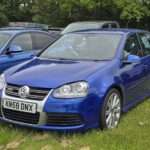
The Mk6 Golf R is a compact, discreet performance hatch with a turbocharged four-cylinder engine and four-wheel drive. Its appeal comes with several distinct maintenance systems: an EA113 engine, a Haldex coupling and either a manual gearbox or wet-clutch DSG. A successful purchase checks each separately rather than accepting “full service history” as proof that every fluid, filter and wear item has been covered.
Our buying verdict
Choose a substantially standard hatchback with documented belt and fuel-pump follower attention, working four-wheel drive and a healthy gearbox. A higher-mileage car with meaningful invoices can be a better purchase than a low-mileage example carrying years of overdue work. Confirm that you are buying a genuine R and the correct generation: a Mk6 GTI, R-Line, R Cabriolet or later Mk7 needs different advice.

Identify the correct Golf R before comparing specifications
Volkswagen’s archive identifies the 2009 introduction of the 199kW/270PS Golf R with standard 4MOTION. The core UK Mk6 hatchback buying proposition is the 2010–2012 period, allowing for registration overlap. Three- and five-door bodies and six-speed manual or DSG transmissions need their own like-for-like comparisons. An imported car may have different equipment or output, so establish its original market and build record.
| Choice | Why it matters | Check before paying |
|---|---|---|
| Mk6 R hatchback | EA113-family 2.0-litre turbo and Haldex four-wheel drive | VIN, engine code, drivetrain and factory specification. |
| Manual | Conventional six-speed driver involvement | Clutch, flywheel, selection and torque-related wear on tuned cars. |
| DSG | Six-speed wet-clutch dual-clutch gearbox | Correct fluid/filter history, hot/cold behaviour and diagnostics. |
| Three-door / five-door | Different access and day-to-day usefulness | Door operation, seat access, seals and repair history. |
| Modified example | Software may change fuel, cooling and clutch requirements | Named tuner, hardware, maintenance and insurer acceptance. |
The Mk6 R’s belt-driven EA113 differs from the ordinary Mk6 GTI’s EA888. It also has a short chain between the camshafts: “it has a belt” does not eliminate every chain-related inspection question. R-Tech identifies the CDL engine family among Golf R applications, but the actual code and fitted parts still need checking before ordering.
R-Line trim is not an R powertrain. The later R Cabriolet is also a separate proposition and should not be assumed to share the hatchback’s all-wheel-drive layout. Do not rely on a registration year, bumper or central exhaust conversion to establish identity. Confirm options such as adaptive damping and lighting from the car and its build information rather than a general brochure.
UK prices: use clean hatchback comparisons
Snapshot checked 4 November 2026. PistonHeads displayed twelve Mk6 R listings. Clearly described hatchbacks included a 2011 DSG with 113,000 miles at £7,995; a 2011 DSG with 76,000 miles at £9,989; a 2010 manual with 60,886 miles at £11,000; a 2010 DSG with 61,931 miles at £11,995; and a 2011 DSG with 29,000 miles at £13,749. These are asking prices, not sold values or inspected-condition evidence.
Several entries had contradictory body classifications such as convertible or estate attached to hatchback descriptions. They were not used to build a clean comparison. This is a reminder to read the individual advert and confirm the car, rather than treating a portal filter or an automatically generated price range as a valuation.
Separate genuine maintenance evidence from a list of modifications. Ask how recently belts, Haldex and DSG were serviced and what each invoice actually included. A cheap car with unidentified four-wheel-drive or gearbox trouble needs diagnosis before negotiation; guessing a pump or mechatronic repair cost can make an apparent bargain misleading.
Compare total first-year expenditure: purchase, inspection, catch-up maintenance, tyres and known faults. A low annual mileage does not remove time-based servicing. Get an insurance quote for the actual car and declared software before committing, especially when a seller cannot confirm whether it remains standard.
Bodywork, corrosion and accident checks
Inspect bonnet and wing gaps, headlamp brackets, radiator support areas, door apertures and the luggage floor for impact or poor reassembly. Check paint texture and overspray around seals and fixings. Low bumpers and undertrays collect scrapes; broken mountings can make a cosmetic repair less straightforward than it first appears.
Check sills, jacking points, arch edges, front wings and exposed underside hardware on a lift. Look for trapped dirt, corrosion, crushed seams and the quality of previous repairs. Fresh coating should not prevent inspection of what it covers. Follow MOT advisories over time and investigate recurring brake-pipe, spring and suspension concerns.
Inspect the boot and spare-wheel area for moisture, damaged seals or disturbed trim. Check rear wash/wipe, hatch release, heated glass and lights. On three-door cars, test long-door hinges, seat tilt mechanisms and rear access. If fitted with a sunroof, examine its operation and surrounding headlining for water marks rather than assuming a dry viewing day proves it does not leak.

EA113, timing belt, cam follower and four-wheel drive
Insist on a genuine cold start and a fully warm drive. Listen for persistent rattles, observe idle quality and exhaust smoke and inspect for oil and coolant loss. Obtain a diagnostic scan including the gearbox and all-wheel-drive controller, not just generic engine codes. Recently cleared faults or readiness monitors need explanation and further assessment.
Timing belt and pump: require dated invoices showing mileage, belt, tensioner/idler scope and the water-pump decision. Confirm the VIN-specific time-and-mileage schedule with a specialist. A sticker or a parts receipt does not establish correct installation. Inspect oil leaks that could contaminate the belt area and investigate cam-chain/tensioner noise separately.
High-pressure fuel-pump follower: R-Tech’s first-party material explains that wear at this contact can damage the camshaft and pump. Ask for physical inspection evidence and the specialist’s recommended monitoring approach. Replacing a follower after severe wear does not prove that consequential damage was repaired. Its online historical price examples are not used here as current repair quotes.
Investigate misfires, uneven boost, poor idle and unexplained oil use. Inspect the PCV and diverter-valve systems, intake and boost hoses, ignition components and cooling hardware. Direct-injection intake deposits may need assessment when symptoms justify it, but a generic “carbon clean” should not substitute for diagnosing a compression, fuelling or ignition problem.
Haldex: an R badge and absence of a dashboard warning do not prove rear drive works. Auto Fault Finder’s Generation 4 guidance describes pump, cartridge-filter and controller faults that can overlap. Ask a suitable workshop to confirm the unit, service history and actual operation using appropriate diagnostics and tests. An oil-only invoice is not necessarily a filter service.
Separate Haldex coupling oil from rear differential oil and DSG oil; they are different jobs. Have the specialist inspect the pump strainer/filter arrangement, wiring and controller as appropriate. Do not assume that a used controller from another car is correctly configured, or that replacing the pump cures every fault. Avoid improvised road tests involving wheelspin at a viewing.
On DSG cars, test drive and reverse engagement, low-speed manoeuvring and changes when hot as well as cold. Shudder, flare, harsh selection or flashing indicators need diagnosis. On manuals, check clutch slip, take-up and flywheel noise, especially with increased torque. Neither a software reset nor a promise of a fluid change is a complete answer to an unresolved fault.
Check springs, dampers, bushes, wheel bearings, brakes and driveshafts. If adaptive dampers are fitted, test the modes and scan the system. Use compatible quality tyres and investigate uneven wear or mismatched rolling sizes. An alignment should follow correction of worn parts. Modifications need a full hardware and software record, appropriate fuel requirements and evidence that the clutch and cooling can cope.
Interior, electronics and daily use
Test air conditioning, heater output, all fan speeds, windows, locks, mirrors, both keys and any parking equipment. Check display pixels, navigation, Bluetooth and aftermarket audio rather than assuming that every fitted unit has modern connectivity. Electrical additions should have tidy wiring and a credible installation record.
Inspect bolsters, steering-wheel wear, pedals and carpets against the mileage history. Check warning-lamp self-tests and investigate damp trim or a recently replaced battery. A basic engine scan does not assess every body-electronics fault. On a daily car, confirm that the ride on its actual wheels and suspension still suits your roads and passengers.
Check the luggage floor, tools and locking-wheel-bolt key and try rear-seat access. Missing original trim, a damaged R-specific seat or a faulty xenon lamp can add a disproportionate bill. List these items during the inspection so that a visually tidy engine bay does not distract from accumulated convenience and cosmetic repairs.

Maintenance costs, belt kits and affiliate parts searches
The figures below are editorial planning allowances for parts only, unless a fitted service is explicitly identified. They are not live eBay quotes: brand, specification, availability, delivery and VAT treatment vary. Obtain a registration/VIN-matched written estimate before committing to a repair. Cheap search results can include incompatible parts, deposits or single components rather than a complete kit.
Affiliate disclosure: the parts searches below use our eBay affiliate campaign. We may earn a commission if you buy, at no additional cost to you. Search results are not a recommendation of every seller or product; verify fitment, maker, returns and warranty.
| Maintenance item | Parts allowance / search | What to check |
|---|---|---|
| Timing belt/water-pump kit | £120–£240 | VIN/engine match; confirm tensioner/idlers and fitted scope. |
| HPFP cam follower | £25–£55 | Inspect cam/pump if wear is found; a follower is not the whole repair. |
| Oil/filter service parts | £45–£85 | Correct approval and quantity; labour extra. |
| Spark plugs and coils | £90–£200 | Check stock/tuned specification and whether sold singly. |
| PCV assembly | £30–£90 | Confirm correct revision and diagnose the fault. |
| Diverter valve | £35–£100 | Match application and hardware. |
| Alternator | £130–£300 | Part number, output and exchange terms vary. |
| Haldex Gen 4 service parts | £60–£110 | Different from rear differential oil; inspect pump strainer too. |
| DSG fluid/filter parts | £80–£150 | Correct unit, fluid and filling procedure required. |
| Front discs and pads | £160–£330 | Verify fitted brakes and include caliper inspection. |
Use a VIN-specific service plan for the timing belt, DSG, Haldex and other fluids, with time limits as well as mileage. We have not converted a tuner’s preferred interval into a universal factory requirement. Ask for a written estimate stating parts, labour, coolant, seals, VAT and diagnostics, especially where belt work and oil leaks overlap.
A Haldex pump or DSG mechatronic fault needs diagnosis before a parts order. The searches are a way to compare plausible components, not proof that every result fits or that the cheapest listing solves the problem. Keep invoices that distinguish each separate drivetrain service.
Hidden ownership costs: three systems and accumulated wear
A single “major service” can leave the transmission and four-wheel-drive system untouched unless they are explicitly included. Catch-up work on belts, Haldex, DSG, tyres and brakes can arrive together. Build your first-year budget from the inspection findings rather than assuming the latest oil change reset the entire maintenance clock.
If the cam follower has worn through, a small replacement part can sit inside a much larger camshaft and fuel-pump repair. Similarly, a Haldex oil change will not repair a failed controller, and a gearbox fluid service cannot guarantee healthy clutch or mechatronic hardware. Written diagnostic findings are more valuable than a seller’s suggested cheap cure.
Factor in quality tyres, adaptive-damper costs where fitted, lighting units, air conditioning and corroded exhaust or suspension fixings. Ask about labour overlap and alignment after suspension work. Leave a repair reserve instead of using the full budget to buy the lowest-mileage advert.
Check insurance for all modifications, current tax from the actual registration and realistic fuel costs using the required fuel for its calibration. A remapped car may need different supporting hardware and consumables. Declared power alone is not evidence that the installation, cooling, clutch or exhaust is suitable for road use.

Golf R Mk6 viewing checklist
- Verify genuine R identity, engine code, hatchback body, gearbox and original market.
- Read MOTs, invoices and declared tuning hardware/software before agreeing a viewing.
- Check belt/pump scope and fuel-pump follower inspection evidence.
- Start cold, drive fully warm, scan relevant modules and diagnose oil/coolant loss or misfires.
- Confirm working rear drive and the exact Haldex service scope with a specialist.
- Test DSG or manual operation hot and cold; investigate slip, shudder and warnings.
- Inspect structure, tyres, brakes, suspension, lighting and any adaptive dampers.
- Price immediate work, verify insurance and retain a first-year contingency.
Golf R Mk6 buying questions
Does it use the same engine as an ordinary Mk6 GTI?
No. The R uses an EA113-family engine with a timing belt and a short camshaft chain; the ordinary Mk6 GTI has different EA888 timing-system concerns. Order by the actual engine code.
Does an oil service include Haldex and DSG?
Only if the invoice explicitly says so. Engine, DSG, Haldex coupling and rear differential servicing are separate scopes with different fluids and procedures.
Can four-wheel drive fail without an obvious warning?
Do not rely on the dashboard alone. Have a specialist assess actual operation and relevant fault codes, pump/filter condition, wiring and controller behaviour.
Should I avoid a modified Golf R?
Not automatically, but require named software, matching hardware, maintenance evidence and insurer acceptance. Unexplained boost, misfires or clutch slip need diagnosis before purchase.
Is the cheapest example good value?
Only when the total purchase-plus-repair cost makes sense. Missing belt evidence or undiagnosed gearbox and rear-drive faults can outweigh an attractive asking price.
Sources, method and image credits
Checked 4 November 2026. Independent inspection advice is supported by the following factory and first-party technical material and a dated advert sample. Supplier recommendations have a commercial context; no vehicle shown or advertised was inspected by us.
- Volkswagen: Golf VI archive and R introduction
- R-Tech: EA113 engine families and fuel-pump follower/PCV considerations
- Auto Fault Finder: Generation 4 Haldex components and diagnostic distinctions
- PistonHeads: dated hatchback asking-price observations
Four licensed photographs show the relevant generation, including overseas cars with differing equipment. They do not prove standard specification or inspected condition. Attribution, source and licence appear beside each image; thumbnail credits remain outside hub cards.