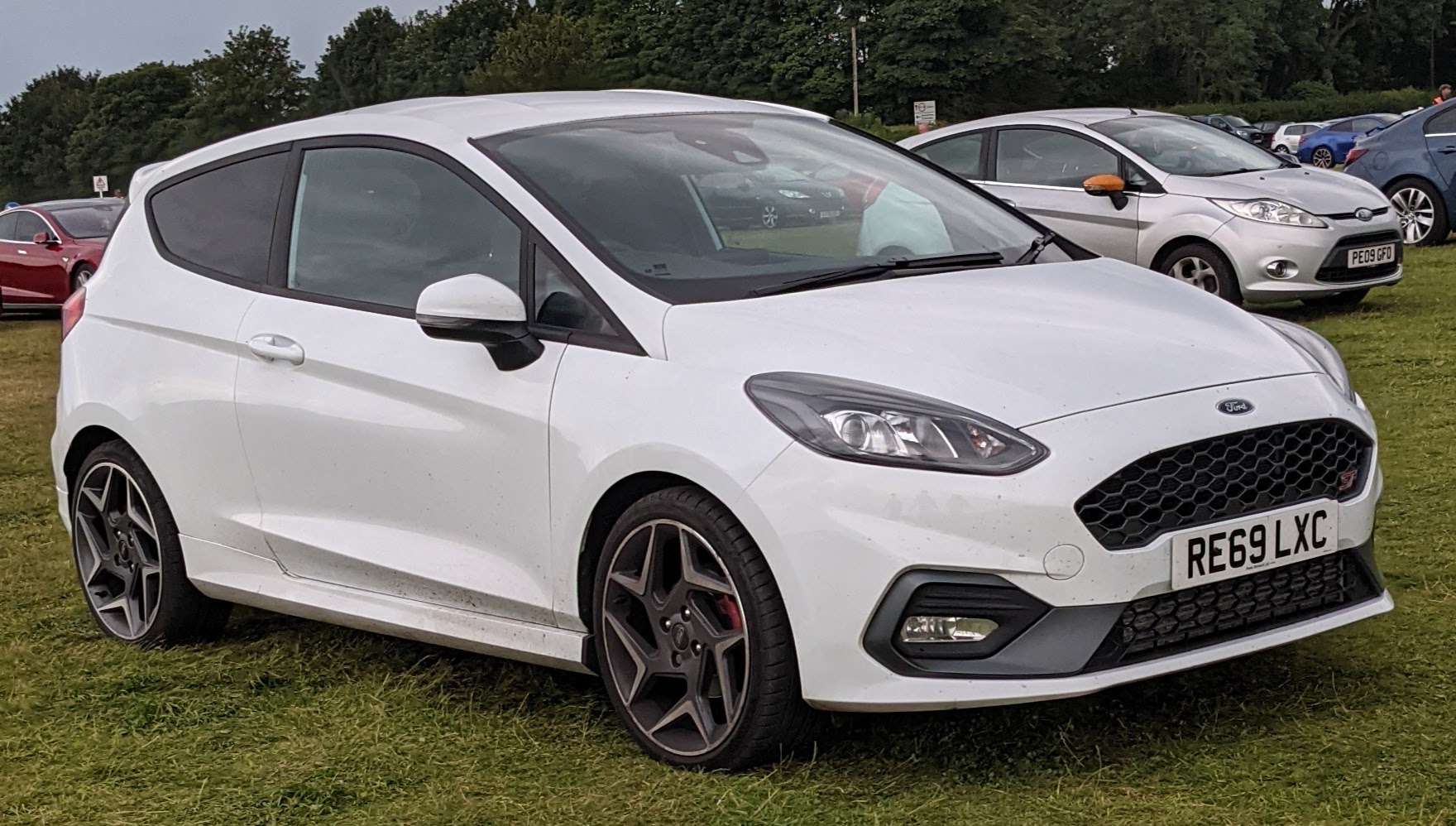
The Ford Fiesta ST Mk8 makes a convincing used performance car because its appeal survives ordinary road speeds: compact dimensions, a six-speed manual gearbox and a lively 1.5-litre three-cylinder engine. Buying one well means checking much more than the ST badge. Factory equipment, maintenance quality, previous tuning and the condition of tyres, brakes and suspension all influence whether an affordable hot hatch stays affordable.
Our buying verdict
Choose a genuine ST with a coherent service history, sound cooling system, clean diagnostic report and quality matching tyres. A verified Performance Pack is desirable, but it should not distract from accident repairs or deferred maintenance. For most buyers, a standard or carefully documented mildly modified car is a stronger starting point than an unexplained high-output example.

Which Fiesta ST Mk8 should you buy?
This guide covers the generation introduced in 2018 and the later facelift, often called Mk8.5 by UK enthusiasts. Naming differs between markets, so identify the engine and generation rather than relying on a search label. The older ST180 uses a different 1.6-litre four-cylinder engine and has its own guide in our hub.
Quaife’s original 2018 technical account gives the launch ST’s output as 200 PS and 290 Nm, with a six-speed manual drivetrain and a 0–62 mph time of 6.7 seconds. The same article explains the optional mechanical limited-slip differential and its integration with the electronic brake-based traction functions. An advertisement saying 197 bhp may simply use different units for the standard 200 PS output.
| Choice | Why consider it | What to verify |
|---|---|---|
| Early three-door | Compact appearance and an involved manual driving experience. | Seat access, trim level and the actual optional equipment. |
| Five-door | Easier rear-seat access for everyday use. | Rear doors, child-seat requirements and condition; do not assume body style determines mechanical specification. |
| Performance Pack-equipped car | Mechanical Quaife differential is a meaningful enthusiast feature. | Original build information and invoices; a dashboard menu or badge alone is insufficient proof. |
| Facelift / later example | Different equipment, cabin details and appearance. | Compare the exact build specification and seats; do not apply an early brochure to every later car. |
| Modified ST | Potentially enjoyable when hardware, software and maintenance agree. | Tuner documentation, insurance acceptance and specialist diagnosis. |
Trim equipment and option availability changed. Check heated seats, climate equipment, navigation, lighting and driver-assistance features on the individual car. Sit in the seats long enough to decide whether they fit you; an impressive specification is little consolation if the seat shape makes every journey uncomfortable. A lower trim with the right condition may suit you better than a tired high trim.
Ask specifically whether the car is standard now and whether it has ever been tuned. Returning software to a standard file does not reverse mechanical wear or prove that all supporting hardware was removed correctly. Original parts, invoices and honest ownership accounts are more useful than a vague “never raced” statement.
Prices and buying priorities
A UK PistonHeads sample checked on 4 November 2026 included a 2018 ST-2 five-door advertised at £8,490 with 100,625 miles, a 2018 ST-2 five-door at £10,695 with 61,336 miles, and a 2018 ST-3 three-door at £11,490 with 66,365 miles. Another ST-3 was listed at £11,995 with 48,200 miles. These are asking prices and seller descriptions, not verified condition reports or completed transactions.
The sample covers early cars, so it should not be used to value a facelift, special edition or unusually low-mileage example. Compare similar cars with the same body, equipment and credible maintenance. Confirm whether advertised Performance Pack fitment is genuine before paying a premium.
Use the inspection to create a first-year budget. Four tyres, brakes, a clutch and catch-up servicing can consume the saving on a cheaper car. Request itemised estimates for known defects before negotiation. If the seller will not allow a reasonable independent inspection, there are usually better ways to spend your money than accepting an unexplained risk.
Bodywork, underside and accident checks
Inspect in dry daylight. Check the bonnet, front wings, bumper, lamps, rear quarters and tailgate for uneven gaps, paint differences and damaged fixings. Look behind accessible covers and beneath the luggage floor for repair evidence or moisture. Small hatchbacks can accumulate parking damage, while a hard impact may have affected geometry even after the paint was repaired.
Inspect sill edges and lifting points, wheelarch liners, undertrays, exhaust mounts and the front cooling pack on a lift. Look for damaged or missing shields and hoses rubbing against altered parts. A very low front splitter can conceal regular grounding; ask whether it is original equipment or an aftermarket addition.

Compare the wheel condition and tyre wear side to side. A freshly refurbished wheel is not proof that it is straight. Persistent steering pull, an off-centre wheel or uneven tyre wear should trigger geometry and suspension checks. Do not accept “they all do that” as a diagnosis.
Read the VIN, registration, service record and mileage history together. A vehicle-history check is worthwhile but cannot establish the quality of every repair. Ask for invoices and photographs of work, including changes to suspension, brakes or exhaust. Agree what original components are included in the sale.
Engine, transmission and chassis checks
Cold start, oil history and cooling
Arrange a genuinely cold start and inspect oil and coolant before the engine is run, following the correct safe procedure. Look for persistent misfire, abnormal mechanical noise, smoke, warning messages and visible leaks. A three-cylinder engine has its own sound and vibration, but that is not a reason to dismiss a new knock, unstable idle or recorded misfire.
Check service invoices for the oil specification, dates and mileage rather than relying only on a stamp. Ask who maintained a modified car and whether its schedule reflects the use. Short trips, prolonged storage and track days place different demands on fluids and components. Correct servicing is more valuable than a polished engine cover.
Inspect the expansion tank, radiator, hose joints, turbo plumbing and water-pump area for leaks or dried residue. Watch temperature behaviour during a full warm drive and recheck for leaks afterwards. Repeated coolant topping-up, overheating history or unexplained pressure needs professional diagnosis before purchase. Do not open a hot coolant system.
Timing drive: do not buy the wrong kit
The 1.5-litre Dragon engine is not the earlier ST180’s 1.6. Mountune’s own Mk8 engine-rebuild specification identifies a timing chain, gear and guide. This is a useful check against generic online listings that group unrelated EcoBoost timing kits together. It does not mean the entire engine is maintenance-free or that every drive component has the same service requirement.
Have a Ford-aware specialist establish the VIN-specific schedule and identify the camshaft, oil-pump and accessory-drive arrangements on the actual engine before ordering parts. Investigate abnormal noise or oil-pressure warnings promptly. A chain-related repair is a diagnosed specialist job, not a reason to purchase a generic 1.0-litre wet-belt kit from an ambiguous listing.
Turbocharging, modifications and emissions equipment
Check smooth throttle response and consistent boost only once the engine is warm. Hesitation, excessive smoke, warning lights or pronounced surging needs diagnosis. Inspect intake and charge hoses, clamps, heat shielding and exhaust installation. A louder intake is not evidence of either extra power or a fault, but its fitment should be secure and documented.
For a tuned car, identify the exact calibration, supporting hardware, fuel requirement and installer. Ask for invoices and any relevant health checks. A dyno graph records a test under particular conditions; it does not guarantee future reliability. If the car has changed specification since the graph was produced, its relevance is even more limited.
Establish whether the original emissions equipment remains present and functional, including a petrol particulate filter where fitted. A car passing a previous inspection is not proof that every current modification is suitable for road use. Obtain insurance acceptance for the complete modification list and use a specialist to assess an unfamiliar exhaust or software setup.
Clutch, gearbox and differential
Test every gear from cold and again once warm, including reverse and low-speed manoeuvring. Feel for clean clutch engagement, listen for abnormal whine and check for slipping under reasonable load. Avoid launch demonstrations. A seller repeatedly using launch control to impress you has not provided evidence of careful mechanical ownership.
If the car is described as having the Performance Pack, confirm it from build information and supporting documentation. Quaife explains that its differential is mechanical and works with the electronic torque-vectoring system; those are related but distinct functions. Do not try to prove the presence of the differential with risky road manoeuvres or a simplistic wheel-spinning test.
Inspect driveshaft boots, mounts and gearbox leaks. A clutch estimate needs to state whether flywheel, release components, bolts and labour are included. An uprated clutch can alter pedal feel and refinement, so choose a car whose setup suits daily use rather than assuming every expensive component improves your experience.
Suspension, steering and brakes
Quaife’s launch account describes Ford’s direction-specific rear force-vectoring springs. This makes correct component identification important: do not treat left and right springs or arbitrary lowering parts as interchangeable. Inspect springs, dampers, bushes, top mounts and wheel bearings on a lift, and check that a modified car has a sensible alignment.
Check brake condition, fluid history, caliper operation and ABS/stability-control warnings. The launch specification lists 278 mm ventilated front and 253 mm solid rear discs, but confirm actual fitment before ordering, especially if upgraded. Uneven braking or recurring vibration needs diagnosis rather than automatically fitting another set of discs.
Seats, electronics and everyday usability

Inspect seat bolsters, runners, folding mechanisms and rear access. Check belt operation, airbag warning behaviour and signs of interior dismantling. Make sure seats lock properly and that aftermarket parts have not introduced faults. Seat comfort is personal, so include your normal driving position in the viewing.
Test both keys, locking, windows, mirrors, lights, heated equipment, air conditioning and infotainment. Pair your phone and try the connection method you intend to use. Check parking sensors or cameras where fitted and confirm that optional equipment works rather than simply appearing in an advertisement.
Read diagnostic faults across relevant modules and retain the report. An intermittent warning may need a longer investigation than a quick generic code reader allows. Test the battery and charging system if symptoms point that way; do not replace an alternator simply because a dashboard message appeared.
Maintenance and useful parts allowances
Start with a baseline service plan based on invoices and an inspection. Confirm oil, coolant, plug and brake-fluid requirements for the actual build. Have the garage distinguish urgent work from optional upgrades, and retain clear invoices for future buyers.
These are editorial UK parts-only budgeting allowances, not live offers or fitted quotes. Brand, VAT treatment, exchange surcharges and availability can change the total. Obtain a written fitted quote and check part numbers against your VIN, engine and modifications.
Affiliate disclosure: we may earn a commission from qualifying eBay purchases, at no extra cost to you. The links open vehicle-specific searches; they do not certify the suitability or quality of individual listings. Check seller, fitment, warranty and returns.
| Maintenance item | Parts allowance | What to check |
|---|---|---|
| Oil and filter service parts | £50–£100 | Match the correct Ford oil approval and quantity. |
| Spark plugs | £35–£80 | Verify the correct specification for standard or documented tuned use. |
| Air filter | £15–£45 | Check the fitted airbox; aftermarket systems may use a different element. |
| Alternator | £140–£320 | Confirm output, connections and exchange surcharge after diagnosis. |
| Starter motor | £90–£220 | Test battery, cables and earth connections first. |
| Accessory belt components | £45–£140 | Confirm the actual drive arrangement and kit contents. |
| Timing-chain components, if diagnosed | £150–£350 | Not a scheduled generic cambelt purchase; specialist fitment and extra parts add cost. |
| Water pump and cooling parts | £50–£160 | Identify the pump and fault correctly; coolant and fitting are additional. |
| Manual clutch kit | £180–£380 | Flywheel, hydraulics and labour may be excluded. |
| Front discs and pads | £100–£220 | Confirm dimensions and standard versus upgraded hardware. |
| Rear discs and pads | £70–£160 | Check calipers, handbrake and bearing-related components separately. |
Hidden ownership costs
Tyres and alignment: price a complete matching quality set for the wheels actually fitted. Mismatched or aged tyres can undermine the car’s best qualities, while damaged wheels or poor geometry make replacement tyres wear badly. Include alignment after relevant suspension work.
Insurance and security: quote the registration, driver profile, storage and modifications before paying a deposit. Confirm any security requirements and whether the insurer accepts the current tune. A car advertised as “only a stage one” still needs an accurate declaration.
Returning to standard: original exhaust, intake, wheels and springs may be missing. Check that boxed original parts actually belong to the car and remain usable. Removal of modifications can involve diagnostics, software and labour as well as buying replacement hardware.
Clutch and track consumables: repeated launches and circuit use can accelerate wear. Track use is not automatically a reason to reject a car, but it should be accompanied by sensible servicing and a transparent account of the use. A recent set of tyres does not establish a healthy clutch.
Tax, fuel and routine use: verify current costs from the individual registration and your annual mileage. Original test figures should not be presented as a guarantee for urban traffic or enthusiastic driving. Budget for time-based maintenance even if the car is a low-mileage weekend purchase.
Diagnosis and downtime: modified boost, sensor and electrical faults can require careful testing before parts are ordered. A reserve for professional diagnosis is often better spent than buying speculative replacement components from a search result.

Eight checks before you buy
- Confirm a genuine 1.5-litre ST, exact generation, body, trim and build specification.
- Verify Performance Pack claims with documentation rather than styling or menus.
- Read oil and servicing invoices and establish the applicable VIN-specific maintenance schedule.
- Inspect a cold start, cooling system and warm running, then obtain a diagnostic scan.
- Inspect body repairs, underside, cooling pack and lifting points on a lift.
- Test clutch, all gears, braking, steering and the condition of tyres and springs.
- Audit software, intake and exhaust changes, retaining evidence and insurance acceptance.
- Price immediate work and retain a repair reserve before agreeing the purchase.
Frequently asked questions
Is an ST-Line the same as a Fiesta ST?
No. Styling and trim labels do not establish the 1.5-litre performance model. Verify the VIN specification, engine and registration details.
Is the Performance Pack worth having?
Its mechanical limited-slip differential is a meaningful enthusiast feature. Verify genuine fitment, but do not choose a damaged or poorly maintained car merely because it has the pack.
Does the Mk8 ST use the ST180 timing-belt kit?
No. Mountune identifies a timing chain in the Mk8 1.5-litre engine. Have a specialist identify every relevant drive and the VIN-specific schedule before ordering service parts.
Should I avoid a tuned Fiesta ST?
Not automatically. Require a coherent hardware and software specification, maintenance evidence, suitable diagnostics and insurance acceptance. An unexplained tune is an additional uncertainty rather than a free upgrade.
What should come before cosmetic upgrades?
A baseline service, sound tyres, correct geometry, healthy brakes and investigation of any fault. Those establish whether the car delivers its intended driving experience.
Research and sources
This guide uses original supplier documentation and a dated sample of advertisements. Supplier technical descriptions are attributed and do not establish population-wide failure rates. We have not inspected the cars in the price sample.
- Quaife: ATB differential in the 2018 Ford Fiesta ST: launch engine, braking and rear-spring specification, plus the mechanical differential’s integration with Ford’s electronic systems.
- Mountune: Mk8 Fiesta ST forged-engine rebuild scope: identification of the 1.5-litre Dragon engine and its timing-chain components; this is not a factory service-interval schedule.
- PistonHeads 2018 Fiesta ST listings: asking-price observations discussed above, subject to changing availability.