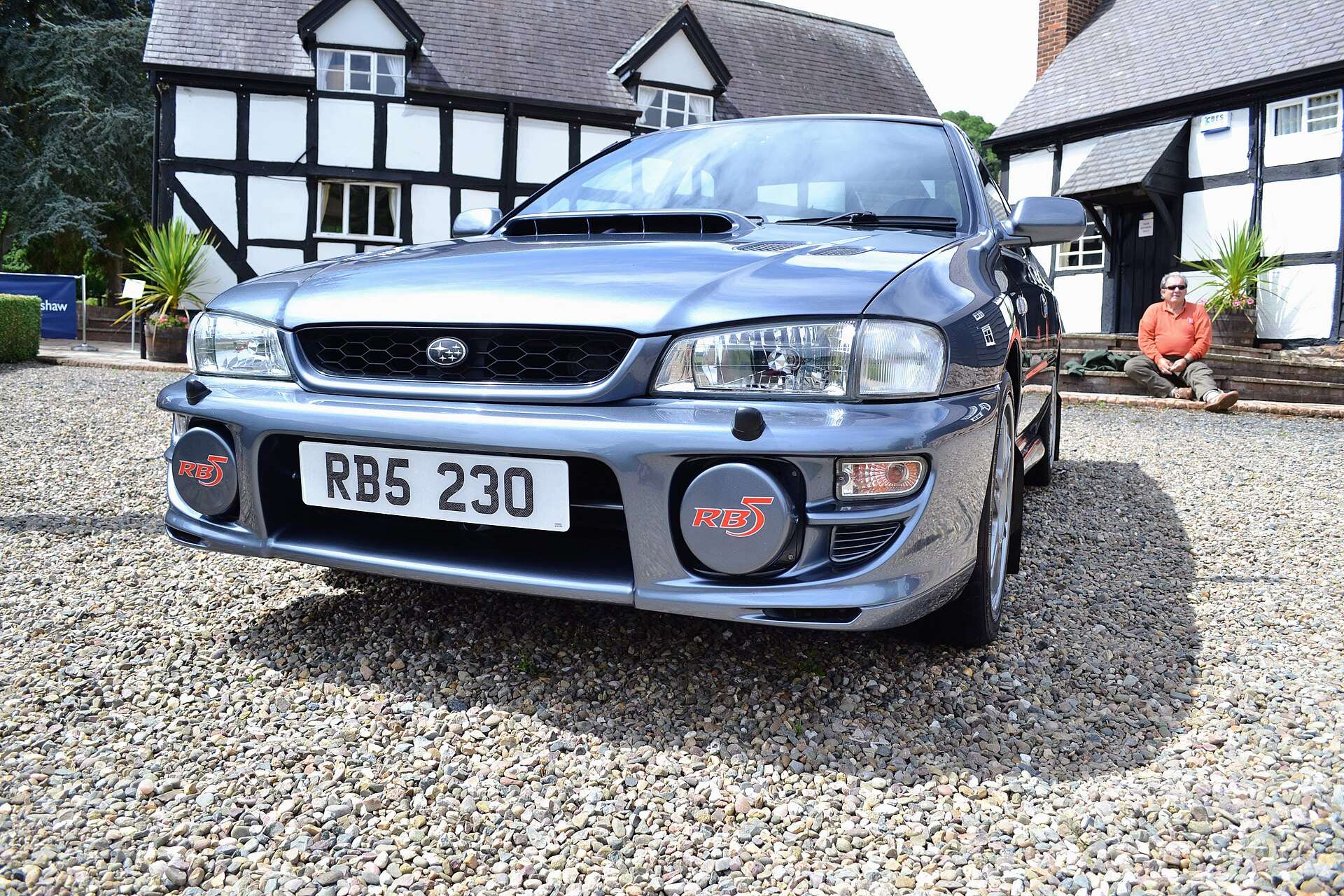
The Subaru Impreza RB5 is one of the most important British-market performance Subarus. Created to mark Richard Burns joining the Subaru World Rally Team for the 1999 season, it combined the familiar pace and all-weather ability of the Impreza Turbo 2000 with a carefully judged collection of Prodrive-developed details. Only 444 were produced, all in Steel Blue metallic, and survivors now occupy the space between usable modern classic and serious rally-era collectible.

Why the RB5 existed
By the late 1990s Subaru had transformed its British image. The Impreza Turbo 2000 was quick, practical and unusually effective on difficult roads, while Colin McRae and Richard Burns made the blue-and-gold rally cars household objects. Burns joined the works team for 1999 and carried competition number five; the commemorative road car therefore became the RB5.
Subaru UK and Prodrive did not try to turn it into a fragile homologation special. Instead they made the standard UK Impreza more focused and more distinctive without losing the qualities that made it useful every day. Production was capped at 444 numbered cars, a deliberately small run that was sold only through the British network.
What made an RB5 different?
Every RB5 was painted Steel Blue metallic and wore titanium-coloured 17-inch Speedline alloy wheels. Colour-coded mirrors, door handles and side skirts, PIAA driving lamps and discreet RB5 graphics separated it from an ordinary Turbo 2000. Inside were blue Alcantara-effect seat centres, model-specific trim, air conditioning, map-reading lamps and a numbered plaque.
The standard car retained the familiar two-litre turbocharged flat-four, permanent four-wheel drive and five-speed manual gearbox. Contemporary UK figures quote 215bhp in standard form. A Prodrive quickshift was part of the package, but the biggest mechanical step was optional.
The WR Sport version
Buyers could specify the factory-sanctioned WR Sport package. It added a Prodrive engine conversion with revised management, exhaust and intake components, lifting output to about 237bhp and torque to roughly 258lb ft. A taller STI-style rear wing completed the visual change. Because the conversion was available when new and carried Subaru approval, an original WR Sport car is especially desirable today.
Documentation matters. Over the years many standard RB5s have acquired aftermarket exhausts, remaps and replica wings, while some genuine WR Sport cars have lost their original parts. A purchase invoice, Prodrive paperwork and consistent history are stronger evidence than appearance alone.
Specifications
| UK production | 444 numbered cars, 1999 |
|---|---|
| Engine | 1,994cc turbocharged flat-four |
| Power | 215bhp standard; approximately 237bhp with WR Sport package |
| Transmission | Five-speed manual, permanent four-wheel drive |
| Body | Four-door saloon |
| Colour | Steel Blue metallic only |
| Wheels | 17-inch Speedline alloys |
What is it like to drive?
The RB5 still feels compact and direct. Its steering communicates clearly, the narrow body is easy to place and the flat-four delivers the characteristic surge familiar from a late GC8 Impreza. The ride is more compliant than many later performance cars, which helps it cover broken British roads quickly rather than merely producing impressive figures.
A standard car feels quick rather than overwhelming. The WR Sport conversion adds urgency through the mid-range and gives the RB5 the performance its looks promise, but the chassis remains the star. It is a car that rewards smooth inputs and commitment without becoming tiring at ordinary speeds.

Buying guide
Rust and accident damage
Corrosion is now the biggest structural concern. Inspect the rear arches from both sides, the inner and outer sills, jacking points, rear suspension turrets, boot floor and front chassis legs. Mud trapped behind liners can conceal extensive decay. Uneven panel gaps, creased boot floors and poorly repaired inner wings may reveal old accident damage.
Engine and turbocharger
Demand evidence of regular oil changes with the correct grade and allow the engine to start from cold. Listen for bearing knock, piston slap that does not settle, exhaust leaks and a noisy turbo. Blue smoke after idling or under boost is a warning. Modified cars need especially careful inspection because an aggressive remap or inadequate fuelling can damage pistons.
Transmission and running gear
Second and third gear synchros can wear, while harsh clutch engagement may indicate an unsympathetic upgrade. Check that all four tyres match in size, brand and wear: mismatched rolling circumferences strain the four-wheel-drive system. Knocking suspension, seized brake calipers and tired wheel bearings are common age-related faults.
Identity and originality
Confirm the numbered plaque, VIN, colour and paperwork agree. Original Speedline wheels, trim and PIAA lamps are difficult and expensive to replace. Modifications are not automatically bad, but a complete, traceable car is easier to value and will usually be more desirable.
Why the RB5 matters
The RB5 captures a particular moment when British rally enthusiasm, Prodrive engineering and Subaru’s road-car formula aligned perfectly. It is rarer than the later P1, more understated than a 22B and still practical enough to use. That combination explains why the best examples have moved beyond ordinary used-car status.