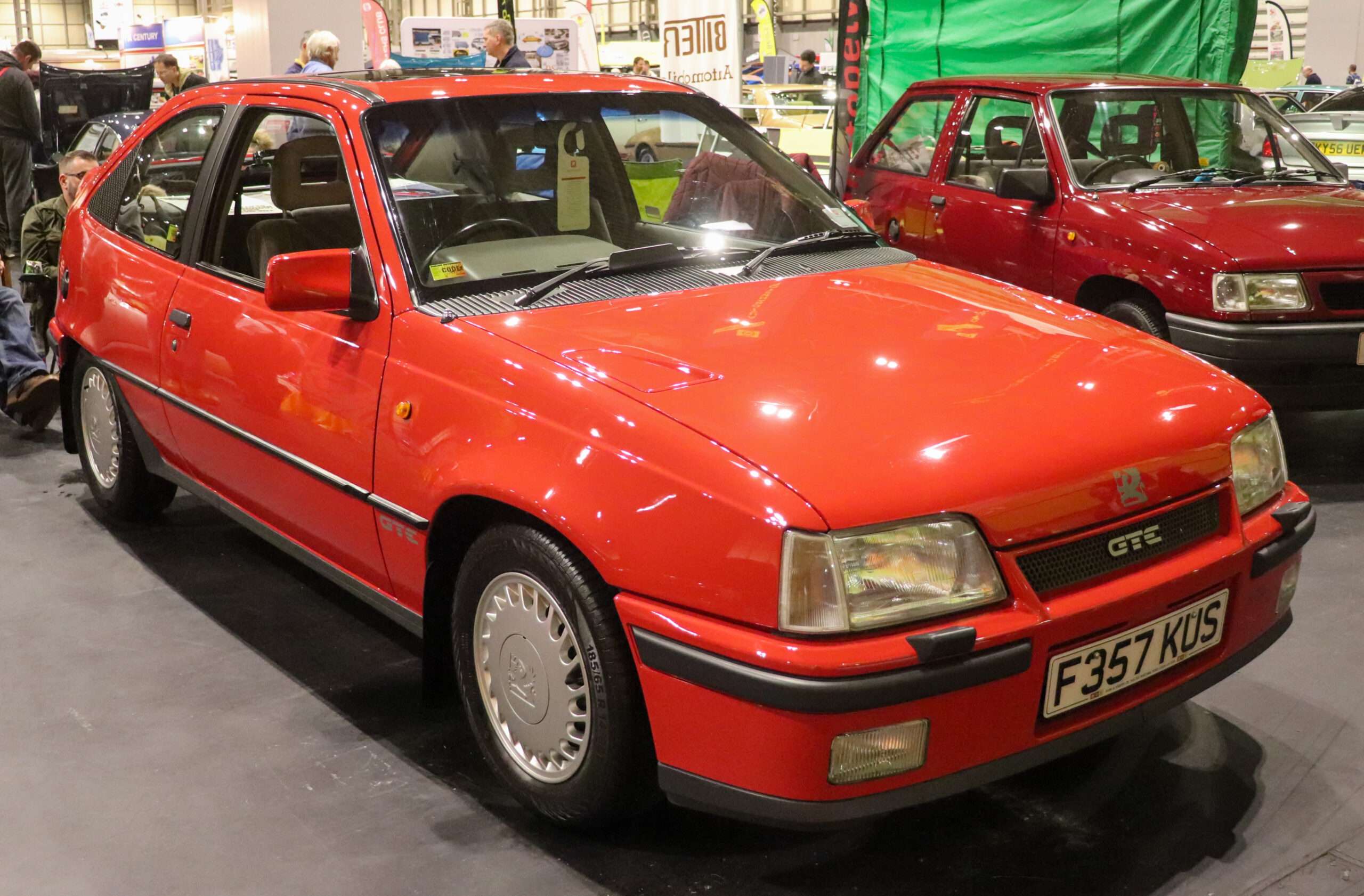
The second-generation Vauxhall Astra GTE 16V arrived at exactly the right moment. Britain was deep in its hot-hatch obsession, and Vauxhall suddenly had a 150PS, sixteen-valve answer to the Golf GTI, Escort RS Turbo and Peugeot 309 GTI. Yet the fast Astra’s story contains far more than a famous digital dashboard and a red-topped engine.
1. The Mk2 Astra was a European Car of the Year winner
The ordinary Mk2 Astra was already an important car before the 16V joined the range. Launched in 1984, it won the 1985 European Car of the Year award. That matters because the GTE was not a hand-built special on an obscure platform: it was the fastest expression of one of Europe’s most modern mass-market hatchbacks.
2. Its slippery shape was serious engineering
Vauxhall promoted the Mk2’s unusually aerodynamic body, with versions achieving a drag coefficient below 0.30. The flush glass, smooth nose and carefully shaped tail were not merely 1980s styling flourishes; they helped performance, refinement and economy. The GTE added spoilers and skirts without losing the basic body’s efficiency.
3. The digital dashboard became its calling card
Plenty of 1980s cars experimented with electronic instruments, but few made them as memorable as the Astra GTE. Its glowing numerical speed display and bar-graph rev counter gave the cabin a genuinely futuristic feel. Today the dashboard is almost as central to the car’s identity as its performance—and working examples are prized.
4. The C20XE was one of Vauxhall’s great engines
The 1,998cc twin-cam C20XE used four valves per cylinder and Bosch Motronic management to produce about 150PS in early form. In a relatively light hatchback, that meant vivid acceleration and an official top speed around 135mph. Enthusiasts came to call it the “red-top” because of its distinctive red spark-plug cover.
Love cars you don’t see every day?
Get forgotten cars, surprising motoring stories and the most interesting finds from Unusual Cars by email.
Free to join. No spam. Unsubscribe whenever you like. See our Privacy Policy.
5. “Coscast” is not the whole cylinder-head story
Enthusiasts often divide C20XE engines into desirable Coscast-headed cars and supposedly inferior later versions. Cosworth did cast early cylinder heads, while other production came from Kolbenschmidt. However, condition, maintenance and previous repairs matter more than a name in the casting. The familiar porous-head problem can affect some engines, but buying purely by the Coscast badge oversimplifies the issue.
6. Not every Mk2 GTE was a 16-valve
The GTE badge appeared first on eight-valve cars, including 1.8- and later 2.0-litre versions. The 16V arrived later and sat at the top of the range, so a Mk2 GTE is not automatically the 150PS model. Exterior details, brakes, engine code and documentation all matter when identifying a genuine survivor.
7. Opel got the sixteen-valve version first
The Astra’s continental twin was the Opel Kadett E, where the equivalent GSi 16V appeared in 1987. The right-hand-drive Vauxhall followed for the 1988 model year. That small timing difference explains why period literature and production dates sometimes appear to disagree about when the celebrated sixteen-valve car really began.
8. The engine enjoyed a huge second life
The C20XE became a favourite for competition cars and engine swaps long after the GTE disappeared from showrooms. Its strong block, free-revving head and plentiful tuning knowledge placed it in everything from Novas and kit cars to rally machinery. That popularity helped build the engine’s legend, but it also meant many original GTEs lost their powerplants.
9. It was a very different proposition from the Mk1
The angular first-generation Astra GTE was lighter, simpler and visually closer to an early-1980s hot hatch. The Mk2 was roomier, more aerodynamic and more sophisticated, especially in 16V form. They share a badge, but their personalities are distinct enough that enthusiasts often have a firm favourite.

10. Survival is its greatest rarity factor
Rust, theft, crashes and the modifying culture of the 1990s and 2000s removed large numbers from the road. Many cars were broken for their engines, while others acquired bodykits, conversions or replacement shells. A straight, correctly trimmed and largely original Mk2 GTE 16V is now far harder to find than its once-common reputation suggests.
Why the Astra GTE 16V still matters
It combined a genuinely advanced mass-market body, one of Vauxhall’s finest production engines and a cabin detail nobody forgets. The result is not just another quick old hatchback, but a concentrated piece of late-1980s British motoring culture.
For the wider model story, read our complete Vauxhall Astra GTE guide. You can also explore every 10 Things article.
Love cars you don’t see every day?
Get forgotten cars, surprising motoring stories and the most interesting finds from Unusual Cars by email.
Free to join. No spam. Unsubscribe whenever you like. See our Privacy Policy.