The E30 BMW 325i Sport was created for British enthusiasts who wanted more focus than a standard 325i without paying for the competition-bred M3. It combined the smooth M20 straight-six with carefully chosen drivetrain, suspension and M-Technic upgrades—and became one of the most imitated E30s.

1. It was chiefly a BMW GB model
The 325i Sport was a market-specific package devised for Britain, rather than a single worldwide model with one universal production code. That is why overseas references can be inconsistent and why UK invoices, build data and supplying-dealer records are so valuable when authenticating a car.
2. It was never an M car
Its body kit, steering wheel and badges drew on BMW Motorsport design, but the Sport was built around the regular 325i rather than the E30 M3’s homologation shell and four-cylinder S14 engine. Calling it an M car obscures what made it appealing: usable six-cylinder road performance.
3. The engine was the 2.5-litre M20B25
The 2,494cc SOHC straight-six produced about 171hp in UK specification. It was valued as much for its smooth delivery and distinctive sound as for outright speed, and it drove the rear wheels through a five-speed manual gearbox.

4. The limited-slip differential mattered more than the spoilers
A factory limited-slip differential was central to the Sport’s character, working with firmer suspension and a close-ratio manual gearbox. Those mechanical changes made it notably more purposeful than a cosmetic 325i wearing an aftermarket M-Technic kit.
Love cars you don’t see every day?
Get forgotten cars, surprising motoring stories and the most interesting finds from Unusual Cars by email.
Free to join. No spam. Unsubscribe whenever you like. See our Privacy Policy.
5. There were two visually distinct generations
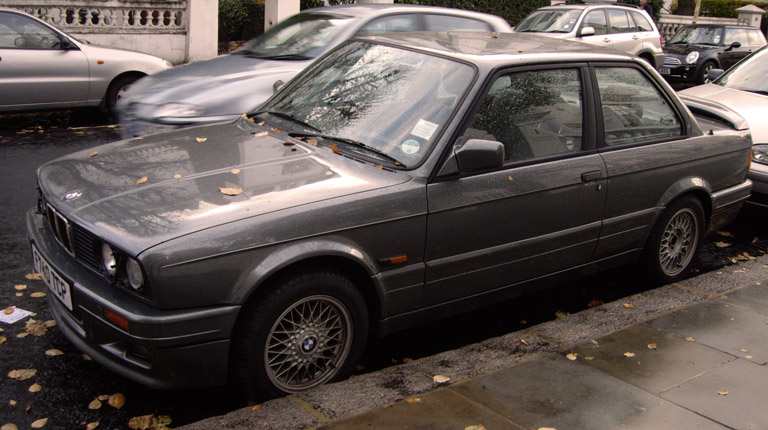
Early chrome-bumper cars wore M-Technic 1 equipment, including a deeper front spoiler, side skirts and rear valance. Facelift cars received the fuller, more integrated M-Technic 2 bumpers and lower cladding. Enthusiasts often refer to them simply as Tech 1 and Tech 2.
6. The facelift did not turn it into a different model
The change from Tech 1 to Tech 2 followed the wider E30 facelift. Underneath, both retained the same basic idea: a 325i sharpened for the British market. Colours, upholstery and options changed, so period-correct specification should be judged against build date.
7. Appearance alone cannot prove authenticity
M-Technic parts have been fitted to ordinary E30s for decades. Verification starts with the VIN, BMW build sheet and original option codes, then checks the gearbox, differential, suspension, interior and period paperwork. A convincing replica can look identical in photographs.
8. Reliable production totals are elusive
Because the Sport was a BMW GB specification rather than a clean global model line, online production numbers vary widely. Without a complete factory-market breakdown, precise totals should be treated cautiously; surviving registries are useful but are not the same as definitive production records.
9. It filled a very deliberate gap below the M3
The M3 was expensive, specialised and motorsport-led. The 325i Sport offered rear seats, refinement and the effortless character of a six-cylinder engine while still feeling meaningfully sharper than a normal 325i. That road-focused balance explains its enduring British following.
10. Original cars are now harder to find than modified ones
E30s were affordable enthusiast cars for many years, so engine swaps, suspension changes and replica styling became common. Today, a genuine Sport retaining its correct drivetrain, trim, wheels and documentation can be much rarer than its familiar silhouette suggests.
Love cars you don’t see every day?
Get forgotten cars, surprising motoring stories and the most interesting finds from Unusual Cars by email.
Free to join. No spam. Unsubscribe whenever you like. See our Privacy Policy.
Sources and further reading
- Unusual Cars: BMW 325i Sport history, M-Technic versions and identification
- BMW UK E30 historical specifications, build-option data and period model literature.