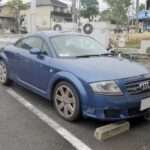
The Mk1 Audi TT was one of the rare concept cars that reached showrooms with its essential shape intact. Beneath the Bauhaus-inspired body sat familiar Volkswagen Group hardware, but the model accumulated an unusually varied technical story.

1. The concept appeared three years before production
Audi showed the TT Coupé study at Frankfurt in 1995 and the Roadster at Tokyo soon afterwards. Series production began in 1998, with the circular roofline, broad arches and geometric cabin detailing scarcely diluted.
2. Its name reaches back beyond Audi
TT recalls the Isle of Man Tourist Trophy and the sporting NSU TT models of the 1960s. NSU later became part of the company that evolved into modern Audi, giving the compact coupé a legitimate historical connection.
3. Painted bodies travelled to Hungary
TT bodies were produced and painted in Ingolstadt, then transported to Audi Hungaria at Győr for final assembly. The cross-border process was unusual for a volume sports car but helped Audi use its established Hungarian engine and manufacturing operation.
4. Most engines were 1.8-litre turbos
The 20-valve 1.8T appeared in outputs including 150, 163, 180 and 225PS, depending on year and market. The 225 was not merely remapped: it used two intercoolers and other hardware changes, normally with six-speed manual transmission and quattro.
Love cars you don’t see every day?
Get forgotten cars, surprising motoring stories and the most interesting finds from Unusual Cars by email.
Free to join. No spam. Unsubscribe whenever you like. See our Privacy Policy.

5. TT quattro used Haldex, not a Torsen centre differential
Because its engine sat transversely, the TT used an electronically controlled Haldex coupling to send drive rearwards when required. It differs fundamentally from the longitudinal quattro system associated with the Ur-quattro.
6. The 3.2 helped introduce DSG
The 250PS narrow-angle VR6 arrived late in 2002 and could be ordered with Audi’s new dual-clutch transmission, then prominently marketed as DSG. A six-speed manual was also available, making transmission part of the 3.2’s identity.
7. The rear spoiler was part of a larger safety response
After early high-speed accidents, Audi recalled cars for aerodynamic, suspension and electronic changes. The visible spoiler is remembered most, but electronic stability control and chassis revisions were also central to the programme.

8. The rare quattro Sport lost its rear seats
Introduced in 2005, the 240PS quattro Sport saved weight by deleting the small rear seats and added Recaros, a black roof and model-specific details. Audi records only 1,168 delivered.
9. The Coupé was much more practical than it looked
Its hatchback and folding rear seat created useful luggage capacity beneath the dramatic roofline. The two-seat Roadster sacrificed that versatility for open-air driving and its distinctive twin rollover hoops.
10. Nearly 270,000 Mk1 TTs were built
Audi records 178,765 first-generation Coupés and 90,733 Roadsters. Those numbers proved the bold design could be commercially successful and secured the TT as a permanent Audi model line.
Love cars you don’t see every day?
Get forgotten cars, surprising motoring stories and the most interesting finds from Unusual Cars by email.
Free to join. No spam. Unsubscribe whenever you like. See our Privacy Policy.