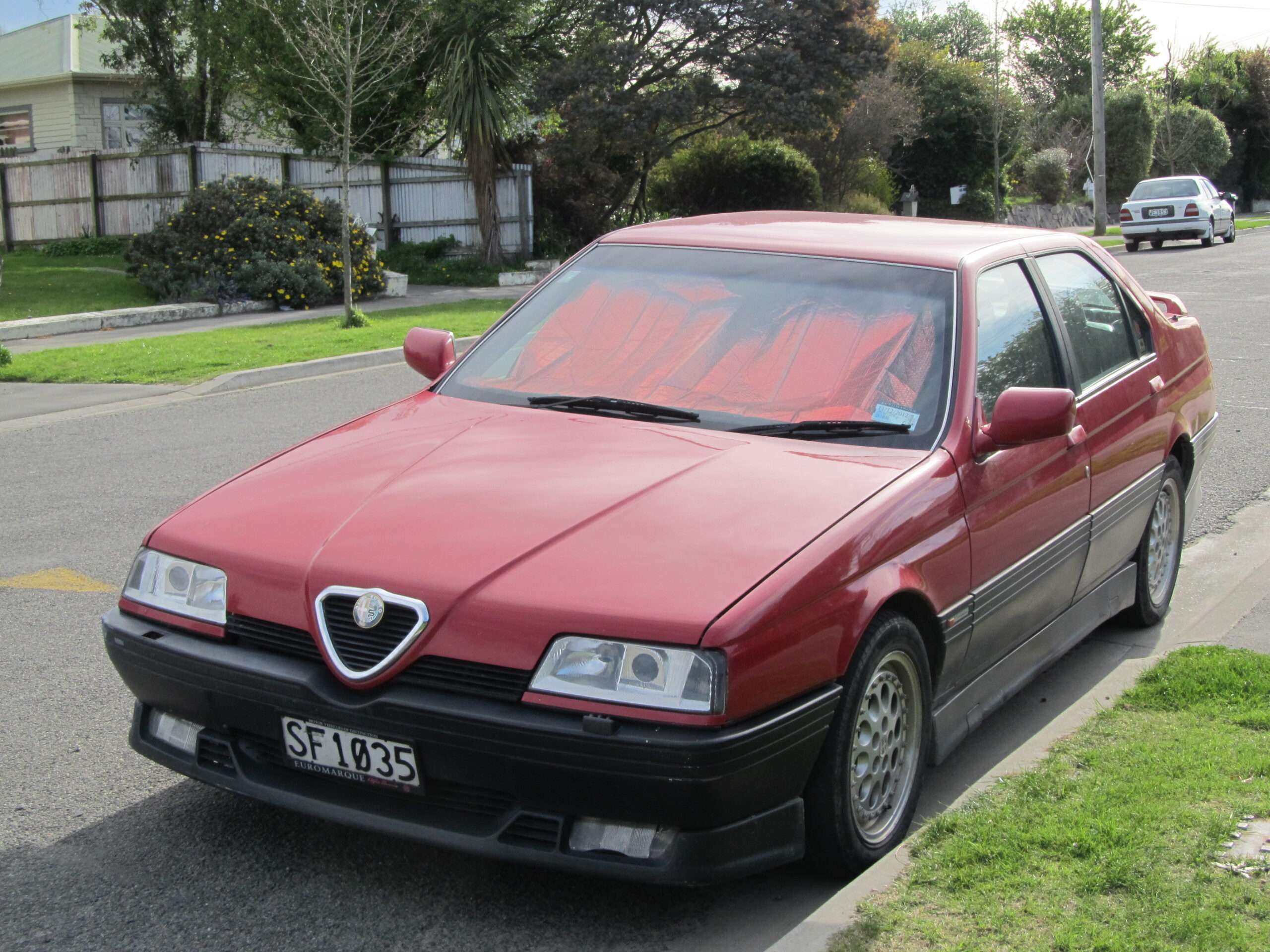
Quick answer: the Alfa Romeo 164 was the marque’s late-1980s executive flagship. The Quadrifoglio Verde made the most of its front-wheel-drive V6 chassis, while the rare 164 Q4 combined a 232PS 24-valve Busso V6, six-speed manual gearbox and an electronically managed four-wheel-drive system developed with Steyr-Puch.

Why the Alfa Romeo 164 mattered
Launched in 1987, the 164 gave Alfa Romeo a credible large saloon for a market dominated by German and Swedish rivals. It shared the Type Four programme’s broad industrial background with the Fiat Croma, Lancia Thema and Saab 9000, yet its Pininfarina body and Alfa powertrains gave it an identity of its own. The low nose, high tail and sharply defined glasshouse have aged particularly well.
The 164 also arrived during a pivotal period. Alfa Romeo had joined the Fiat group, but the flagship retained engines and character strongly associated with the old company. Its transverse V6, communicative steering and distinctive cabin made it more than a rebadged corporate relative.

Quadrifoglio Verde: the sporting 164
The Quadrifoglio Verde, usually shortened to QV, placed Alfa’s celebrated V6 at the centre of a more focused specification. Early versions used the 3.0-litre 12-valve engine; the later 24-valve QV raised performance and refinement. Market specifications and quoted outputs varied, so badges alone are not enough to identify a car.
Compared with an ordinary 164, the QV combined stronger performance with suspension, wheel and trim changes. It remained a spacious four-door saloon, which is precisely what makes it interesting: the car delivered traditional Alfa theatre without abandoning the role of an executive express.

The 164 Q4 and its Viscomatic system
Introduced late in the model’s life, the 164 Q4 was the most technically ambitious production version. Its 3.0-litre 24-valve V6 produced 171kW, or 232PS, and was paired exclusively with a six-speed manual gearbox.
The Q4 name described a permanent four-wheel-drive system centred on an electronically controlled viscous coupling. Alfa Romeo and Steyr-Puch developed the Viscomatic arrangement so it could vary torque distribution using information shared with the engine management and ABS systems. A Torsen differential acted at the rear axle. This was not a simple traction aid: it was an integrated drivetrain intended to make a powerful front-engined saloon secure without removing its agility.
Love cars you don’t see every day?
Get forgotten cars, surprising motoring stories and the most interesting finds from Unusual Cars by email.
Free to join. No spam. Unsubscribe whenever you like. See our privacy policy.
What distinguishes a genuine Q4
A true Q4 has much more than badges. The four-wheel-drive hardware, rear differential, six-speed transmission, suspension specification and 24-valve V6 installation all matter. Documentation should confirm the model identity, because the rarity and visual subtlety of the car make superficial replicas possible.
The most valuable evidence is a consistent chassis identity supported by registration papers, factory data and a coherent mechanical installation. An inspection by somebody who understands the 164 is sensible because drivetrain-specific components can be difficult to replace.
Why enthusiasts are rediscovering the 164
The 164 sits at an attractive point between classic and modern Alfa Romeo. It has genuine long-distance ability, a dramatic naturally aspirated engine and clean Pininfarina styling, yet it remains far less obvious than contemporary German performance saloons.
The Q4 is the engineering summit, but a sound QV can be the simpler enthusiast choice. Either deserves preservation on condition rather than badge alone: corrosion, neglected timing-belt servicing, tired suspension, electrical faults and scarce interior trim can overwhelm a superficially cheap example.
Frequently asked questions
How much power did the Alfa Romeo 164 Q4 have?
Alfa Romeo’s heritage material gives 171kW, equivalent to 232PS, for the 3.0-litre 24-valve V6 Q4. Figures quoted in other units can differ slightly after conversion.
Is the 164 Q4 permanently four-wheel drive?
Yes. Its Viscomatic system used an electronically controlled viscous coupling to vary torque distribution, with a Torsen differential at the rear.
Is the QV the same as the Q4?
No. QV identifies the sporting Quadrifoglio Verde versions; Q4 identifies the later four-wheel-drive flagship. Both used V6 power, but their drivetrains and model histories are different.
Who designed the Alfa Romeo 164?
The production 164 was styled by Pininfarina. Its crisp shape remained recognisably Alfa despite the wider Type Four development programme.
Continue the Alfa Romeo story
Browse the Alfa Romeo hub, then continue with the Alfa Romeo 155 Q4.
Research note: model chronology and Q4 technical details were checked against Alfa Romeo/Stellantis heritage material, including the marque’s 30-year 164 retrospective and Q4 history. Specifications varied by year and market.