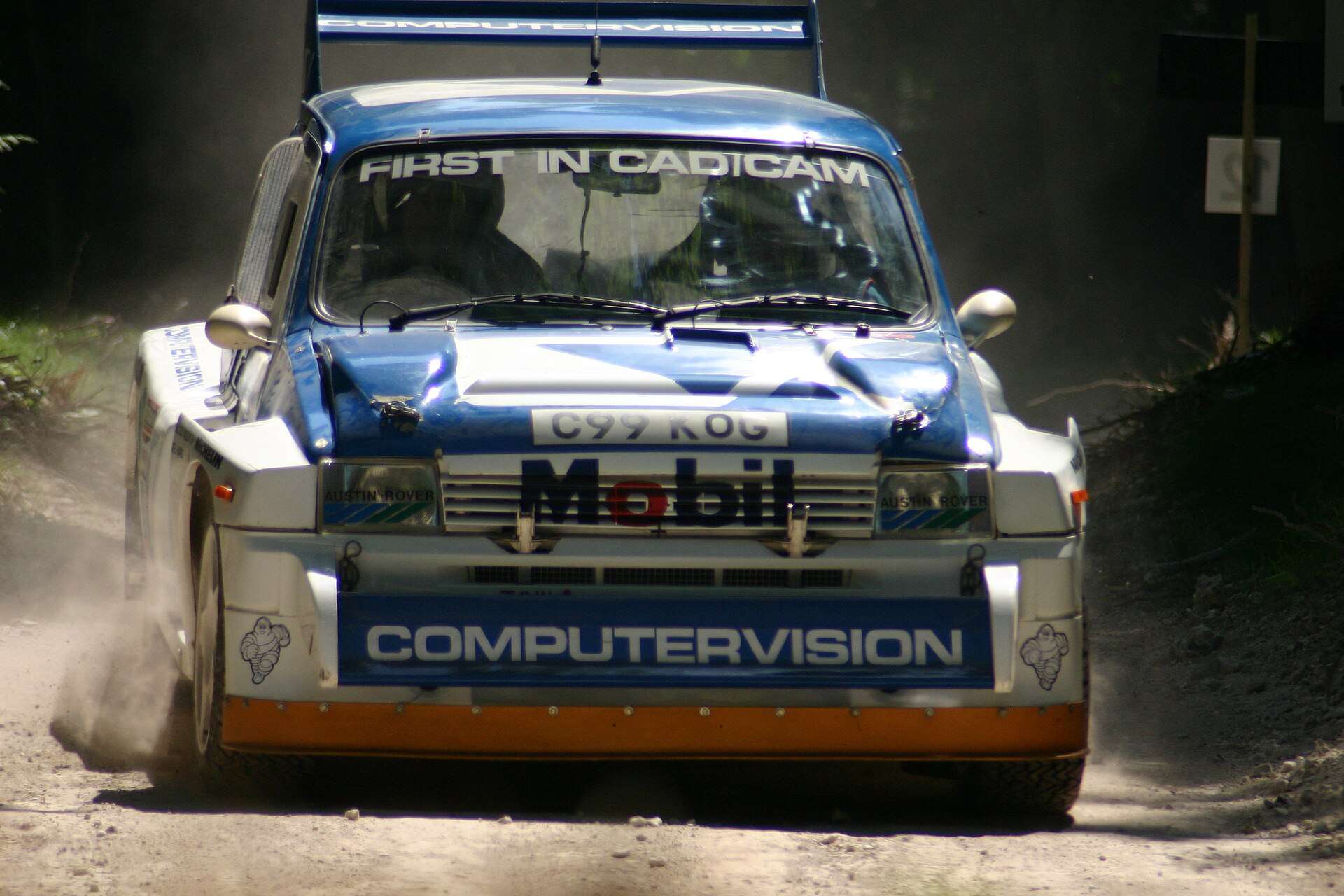
The MG Metro 6R4 was Britain’s most extreme Group B rally car: a mid-engined, four-wheel-drive machine that shared little beyond its name and roofline with the city car in the showroom. Its career was short, loud and endlessly fascinating.

1. The name explains the whole concept
“6R4” stood for six-cylinder, rally, four-wheel drive. The badge was unusually literal, neatly separating the competition machine from front-engined, front-wheel-drive road-going Metros.
2. It was developed with Williams Grand Prix Engineering
British Leyland Motorsport turned to Williams for specialist design and development work. Engineer Patrick Head and his team helped create the compact four-wheel-drive package before Austin Rover completed the programme.
3. The engine was naturally aspirated
Most leading Group B rivals used turbocharging or supercharging, but the 6R4 relied on a 3.0-litre V6 without forced induction. That gave immediate throttle response and a distinctive hard-edged sound.
4. Its V6 was not simply a shortened Rover V8
Early prototypes explored other solutions, but the production V64V was a purpose-designed 24-valve engine. It was mounted behind the seats and became the stressed heart of a bespoke rally car.
Love cars you don’t see every day?
Get forgotten cars, surprising motoring stories and the most interesting finds from Unusual Cars by email.
Free to join. No spam. Unsubscribe whenever you like. See our Privacy Policy.
5. Clubman road cars had much less power
The 200 homologation cars were sold in Clubman form with approximately 250 bhp. International rally versions could exceed 400 bhp, using more aggressive induction, internals and competition preparation.

6. It used a steel spaceframe beneath Metro-shaped panels
The 6R4 was not a reinforced production monocoque. A purpose-built tubular structure carried the drivetrain and suspension, clothed in composite panels styled to maintain a family resemblance.
7. Its WRC debut produced an immediate podium
Tony Pond finished third on the 1985 RAC Rally, the car’s first World Championship appearance. The result suggested enormous promise after a difficult and protracted development programme.
8. Group B ended before the car matured
The FIA cancelled Group B after the 1986 season amid a series of fatal accidents. Austin Rover lost the opportunity to develop the 6R4 through the multiple seasons its rivals had enjoyed.

9. It enjoyed a long second career
After the World Championship ban, 6R4s flourished in British and European national rallies, rallycross and hillclimbing. Without strict factory specification, engines were enlarged and cars evolved into even faster specialists.
10. Its engine architecture lived on at Jaguar
The V64V design was acquired and further developed for Jaguar’s XJ220 supercar programme. The road-going Jaguar used a heavily revised twin-turbo version, giving the Metro’s unusual engine story a remarkable afterlife.
Love cars you don’t see every day?
Get forgotten cars, surprising motoring stories and the most interesting finds from Unusual Cars by email.
Free to join. No spam. Unsubscribe whenever you like. See our Privacy Policy.
More extraordinary MGs
Read our MG XPower SV-R facts, then explore the MG archive.
Sources
For more about this car, read our MG Metro 6R4 guide.