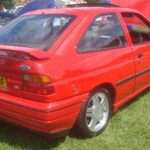
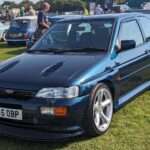
The original Ford Escort RS Turbo arrived with one clear purpose: to turn Ford’s hugely popular front-wheel-drive hatchback into a serious homologation special. It looked restrained beside later Cosworths, but beneath the Diamond White paint was a remarkably focused package.

1. It was the first turbocharged production Escort
Ford had already made fast Escorts famous through the Mexico, RS2000 and XR3, but the 1985 RS Turbo was the first showroom Escort to use a turbocharger. Its arrival put the Escort directly into the rapidly growing 1980s hot-hatch power race.
The engine was a turbocharged 1.6-litre CVH four-cylinder. Ford quoted 132 PS, enough to move the compact three-door beyond 200 km/h in period specifications.
2. Motorsport rules shaped the road car
The Series 1 existed because Ford wanted a competitive Group A Escort. Those regulations required 5,000 broadly identical road cars to be produced within twelve months, so this was not merely a styling exercise with an RS badge.
That homologation target explains why so many unusually serious components appeared on a relatively affordable family-car platform.

3. Every production example was Diamond White
The Series 1 is inseparable from its colour: Ford produced it in Diamond White, with blue pinstriping, colour-matched spoilers and distinctive seven-spoke alloy wheels. That one-colour policy gave the homologation model an identity of its own.
It also makes originality unusually easy to judge. Repaints, altered body kits and non-standard trim stand out immediately to knowledgeable buyers.
4. Fuel injection was as important as the turbo
Bosch KE-Jetronic mechanical fuel injection fed the turbocharged CVH engine. Combined with an intercooler and Ford’s engine-management calibration, it delivered strong mid-range performance without turning the car into an unusable competition special.
Period turbo technology still meant noticeable lag. The delay followed by a hard surge of boost is now a defining part of the Series 1 experience.
Love cars you don’t see every day?
Get forgotten cars, surprising motoring stories and the most interesting finds from Unusual Cars by email.
Free to join. No spam. Unsubscribe whenever you like. See our Privacy Policy.
5. A limited-slip differential was standard
One of the car’s most significant features was its standard mechanical limited-slip differential. In an era when many powerful front-drive cars struggled to put their power down, the differential helped the RS Turbo find traction out of bends.
It also gave the steering and cornering behaviour a distinctive, sometimes demanding character. This was hardware installed for a purpose, not a marketing option.

6. It shared its basic roots with the XR3i—but went much further
The RS Turbo used the familiar three-door Escort shell and CVH engine family, yet Ford’s Special Vehicle Engineering team developed a far more specialised car. Suspension, braking, cooling, transmission and body details were all revised.
That distinction matters today: a cosmetically modified XR3i is not an RS Turbo, and many model-specific pieces are expensive or difficult to replace.
7. The cabin had genuine Recaro seats
Inside, deeply bolstered Recaro front seats, a three-spoke steering wheel and RS instruments created a purposeful driving environment. The blue detailing continued through the upholstery, linking the interior to the pinstriping outside.
The result was unmistakably 1980s Ford: practical Escort architecture mixed with just enough motorsport theatre.
8. Its competition career went far beyond rallying
Although the Escort name is strongly associated with rallying, the turbocharged front-drive car also became a successful touring-car base. Group A rules encouraged manufacturers and private teams to race cars close enough to production specification for fans to recognise.
That motorsport connection is central to the Series 1’s appeal. It was the showroom starting point for a competition programme, not a retrospective tribute.

9. “Series 1” was never the original showroom name
Enthusiasts use Series 1 to distinguish the 1985–86 homologation model from the later facelifted RS Turbo. When it was new, Ford simply sold it as the Escort RS Turbo.
The later car was produced in greater numbers and offered more colours. The white-only original consequently became the sharper-edged and more collectible of the pair.
10. Survival is much lower than production suggests
Fast Fords were heavily used, modified and frequently stolen when values were low. Accident damage, rust and conversions removed many cars, while others lost their original engines, interiors or body trim.
A correctly restored matching-specification Series 1 is therefore far harder to find than its homologation production run might imply—and originality has become a major part of its value.
Love cars you don’t see every day?
Get forgotten cars, surprising motoring stories and the most interesting finds from Unusual Cars by email.
Free to join. No spam. Unsubscribe whenever you like. See our Privacy Policy.
More fast Fords
Continue with our 10 things you probably didn’t know about the Ford Escort XR3i Mk3, or explore more cars in the Ford archive.
Sources
- Ford Media: 50 years of the Escort legend
- Ford Media: 50 years of Ford RS models
- Wikimedia Commons image category
For more about this car, read our Ford Escort RS Turbo guide.