
From Concept D to production
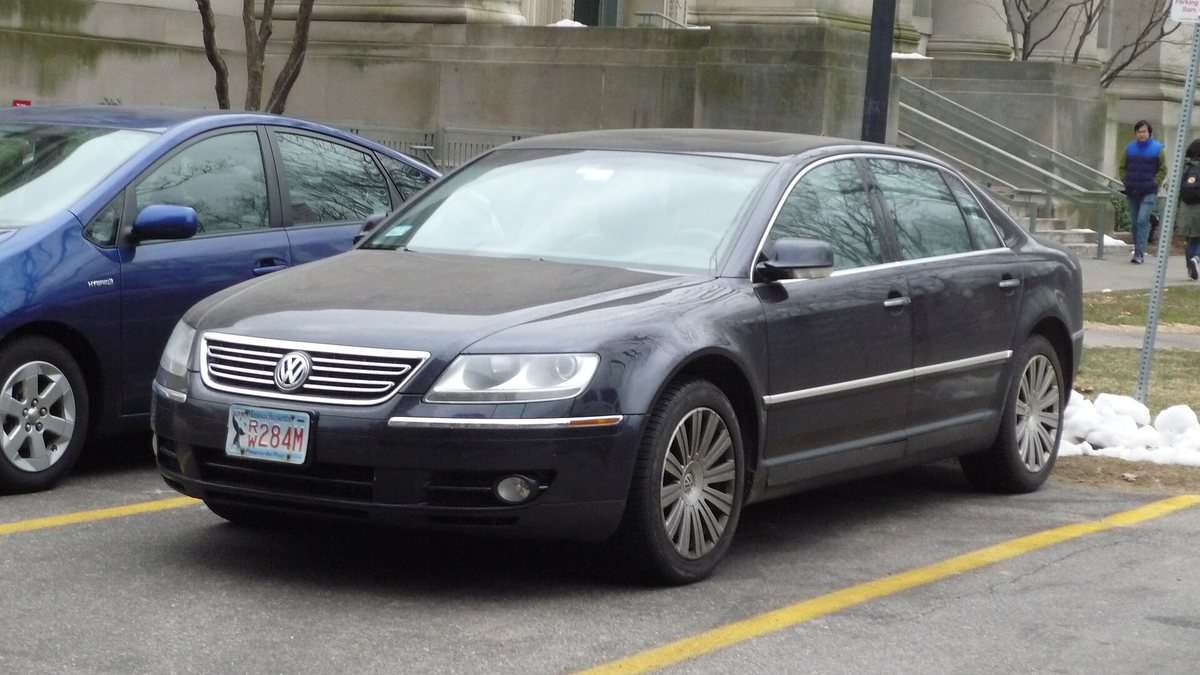
Volkswagen developed the Phaeton from the 1999 Concept D and unveiled the production car at Geneva on 6 March 2002. The project placed the brand directly into the luxury class, with more than 100 patents and a body at least 5.05 metres long. Styling remained deliberately restrained so engineering and comfort—not visual theatre—carried the argument.
_(52874881389).jpg?width=1600)
The Transparent Factory
Phaetons were assembled largely by hand at the Gläserne Manufaktur in Dresden. Workers in white clothing operated in light-filled halls with timber floors, turning the plant itself into part of the model’s identity. The setting emphasised craftsmanship and helped separate the flagship from ordinary high-volume Volkswagen production.
_(52874881439).jpg?width=1600)
Love cars you don’t see every day?
Get forgotten cars, surprising motoring stories and the most interesting finds from Unusual Cars by email.
Free to join. No spam. Unsubscribe whenever you like. See our privacy policy.
W12: compact twelve-cylinder power
The 5,998cc W12 combined two narrow-angle cylinder groups into a compact engine. Early cars produced 420 PS and 550 Nm; later specification reached 450 PS and 560 Nm. Power went through an automatic transmission and 4MOTION, with performance electronically limited to 250 km/h.
.jpg?width=1600)
V10 TDI and the wider range
The 4,921cc twin-turbo V10 diesel delivered 313 PS and 750 Nm, making the Phaeton the world’s most powerful diesel saloon at launch. More conventional V6 petrol, V8 petrol and V6 TDI engines broadened the range. The 3.0 TDI eventually became the European volume choice, but the W12 and V10 defined the project’s engineering ambition.
Updates, production and the cancelled successor
Volkswagen revised the Phaeton repeatedly between 2007 and 2014, adding new driver assistance, infotainment, lighting and cabin details. Production ended on 18 March 2016 after 84,235 cars including pre-series examples. A completed-looking D2 successor remained a prototype when Volkswagen redirected investment toward electric vehicles.
Versions at a glance
| Version | Engine | Output | Notable figure |
|---|---|---|---|
| Phaeton W12 early | 6.0-litre W12 | 420 PS | 550 Nm |
| Phaeton W12 later | 6.0-litre W12 | 450 PS | 560 Nm |
| Phaeton V10 TDI | 5.0-litre twin-turbo diesel | 313 PS | 750 Nm |
| Phaeton 3.0 TDI | 3.0-litre V6 diesel | 224–245 PS | European volume model |
Frequently asked questions
Was the Volkswagen Phaeton based on an Audi A8?
No. It was a separate Volkswagen luxury project, although Group components and engineering knowledge were shared. Its platform also underpinned related Bentley models.
How many Phaetons were built?
Volkswagen states that 84,235 were manufactured in Dresden, including pre-series vehicles.
Was every Phaeton four-wheel drive?
Most versions used 4MOTION. Some 3.2-litre V6 cars were available with front-wheel drive, depending on market and year.
Why did the Phaeton fail commercially?
The price placed it against established luxury marques while the restrained appearance and Volkswagen badge made its engineering difficult to communicate. High complexity also created intimidating ownership costs.
Continue the Volkswagen story
Browse the Rare & Performance Volkswagens hub, compare it with the Passat W8, or explore the New Beetle RSi.