
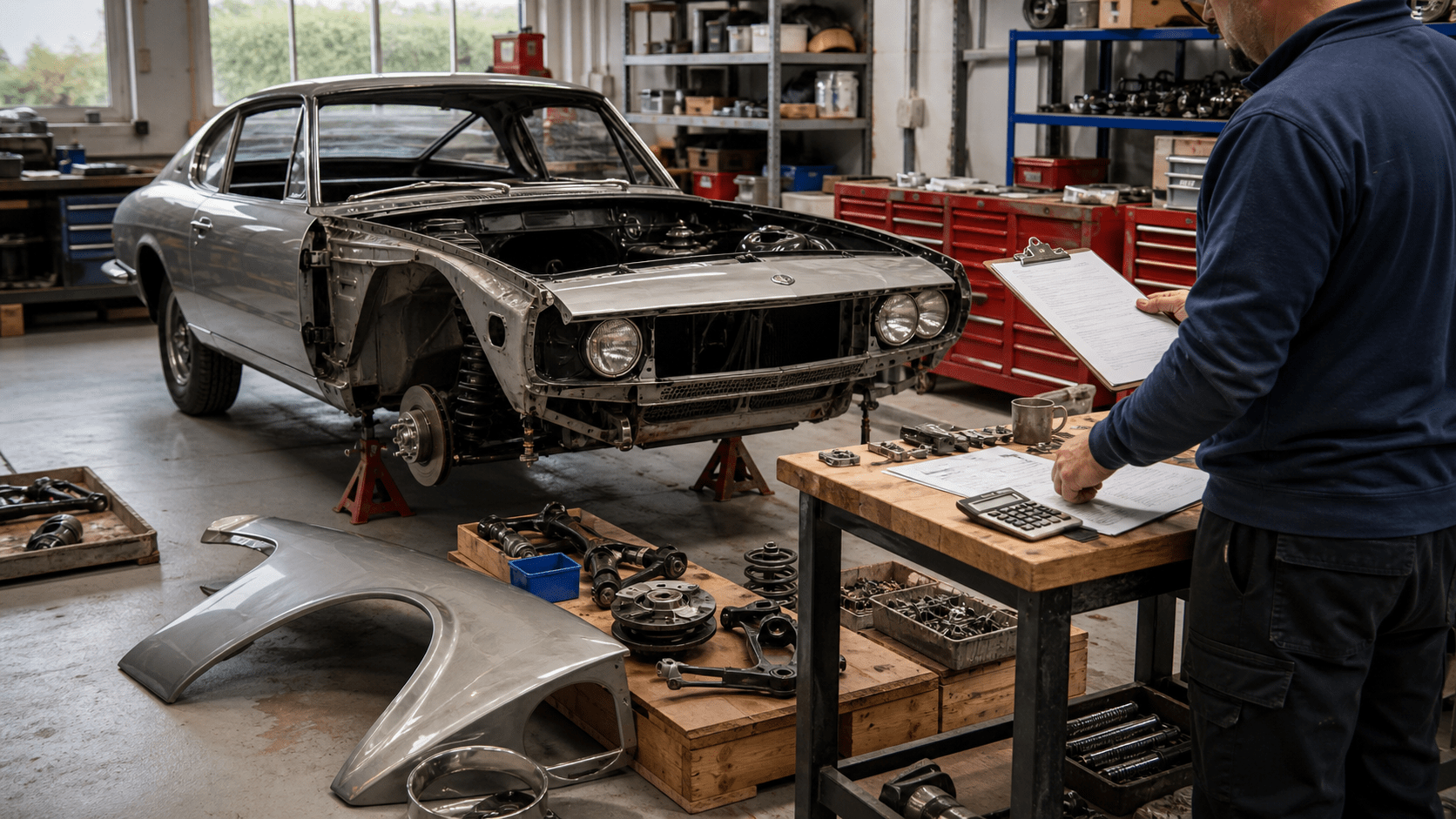
The purchase price is often the smallest predictable figure in a project-car restoration. The final cost depends on corrosion, completeness, parts availability, the required finish and how much skilled work you can perform safely yourself. This UK guide gives realistic budgeting bands and a worksheet for estimating your own car.
Typical UK project-car restoration cost bands
The following bands are broad planning figures, not quotations. They reflect published UK specialist guidance available in 2026 and assume an ordinary classic rather than a rare exotic, historic racing car or extensively coachbuilt vehicle. The condition revealed after stripping can move any project into a higher band.
Recommissioning and light improvement
Approximately £2,000–£8,000For a complete, structurally sound car needing fluids, tyres, brakes, hoses, servicing, minor electrical work and selective cosmetic improvement.
Mechanical refurbishment
Approximately £8,000–£20,000Engine, transmission, brakes, suspension and electrics returned to dependable condition while usable paint and trim are largely retained.
Driver-quality restoration
Approximately £25,000–£55,000Mechanical rebuilding plus meaningful structural and panel work, a sound repaint and refreshed interior intended for regular enjoyment rather than concours judging.
Bare-shell or show-quality restoration
Approximately £55,000–£110,000+Complete disassembly, extensive metalwork, high-quality paint, rebuilt and detailed mechanicals, retrimmed interior, plating and careful final assembly.
These upper three bands broadly align with the current UK specialist cost breakdown published by Restorists. Prices vary enormously by vehicle, region, specification and workshop. Obtain written estimates for your exact car and brief.
Where the restoration budget goes
| Workstream | Why the cost varies | Budgeting approach |
|---|---|---|
| Strip and assessment | True condition may remain hidden behind trim, underseal, filler and previous repairs. | Pay for a documented assessment before treating the first estimate as a fixed total. |
| Structural metalwork | Corrosion spreads beyond visible edges; unavailable panels must be fabricated and alignment preserved. | Separate known repairs from provisional work discovered after stripping. |
| Paint and preparation | Panel fit, rust removal, old coatings, colour changes and finish standard create large differences in labour. | Define exactly what is stripped, painted and reassembled. A bare-metal classic repaint can run well into five figures. |
| Engine and transmission | Parts, machining, specialist complexity and damage visible only after dismantling determine the bill. | Ask whether the estimate includes removal, machining, ancillaries, installation and testing. |
| Brakes, suspension and steering | Safety-critical components often need comprehensive renewal after long storage. | Budget complete systems rather than replacing the first visibly failed component. |
| Electrical system | Old looms, modifications, poor earths and unavailable switches turn isolated faults into lengthy diagnosis. | Compare the cost of fault-finding with a correct replacement loom and professional installation. |
| Interior and trim | Material choice, originality, seat structure, headlining, carpets and missing fittings affect both parts and labour. | Inventory every item before dismantling and obtain trim quotations using photographs. |
| Chrome and brightwork | Repairing and plating damaged original pieces can cost far more than expected. | Check whether usable reproduction parts exist before assuming every original can be restored economically. |
| Final assembly and commissioning | Adjustment, fluids, geometry, road testing and snagging consume many hours after the car appears finished. | Keep a dedicated commissioning allowance instead of spending the entire budget on paint. |
Why bodywork and paint dominate many restorations
Mechanical work is often easier to define: a component can be tested, dismantled and measured. Corrosion is less cooperative. A small blister may be superficial, or it may be the visible edge of rust between multiple structural panels.
Paint price also depends on everything that happens before colour is applied. Removing trim and glass, correcting gaps, stripping unstable coatings, repairing metal, preparing every surface and reassembling without damage all require labour. Current UK specialist guidance places a bare-metal classic respray roughly from £6,000 into £15,000-plus territory, before unusually extensive fabrication or concours preparation.
DIY restoration versus professional labour
Good DIY candidates
Cleaning, careful dismantling, cataloguing parts, basic servicing, trim removal and straightforward bolt-on work can reduce paid hours if completed competently.
Work to outsource
Structural welding, safety-critical systems, machining, complex electrics and high-quality paint require skills, equipment and environments many home garages lack.
The false economy
Poor DIY work costs twice when a specialist must first remove it. Do not treat your learning time as free if delays, damaged parts or repeated work matter to you.
A hybrid restoration is often the most realistic approach: the owner handles documentation, dismantling and selected mechanical work, while specialists complete structural, machining, paint and safety-critical tasks. Agree responsibilities before the project starts so neither party is waiting for the other.
The costs most project-car budgets forget
- Purchase transport and later journeys between specialists.
- Dry storage, workshop rent or long-term storage charged by a restorer.
- Tools, protective equipment, shelving, bags, labels and workshop consumables.
- Parts delivery, import charges and the cost of returning incorrect components.
- VAT on professional work where applicable.
- Insurance for a laid-up or partly dismantled vehicle and its loose parts.
- Replacement fasteners, clips, seals, hoses and finishes that seem inexpensive individually.
- Recovery from one specialist to another if the project changes direction.
- MOT, registration, approval or engineering work relevant to modified vehicles.
- Final alignment, fluids, fuel, road testing and post-restoration snagging.
A simple restoration-cost formula
Purchase price + transport + known parts + estimated specialist labour + paint/body allowance + tools/storage + VAT where applicable + contingency = planned finished cost.
Then compare the planned finished cost with the current price of a sound completed example. The difference is not automatically a reason to stop: sentimental value, rarity, learning and the enjoyment of restoration are legitimate. It is, however, a reason to make the decision consciously.
How large should the contingency be?
For a complete running car with good inspection access, 20% may be a useful starting reserve. For a non-runner, dismantled project or visibly corroded shell, 30% or more may be more realistic. A contingency is not spare money for upgrades; it exists for hidden damage, unavailable parts and additional labour.
If using a professional restorer, agree how discoveries will be documented and authorised. Regular photographs, time records, parts invoices and staged approvals help prevent surprise totals and create valuable history for the finished car.
Project-car restoration budget worksheet
- Purchase price: £________
- Collection and transport: £________
- Strip and assessment: £________
- Structural and panel work: £________
- Paint and preparation: £________
- Engine and ancillaries: £________
- Transmission and driveline: £________
- Brakes, steering and suspension: £________
- Electrical system: £________
- Interior, glass and trim: £________
- Chrome, wheels and tyres: £________
- Tools, storage and consumables: £________
- Final assembly and commissioning: £________
- VAT not already included: £________
- Contingency: £________
- Planned finished cost: £________
Restore this car—or buy a finished one?
A restoration makes strongest financial sense when the project is unusually sound, complete and well supported by parts; when you can perform valuable work to a high standard; or when the finished model is scarce and desirable. Buying finished often makes more sense when extensive professional metalwork and paint are required on a widely available model.
Use current sold prices rather than optimistic adverts, inspect at least one completed example and be honest about the finish you expect. The right comparison is not project price versus finished price—it is the entire route from today’s car to the condition you actually want.
Use the inspection checklist at the viewing, then return to the Project Cars hub to compare current cars and unfinished restorations.
Open the project-car buying checklistBrowse the Project Cars hub