
A cheap project car can become an absorbing restoration—or an immovable collection of expensive problems. This UK project-car buying checklist helps you examine the vehicle, its identity, its history and the unfinished work before money changes hands.
Before travelling to see the project car
A useful inspection begins before you leave home. Ask the seller for the registration number, make, model and enough information to check the vehicle against official records. The government’s used-vehicle buying checks advise comparing the details supplied with DVLA information, checking MOT history and looking for safety recalls.
Research the model
Learn its known corrosion points, unavailable trim, expensive mechanical weaknesses and whether owners’ clubs or specialists still support it.
Study the advert
Save the description and photographs. Look for careful wording, missing angles, old images and claims such as “easy fix” that lack a diagnosis.
Check MOT history
Use the official record to trace failures, advisories and recorded mileage. Repeated corrosion advisories can reveal a long-term structural problem.
The official MOT history service records passes, failures, mileage and defects for covered tests. An expired MOT does not automatically make a project bad, but its last recorded defects provide a valuable starting point.
Confirm the car’s identity and paperwork
Ask to see the original V5C registration certificate, but remember that a V5C is a record of the registered keeper rather than proof of ownership. Match the registration, make, model, VIN or chassis number and engine details to the physical car. The VIN should look original and untampered with; investigate inconsistent plates, fresh welds around stamped numbers or an identity that does not fit the shell.
- Confirm the seller’s name and address make sense in relation to the car and V5C.
- Match the VIN and engine number to the document wherever those details are recorded.
- Check whether major colour, engine, body or chassis changes have been recorded correctly.
- Ask for invoices, old photographs, manuals, keys, import papers and restoration records.
- Obtain a written receipt identifying the car, seller, buyer, price, date and included parts.
- Consider an independent history or finance check appropriate to the vehicle and its value.
Inspect the structure before the shiny parts
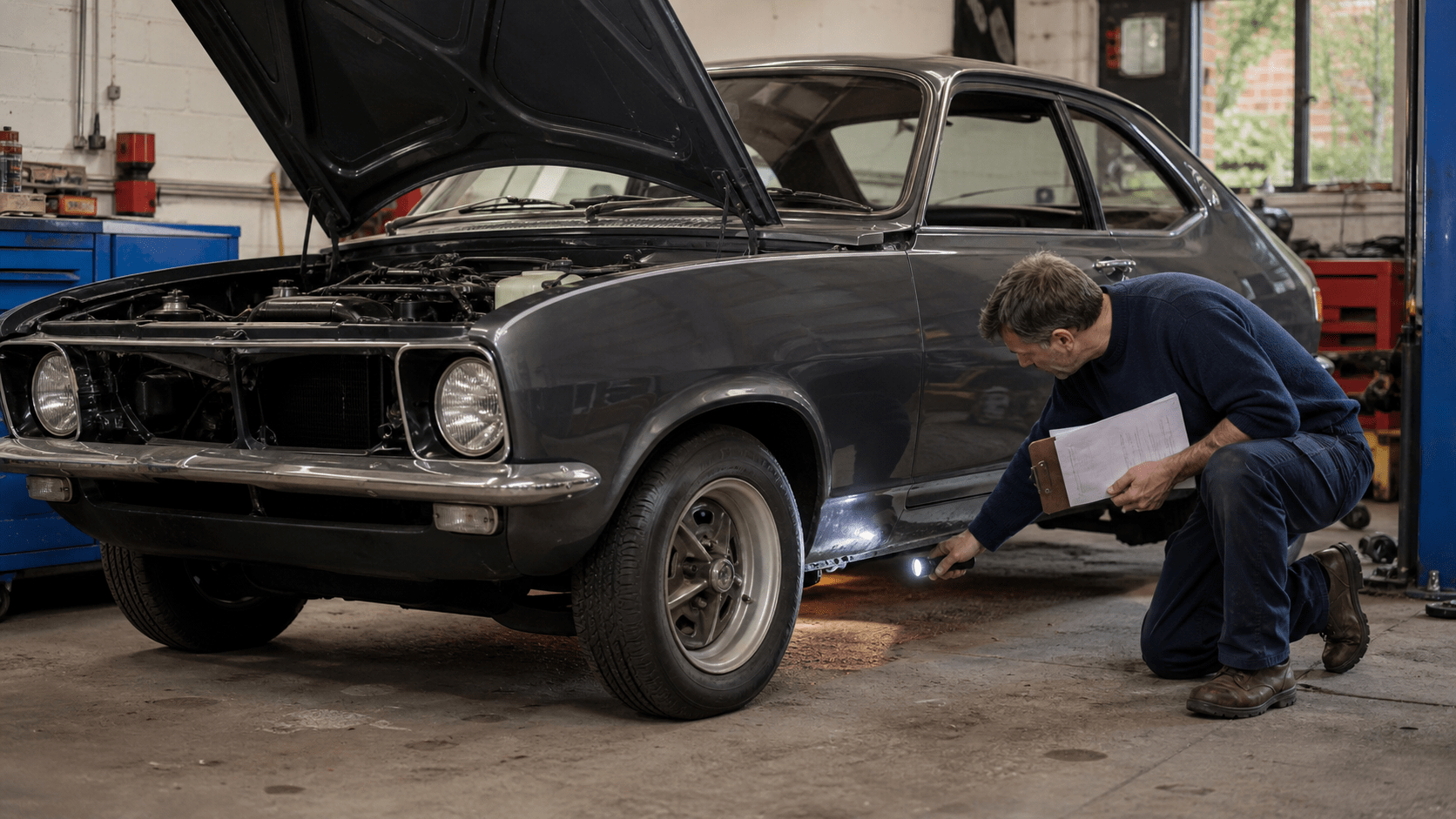
Structural corrosion can consume a restoration budget faster than an untidy interior or tired engine. Take a bright torch, gloves, overalls, a mat and—only with the seller’s agreement—a magnet or non-destructive paint-depth tool. Never crawl beneath a car supported only by a jack.
Start low and work methodically
Inspect sills, jacking points, floor edges, chassis rails, crossmembers, bulkheads, inner wings, suspension and seat-belt mounts. Look for swelling seams, perforation, distorted panels, new underseal over uneven surfaces and patches welded over rather than into sound metal.
Study door gaps and how panels sit. Sagging openings, cracked paint around pillars or doors that lift as they close can suggest structural weakness. On separate-chassis cars, inspect the chassis as carefully as the body and check that body mounts have not deteriorated.
Assess the engine, drivetrain and running gear
A non-running engine should be valued as an unknown engine—not one that merely needs a battery. Ask when it last ran, why it stopped and what testing has actually been done. Check whether the engine turns by the correct safe method, examine oil and coolant condition and look for dismantled components, open ports and long-term water ingress.
Engine
Check completeness, fluids, obvious damage, seized ancillaries, evidence of overheating and whether a rebuild is already partly dismantled.
Transmission
Confirm the gearbox and differential are correct, installed and complete. Missing linkages, mounts and model-specific parts add time and cost.
Brakes and suspension
Assume a long-stored car needs careful recommissioning. Corroded pipes, seized brakes, degraded bushes, old tyres and tired dampers are safety priorities.
Inventory every missing part
A project that appears complete can be missing hundreds of brackets, clips and fixings. Photograph and inventory loose parts. Pay particular attention to model-specific glass, lights, brightwork, instruments, interior trim, bumpers, badges and one-year-only components. An available replacement engine may be easier to find than an obscure piece of exterior trim.
For an unfinished restoration, ask for the dismantling photographs and labelling system. Boxes marked “all parts included” are not evidence until their contents have been checked. Confirm which components belong to this car and which are merely unrelated spares.
Examine work already completed
Someone else’s labour only adds value when the standard is good. Inspect welding penetration and finish, panel alignment, paint preparation, wiring terminations, fuel lines, brake pipes and fastener choice. Ask who completed specialist engine, machining, paint or structural work and request invoices.
Fresh paint can be encouraging, but it can also conceal rushed preparation. A partly restored shell may need stripping again if corrosion, filler or poor repairs remain underneath.
Calculate the real project-car budget
Start with the price needed to collect and store the car. Then add parts, shipping, tools, consumables, tyres, brakes, glass, trim, machining, upholstery, paint, specialist labour, testing and registration work where relevant. Build in a contingency for problems that become visible only after dismantling.
Compare the evidence-based total with the price of a sound completed example. A project does not have to make a profit to be worthwhile, but the likely cost and timescale should be understood before purchase.
Questions to ask the seller
- How long have you owned the car, and is it registered in your name?
- When did it last run, drive and stop safely?
- Why was it taken off the road, and why did the project stop?
- Which parts are missing, damaged or known to be unusable?
- What structural, mechanical, paint or electrical work has been completed—and by whom?
- Can I see the V5C, VIN, invoices, MOT history and photographs from before dismantling?
- Can the car roll, steer and brake sufficiently for safe loading?
- Exactly what loose parts and spares are included in the sale?
Printable project-car inspection checklist
Print this page and take the following list to the viewing.
Identity and history
- Seller and location checked
- Original V5C inspected
- VIN/chassis and engine numbers matched
- MOT history and mileage reviewed
- Invoices, keys and restoration photographs present
- Written receipt planned
Body and structure
- Sills, floors and jacking points inspected
- Chassis rails and crossmembers inspected
- Bulkheads, inner wings and suspension mounts inspected
- Door gaps and panel alignment checked
- Previous welding and underseal examined
- Glass, trim and lights inventoried
Mechanical condition
- Reason for non-running status established
- Engine completeness and fluid condition checked
- Gearbox, differential and driveline present
- Brakes, steering and suspension assessed
- Tyre age and condition checked
- Wiring condition and modifications examined
Costs and collection
- Missing and unusable parts priced
- Professional work estimated
- Transport and loading arrangements confirmed
- Storage and workspace available
- Contingency added to budget
- Maximum purchase price written down before negotiation
Use the main hub to compare current unfinished and restoration projects, or move into the related replica and kit-car research section.
Project cars for sale and guide hubReplica and kit-car guides