
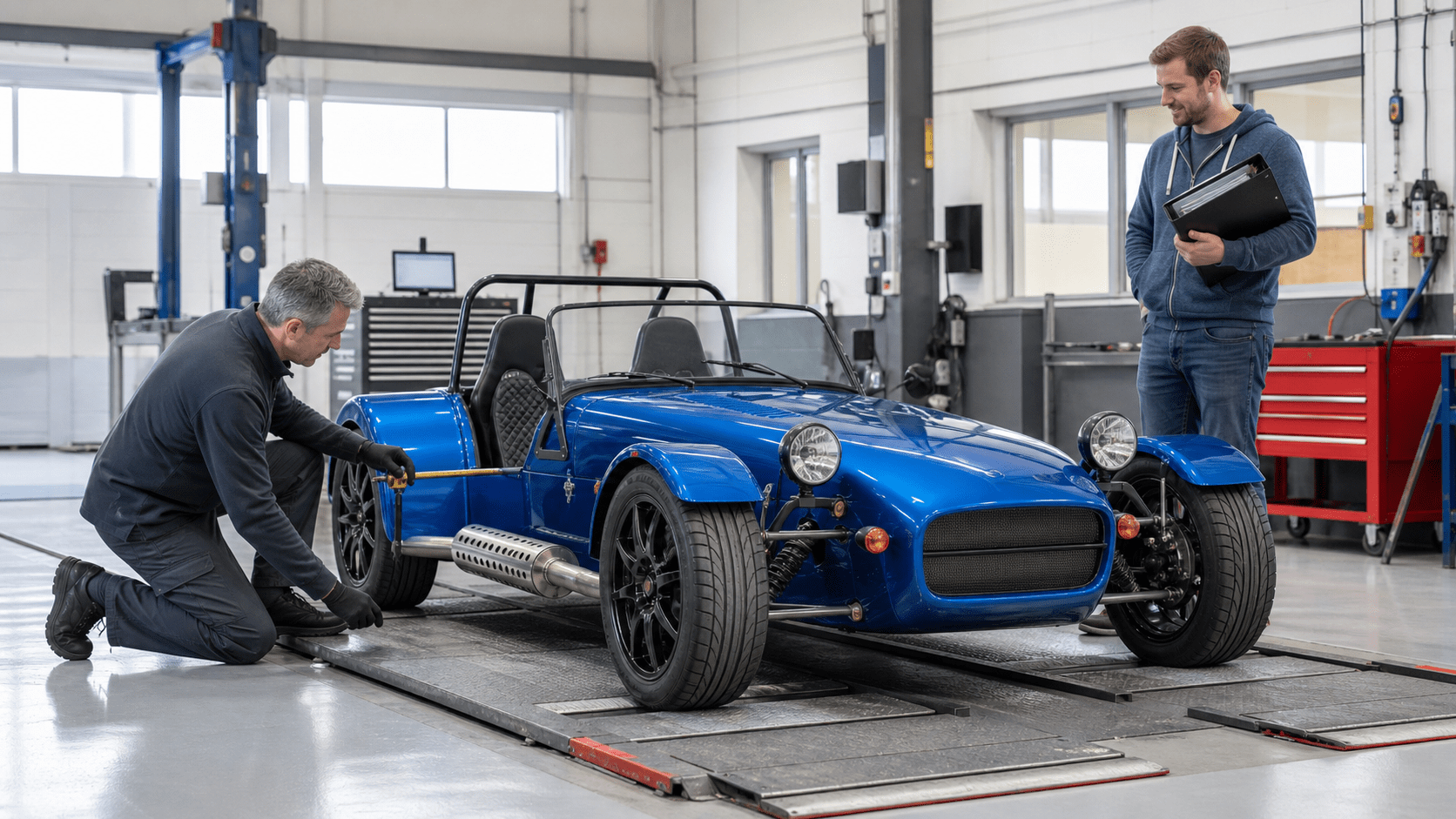
Registering a kit car in the UK starts with identifying what you have actually built. A car assembled from a new kit, a body conversion retaining a donor monocoque and a structurally altered production car do not necessarily follow the same route. This guide explains the current DVLA and Individual Vehicle Approval process in practical language, based on official guidance updated in 2026.
Kit-car registration: the process at a glance
Classify the project
Decide whether it is kit-built, kit-converted, structurally modified, rebuilt or another category. The structure and source of major components matter more than the appearance.
Record the build
Retain invoices, component identities, donor V5C, kit maker’s certificate of newness, plans and dated photographs. Photograph VINs before dismantling or modification.
Complete the vehicle
DVLA’s August 2026 INF318 guidance says notification should be made when the vehicle is fully built, complete and ready for road use. Early applications may be delayed or returned.
Obtain approval where required
Kit-built cars require type approval. Other built, rebuilt, radically altered or reconstructed cars may also require IVA, depending on their circumstances.
Apply to DVLA
Send the appropriate first-registration form and supporting evidence, including the parts statement, approval certificate and donor or newness documents where applicable.
Receive the registration outcome
DVLA assesses identity, construction and component evidence before deciding whether the vehicle receives a current, retained, age-related or Q registration.
First decide which type of vehicle you have
Kit-built vehicle
Official guidance defines this as a vehicle where all parts are supplied new by the manufacturer. All kit-built vehicles require type approval. A current registration can be available when the vehicle is built from new parts, or with no more than one qualifying reconditioned part that is not the chassis, monocoque or frame.
Kit-converted vehicle
This is a kit of new parts added to an existing vehicle, or old parts added to a manufactured kit body, chassis or monocoque. The general appearance changes and DVLA guidance says this results in a different description on the V5C.
Structurally modified vehicle
Changing the dimensions or appearance of a chassis, monocoque or frame can be a structural modification. Examples include cutting roof pillars or changing load-bearing subframes. These changes must be notified to DVLA and should be undertaken by specialists.
Reconstructed classic
This scheme supports qualifying unregistered vehicles reconstructed using genuine period components. It has specific age, specification, owners’ club, VIN and MOT requirements and should not be assumed to cover a newly created classic-style replica.
When does a kit car need IVA?
Individual Vehicle Approval is the DVSA process for checking a single vehicle or very small number of vehicles against applicable construction and safety standards. Official guidance says approval may be required where a car has been built, rebuilt, radically altered, reconstructed or imported. All kit-built vehicles require type approval.
Amateur-built vehicles such as kit cars can normally use the Basic IVA route, subject to the precise classification and requirements. An amateur-built declaration must accompany the application. IVA is not an MOT: IVA examines the way the car was constructed or adapted; an MOT assesses roadworthiness at the time of the test.
Apply for car IVA Read the current IVA manual
What IVA inspectors check
The passenger-car IVA manual is extensive. The relevant standards depend on the vehicle, but common build areas include:
- vehicle identification and statutory plates
- brakes, steering and suspension
- seat-belt anchorages and seats
- lighting, reflectors and rear fog lamps
- mirrors, field of vision, wipers and washers
- speedometer and audible warning
- fuel tanks, fuel lines and exhaust
- emissions and engine-age evidence
- interior fittings and exterior projections
- tyres, wheels, guards and general construction
DVSA’s guide to common IVA failures highlights headlamp aim, general construction, brakes, rear fog lamps, exterior projections, speedometers, statutory plates, seat-belt anchorages, emissions and interior fittings. Designing around the manual from the beginning is usually easier than correcting a finished car.
Preparing for IVA
Use the current manual
Do not rely entirely on an old build diary or another owner’s test. Manuals and forms are revised. Use the version that applies when your car is presented and record any interpretation agreed with DVSA.
Preserve engine evidence
Engine age can affect the emissions standard applied. Retain reliable manufacturer or donor documentation showing engine identity and age rather than trying to reconstruct the evidence shortly before the test.
Carry out a pre-IVA inspection
A builder who has lived with the project can overlook sharp edges, labelling, lamp positions or small construction details. A fresh inspection by someone experienced with the current IVA manual is valuable.
Make the car accessible
Inspectors need to assess components. Avoid permanently hiding VINs, brake lines, anchorages and other relevant areas before the test. Bring organised supporting documents and any removable covers or tools reasonably required by the test centre.
Documents to keep during the build
| Evidence | Why it matters |
|---|---|
| Kit invoice and certificate of newness | Supports the source and new status of the kit and components. |
| Donor V5C and purchase receipt | Connects donor identity and major components to the project. |
| Component invoices | DVLA asks for identifiable suppliers, specification, provenance and serial or identification details where applicable. |
| Dated build photographs | Show the original VIN, construction sequence, structure and components before they become hidden. |
| Reconditioning evidence | Required when a component is claimed to have been reconditioned to an as-new standard. |
| Plans and maker information | Help describe what was built and the intended component specification. |
| IVA paperwork | The approval certificate is required for registration where IVA applies. |
Which DVLA forms are used?
The exact pack depends on the vehicle. Current INF318 guidance identifies:
- V55/4 — application for first vehicle tax and registration of a new motor vehicle, used for new kit-built vehicles.
- V55/5 — application for first vehicle tax and registration of a used motor vehicle.
- V627/1 — vehicle parts statement, recording the origin of major components.
- V627/3 — modified vehicle statement for relevant structural-modification notifications.
Other evidence can include the IVA certificate, MOT where required, certificate of newness, donor V5C, identity and address documents, receipts, vehicle tax, registration fee and NOVA confirmation where applicable. Check the current instructions rather than copying an old application pack.
Current, retained, age-related and Q registrations
Current registration number
A qualifying kit-built vehicle made from new parts can receive a current registration. Official guidance also allows one qualifying reconditioned component, excluding the chassis, monocoque or frame, when evidence shows it was reconditioned to an as-new standard.
Retaining the donor registration
DVLA says a kit-converted vehicle can keep the original registration when it uses the original unaltered chassis or monocoque together with two other original major components.
Age-related registration
A kit conversion using a new specialist chassis or monocoque, or an altered donor structure, with two original major donor components can receive a replacement registration based on the donor’s age, subject to the stated approval requirements.
Q registration
A Q registration can be issued where the conditions for another registration are not met or the vehicle’s age or identity is uncertain. It is not automatically evidence of a poor build, but it tells future buyers that age or identity could not be established for another registration outcome.
The six major components DVLA considers
For cars and light vans, the August 2026 INF318 guidance lists:
- chassis or monocoque bodyshell
- engine or electric motor
- transmission
- steering assembly
- axles
- suspension
Record exactly which vehicle or supplier provided each component. Avoid mixing identities or assuming that a donor registration can simply be transferred to a newly constructed vehicle.
After IVA: applying to DVLA
When the completed vehicle has the required approval, assemble the DVLA registration pack carefully. INF318 directs kit and rebuild applications to Kits and Rebuilds, D10, DVLA, Swansea, SA99 1ZZ. DVLA may request an inspection to verify the vehicle, VIN, evidence and particulars before issuing the V5C.
Do not book non-refundable events or promise a registration outcome based on an assumed timescale. DVLA can request clarification or further evidence, and incomplete applications can be delayed or returned.
Common mistakes that cause problems
- Buying a donor without preserving its V5C, VIN and purchase evidence.
- Cutting or modifying a monocoque without checking how the work affects classification.
- Relying on a passed MOT as proof of IVA compliance or correct registration.
- Using receipts that do not identify the supplier, component or provenance.
- Hiding anchorages, lines or VIN markings before recording and inspection.
- Building to an outdated IVA manual or copying another car’s interpretation.
- Submitting the DVLA notification before the vehicle is complete and ready for road use.
- Assuming DVLA can guarantee a number-plate outcome before examining the full evidence.
Frequently asked questions
Does every replica car need IVA?
Not necessarily. The answer depends on whether it is kit-built, kit-converted, structurally modified or another category, what structure remains and what approval already applies. All kit-built vehicles require type approval, while an individual conversion must be assessed on its facts.
Can a kit car keep its donor registration?
A kit-converted vehicle can qualify to retain the donor registration where it uses the original unaltered chassis or monocoque and two other original major components. This should not be confused with assigning a donor identity to a new chassis.
Is IVA the same as an MOT?
No. IVA assesses construction or adaptation against approval standards. An MOT assesses roadworthiness at the time of the test. A vehicle may pass an MOT without satisfying IVA requirements.
When should I apply to DVLA?
Current INF318 guidance says the notification should be made only when the vehicle is fully built, complete and ready for road use. Obtain any required approval first and include the evidence requested for the relevant route.
Can DVLA confirm my registration number before I build?
DVLA says it cannot confirm the outcome in advance because the complete evidence and vehicle record must be reviewed. Early advice can help classify the project, but it is not a guaranteed decision.
Donor-vehicle guide Used-replica buying checklist All replica & kit-car guides
This article is general editorial guidance, not legal, engineering or registration advice. Rules, forms and individual circumstances can change. Check current DVLA and DVSA instructions and obtain appropriate professional advice for your vehicle. Northern Ireland has separate guidance and processes in some areas.