
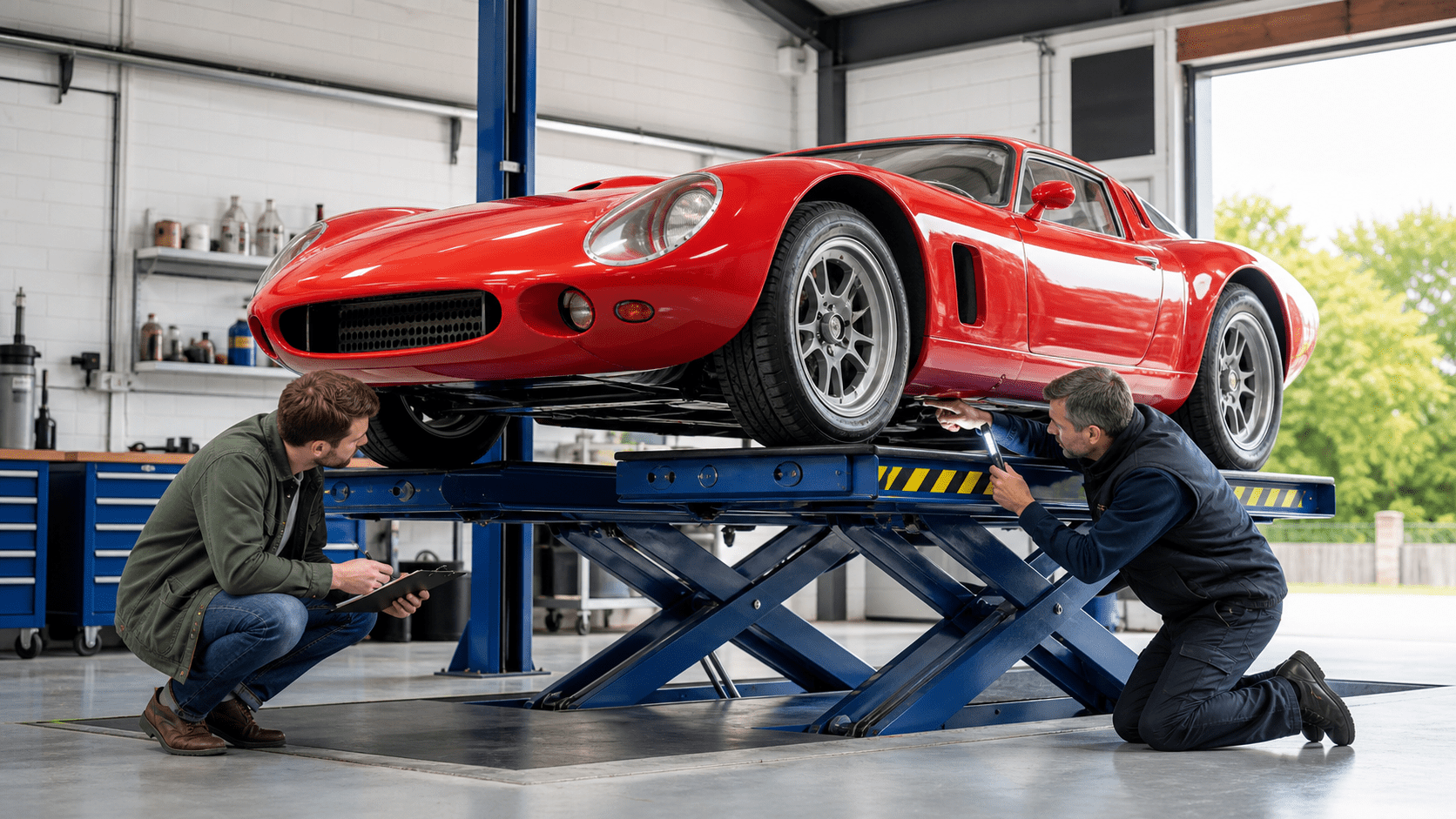
A used replica car needs a more searching inspection than an ordinary production car. You are assessing the donor vehicle, the conversion, the builder’s workmanship and the registration history at the same time. This UK buying checklist explains what to examine before money changes hands, whether the car is finished, recently built or an abandoned project.
Before arranging a viewing
Ask for the registration number, exact V5C description, donor model, kit or body manufacturer, approximate build date and several clear photographs of the engine bay, interior and underside. Confirm whether the seller is the registered keeper and how long they have owned the car.
Use the official MOT-history service before travelling. Look beyond the latest pass: repeated corrosion, brake imbalance, suspension play, tyre defects and unexplained mileage changes reveal patterns. A current MOT is useful evidence, but DVLA notes that a vehicle can still be unsafe because the test records its condition only at the time it was examined.
Check MOT history Check current MOT status
1. Identity, V5C and registration
Match the vehicle to the documents
Compare the number plate, VIN or chassis number, engine details, colour, fuel type and seating capacity with the physical car. Inspect the stamped or manufacturer-applied VIN rather than relying on a loose plate or paperwork alone.
Read the vehicle description
The V5C should make sense for the vehicle in front of you. A kit conversion normally changes the vehicle’s general appearance and can result in a different description. Do not accept “they all stay registered as the donor” as proof.
Understand the registration mark
An original, age-related or Q registration can each be legitimate, depending on the build and components used. The important question is whether the registration outcome and supporting records fit the actual construction.
Keep a paper trail
Useful evidence includes kit invoices, donor receipts, build photographs, IVA or approval documents where applicable, engineering invoices, wiring diagrams, manuals and records of major replacement components.
2. Chassis, monocoque and bodywork
Determine what carries the loads. A rebody may retain much of the donor monocoque; another car may use a separate space-frame chassis; a traditional replica may combine a specialist frame with donor suspension and drivetrain components.
- Inspect chassis rails, outriggers, floors, sills, suspension pick-up points and seat-belt mountings.
- Look for corrosion around welds, tubes and boxed sections, including fresh underseal concealing repairs.
- Check weld consistency, alignment, cracked coatings and signs of previous impact damage.
- Inspect body mounts, door hinges and bonnet catches; flexing, cracking and irregular gaps may indicate poor support or accident repair.
- Look along fibreglass panels in good light for ripples, star cracks, blistering, sink marks and repairs visible from the reverse side.
If possible, arrange a lift inspection with a specialist familiar with kit or low-volume cars. Crawling beside a parked car rarely reveals enough.
3. Donor vehicle and mechanical condition
The finished body does not erase the donor’s age. Identify the engine, gearbox, steering, suspension, hubs, brakes, ECU and instruments, then assess parts availability and whether the specification matches the seller’s description.
| Area | Checks | Warning signs |
|---|---|---|
| Engine | Cold start, oil pressure, smoke, leaks, idle and service evidence. | Already warm on arrival, coolant pressurisation, heavy breathing or unexplained warning lights. |
| Cooling | Radiator, hoses, fan operation, header tank and stable temperature in traffic. | Temporary wiring, missing ducting, bubbling coolant or repeated overheating history. |
| Transmission | Clutch take-up, every gear, differential noise, driveshafts and mountings. | Gear selection problems, vibration, oil leaks or mismatched components. |
| Brakes | Pedal feel, balance, hoses, pipes, handbrake and component identity. | Pulling, long pedal travel, seized adjusters or improvised brackets. |
| Suspension | Joints, bushes, dampers, springs, alignment and tyre wear. | Bump steer, fouling, coil binding, cracked mounts or tyres rubbing the body. |
Compare popular donor vehicles
4. Wiring, lighting and cabin safety
Electrical problems can be time-consuming because a replica may combine the donor loom with bespoke gauges, lighting and switches. Test everything, including headlights, indicators, hazard lights, fog lamp, brake lights, wipers, washer, horn, heater fan, cooling fans, charging and instruments.
- Look for labelled circuits, proper fusing, protected terminals, relays and secure loom routing.
- Watch for household connectors, twisted wires, exposed joins and cables close to hot or moving parts.
- Inspect seats, runners, belt anchorages, steering-column security and pedal clearance.
- Check visibility through mirrors and windscreen and confirm that doors and emergency releases work reliably.
5. Wheels, tyres and exterior details
Large wheels can transform appearance while making the car worse to drive. Confirm tyre age, load and speed suitability, matching axle pairs, adequate tread and clearance throughout steering and suspension travel. Inspect wheel offsets, spacers and fasteners. Look for sharp or insecure exterior fittings, poor lamp installation and bodywork contacting tyres or exhaust components.
6. The test drive
Do not test drive an uninsured or obviously unsafe vehicle. Start with the seller driving so you can listen and observe. Then, where legal and insured, assess low-speed steering, clutch control, brake balance, straight-line stability, ride, engine temperature and hot restarting.
- The car should track predictably without constant correction.
- Brakes should stop it squarely without locking prematurely or producing excessive pedal travel.
- Watch the temperature in slow traffic as well as at speed.
- Listen for chassis knocks, drivetrain vibration, wheel rubbing and body movement.
- Afterwards, recheck underneath for new leaks and smell for hot wiring, coolant or brakes.
7. Insurance, valuation and future ownership
Obtain an insurance indication before paying a deposit. Give the insurer the precise registered description, modifications, engine, intended mileage and storage arrangements. Confirm whether the policy uses an agreed value and what evidence is needed.
Value depends on more than the badge the car resembles. Build quality, registration clarity, chassis condition, parts support, maker reputation and documentation generally matter more than paint colour or claimed build cost. Price incomplete cars conservatively: missing trim, glazing, bespoke hinges or obsolete kit parts can be disproportionately expensive.
Questions to ask the seller
- Who built the car, when, and using which kit and donor?
- What structural alterations were made?
- Why does the V5C describe the vehicle as it does?
- Was IVA or another approval required, and is the evidence available?
- Which parts are bespoke and where can replacements be bought?
- Has it overheated, suffered accident damage or failed an MOT on structure?
- What faults would the seller repair if keeping it?
- Which spare parts, manuals, moulds, keys and immobiliser components are included?
Printable replica-car viewing checklist
Vehicle: ____________________ Registration: ____________________
Seller: ____________________ Date: ____________________
- ☐ Original V5C seen; seller and address make sense
- ☐ VIN/chassis number physically inspected and matched
- ☐ V5C description, engine, colour and seats checked
- ☐ MOT history reviewed before viewing
- ☐ Kit, donor and builder identified
- ☐ Build photographs, receipts and approval records examined
- ☐ Chassis/monocoque and suspension mounts inspected underneath
- ☐ Fibreglass, panel mounting, catches and hinges checked
- ☐ Engine started from cold; fluids and cooling checked
- ☐ Gearbox, clutch, brakes, steering and suspension assessed
- ☐ Tyres, wheels, clearance and alignment examined
- ☐ All lights, instruments, fans, wipers and switches tested
- ☐ Seats, belts, pedals and steering-column security checked
- ☐ Insured/legal test drive completed
- ☐ Hot restart and post-drive leak inspection completed
- ☐ Insurance quotation or indication obtained
- ☐ Independent specialist inspection considered
Estimated immediate work: ________________________________________________
Maximum sensible price: _________________________________________________
Frequently asked questions
Is a Q registration automatically bad?
No. A Q registration can be a legitimate outcome where a vehicle’s age or identity cannot be established sufficiently for another registration. Judge the individual car’s documentation, construction, condition, insurance position and value rather than treating the prefix alone as proof of poor quality.
Does an MOT prove a replica was registered correctly?
No. An MOT records roadworthiness at the time of the test; it is not the same as IVA and does not by itself resolve vehicle identity or registration questions.
Should I buy an unfinished replica project?
Only after inventorying every component and establishing that missing bespoke parts remain obtainable. Also verify the donor identity, ownership, chassis and registration route before valuing the collection.
Is a specialist inspection worthwhile?
Usually, especially for an unfamiliar design, high-value car or vehicle with limited build evidence. Choose someone who understands fabricated chassis, donor components and low-volume vehicles—not only the original car being imitated.
Replica & kit-car guides Current DVLA guidance
This is general editorial guidance, not legal, engineering, registration or insurance advice. Requirements depend on the individual vehicle and can change; consult DVLA, DVSA, your insurer and appropriate specialists.