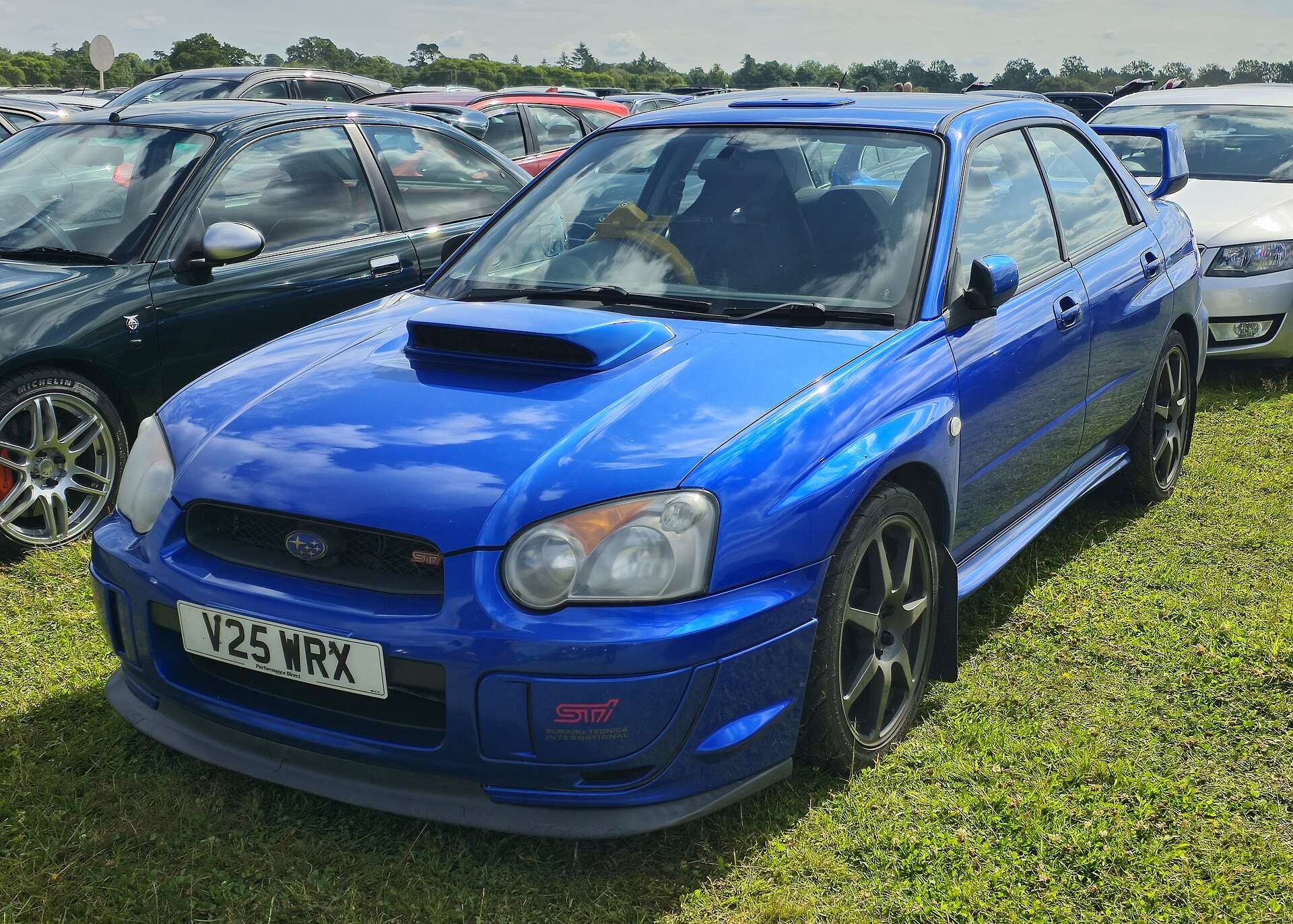
The Subaru Impreza WR1 was the most focused official UK Impreza of the blobeye era. Built to celebrate Petter Solberg’s 2003 World Rally Championship drivers’ title, it combined an STI Type UK base with a Prodrive-developed 320PS conversion, sharper suspension and the first Driver Controlled Centre Differential offered on a UK-market Impreza. Just 500 were made, all finished in Ice Blue metallic.

A championship celebration
Petter Solberg secured the 2003 WRC drivers’ championship for Subaru after a season-long contest that ended at Wales Rally GB. Subaru UK marked the achievement with a special road car created alongside Prodrive, the Banbury organisation that ran the works rally programme. The name combined World Rally with the champion’s number one status.
Unlike cosmetic limited editions, the WR1 received changes that materially altered its performance. Every car began as a right-hand-drive STI Type UK and was finished in model-specific Ice Blue. Production was limited to 500 numbered examples for Britain.
Prodrive’s 320PS package
The two-litre turbocharged flat-four gained revised engine management, a freer-flowing exhaust and supporting changes developed by Prodrive. Output rose to 320PS, normally quoted as 316bhp, with 420Nm of torque. Contemporary figures claimed 0–62mph in about 4.25 seconds and 0–100mph in approximately 10.7 seconds.
The most significant drivetrain feature was DCCD. A rotary controller allowed the driver to vary the centre differential’s locking strategy, while an automatic mode managed the torque split electronically. It brought the UK car closer to Japanese-market STI specification and gave experienced drivers more influence over its balance.
Chassis, wheels and identity
Prodrive springs lowered the ride height and worked with the STI’s inverted dampers. Anthracite 18-inch Prodrive P-FF7 wheels, a stainless mesh grille, high-intensity driving lamps and WR1 badging completed the package. The result was immediately recognisable without abandoning the functional aggression of the standard STI.
Inside, the WR1 retained the supportive blue-and-black STI seats, Momo steering wheel and practical four-door layout. It was still a usable family saloon, but firmer suspension, road noise and a demanding clutch made its priorities clear.
Specifications
| UK production | 500 numbered cars, 2004 |
|---|---|
| Engine | 1,994cc turbocharged flat-four |
| Power | 320PS / approximately 316bhp |
| Torque | 420Nm / approximately 310lb ft |
| Transmission | Six-speed manual, permanent four-wheel drive with DCCD |
| Claimed 0–62mph | Approximately 4.25 seconds |
| Colour | Ice Blue metallic only |
| Wheels | 18-inch Prodrive P-FF7 |
How it drives
The WR1 is fast even by modern standards. Its engine has little interest in disguising turbo lag, then delivers a hard-edged rush as boost arrives. Close ratios keep the engine in its strongest range, and the six-speed gearbox feels substantially more robust than the five-speed units used in lesser Imprezas.
On a rough road the lowered chassis can feel busy, but the steering, brakes and traction create enormous confidence. DCCD adds another layer: it can make the car feel more tightly tied together in poor conditions or permit a more agile balance when the surface and driver allow.
Buying guide
Confirm it is a genuine WR1
Check the VIN, numbered plaque, Ice Blue paint, original wheels and supporting invoices. Replica badges and wheels are readily available. A history file showing supply through the UK network and Prodrive specification is essential for a collectible example.
Engine health
Compression and leak-down tests are sensible on any expensive candidate. Listen for bottom-end knock, inspect for oil and coolant leaks, and check that boost is smooth. Poor remaps, excessive boost and inadequate fuelling can damage pistons. A standard or conservatively maintained engine with regular oil changes is preferable to a heavily modified one.
Gearbox, differentials and clutch
Test every gear from cold and hot, listen for bearing noise and make sure DCCD responds without warning lights. Tight slow-speed manoeuvres should not produce violent binding. A very heavy clutch may be an aftermarket item; verify its specification and installation quality.
Body and chassis
Inspect rear arches, sills, subframes, suspension mounting points and brake pipes. Look for uneven tyre wear and cracked wheels. Many cars have been used on track or repaired after accidents, so examine inner wings, boot floor and panel gaps carefully.
Why the WR1 matters
The WR1 belongs to the short period when Subaru UK and Prodrive could translate a world rally title directly into a showroom special. It is rarer than most later STIs, technically more significant than a trim-led edition and fast enough to remain thrilling. Originality, condition and evidence of careful maintenance now matter more than headline modifications.