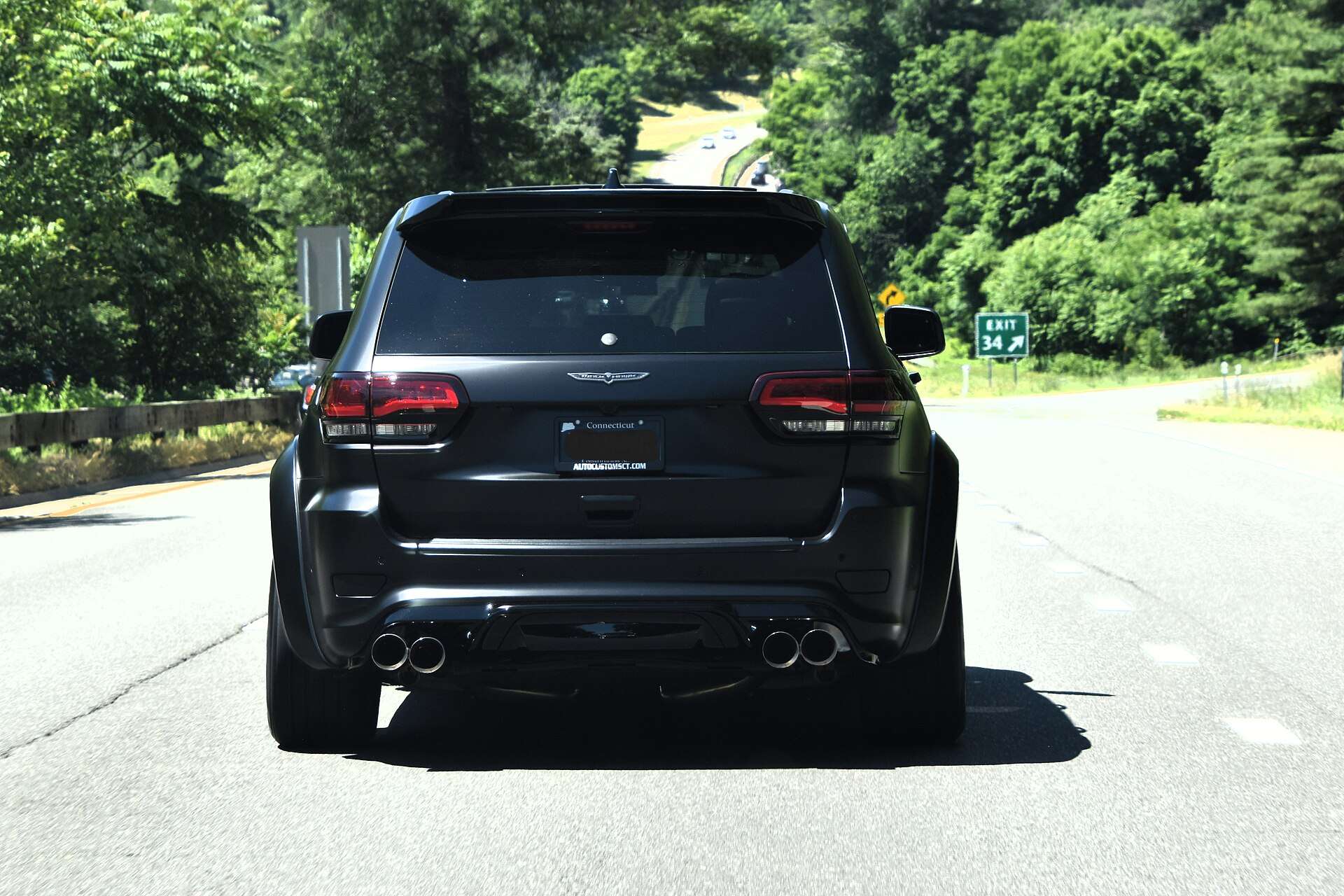
The Jeep Grand Cherokee Trackhawk was one of the most improbable performance cars officially sold in Britain. It combined a family-sized four-wheel-drive body with the 6.2-litre supercharged Hellcat V8, 710hp and acceleration that embarrassed contemporary sports cars. Only 20 examples were allocated to the UK for its first year, so a genuine right-hand-drive Trackhawk is now a particularly rare sight.
Trackhawk history and the UK launch
Jeep revealed the Trackhawk for the 2018 model year as the ultimate development of the WK2 Grand Cherokee. UK pricing followed in November 2018 at £89,999 on the road. The official announcement stressed that only 20 cars would be available that year, immediately making the model scarcer in Britain than most supercars.
Unlike a grey-import conversion, the UK Trackhawk was a factory right-hand-drive model with British-market equipment. Its understated shape was part of the appeal: beyond the vented bonnet, deeper front bumper, 20-inch wheels, yellow Brembo calipers and four exhaust outlets, it could be mistaken for a well-specified diesel Grand Cherokee.
Engine, transmission and performance
Under the bonnet sits Chrysler’s supercharged 6.2-litre Hemi V8. UK figures were 710hp and 868Nm, channelled through a strengthened eight-speed TorqueFlite automatic gearbox and permanent four-wheel drive. Jeep quoted 0-62mph in 3.7 seconds and a 180mph maximum speed.
The Selec-Track system provides Auto, Sport, Track, Snow and Tow modes. Launch Control manages the violent standing start, while adaptive Bilstein dampers and an electronic limited-slip rear differential help the chassis use the engine’s output. Huge Brembo brakes—six-piston front and four-piston rear—are essential rather than decorative.
What is a Trackhawk like to own?
The Trackhawk remains a large, comfortable five-seat SUV with a useful boot and substantial towing ability. In normal driving the gearbox shifts unobtrusively and the ride is more civilised than the specification suggests. Press the accelerator hard, however, and the supercharger whine and relentless thrust define the experience.
Fuel consumption is predictably severe. Low-to-mid teens mpg is realistic in mixed enthusiastic use, while tyres, brakes, insurance and tax all belong in the high-performance-car category. This is not a cheap Grand Cherokee with a large engine; it requires supercar-sized running-cost reserves.
Jeep Grand Cherokee Trackhawk common problems
Supercharger noise and drive system
Listen for abnormal bearing rattle, grinding or an uneven supercharger note rather than the normal high-pitched whine. Check the auxiliary drive, cooling system and service history carefully. Any tuning increases heat and mechanical load, so standard cars with documented maintenance are preferable.
Eight-speed automatic and transfer case
Gear changes should be decisive without flaring, thumping or hesitation. Repeated launches and poorly executed power upgrades can stress the gearbox, driveshafts and transfer case. Test every drive mode and look underneath for leaks.
Brakes, tyres and suspension
Replacement Brembo discs and pads are expensive. Inspect for a lip, vibration and uneven wear, and make sure all four tyres are a matched premium set. Adaptive dampers should remain quiet and control the body cleanly; warning lights or a harsh, bouncy ride deserve investigation.
Electronics and security
Check the Uconnect screen, cameras, parking assistance, adaptive cruise control, heated and ventilated seats and every driver-assistance feature. Trackhawks are also desirable to thieves, so confirm that keys, immobiliser, tracker and any additional security installation are complete and professionally fitted.
How to identify a genuine UK Trackhawk
- Check the VIN and obtain the factory build specification.
- Look for the 200mph instrument display, Trackhawk Performance Pages and model-specific Laguna leather.
- Confirm the supercharged door badges, boot badge, vented bonnet, quad exhausts and yellow Brembo calipers are original.
- Compare the history with Jeep dealer records and invoices rather than relying on badges.
- Be cautious of ordinary SRT models cosmetically converted to resemble a Trackhawk.
Trackhawk buying checklist
- Start the engine from cold and listen for knocks, prolonged rattles or supercharger bearing noise.
- Scan every control module for stored faults.
- Check coolant and oil condition and insist on evidence of correct-grade fluids.
- Test the gearbox in normal and manual modes once fully warm.
- Inspect the underside, differential, transfer case and driveshafts.
- Measure brake and tyre life before agreeing a price.
- Confirm whether the ECU has ever been tuned.
Verdict
The Trackhawk is rare, outrageously fast and much more usable than its performance suggests. The best examples are original UK cars with meticulous histories and no unexplained modifications. Buy on condition and provenance rather than mileage alone, and budget for maintenance as though purchasing an exotic performance car—because mechanically, that is exactly what it is.
Research sources included Jeep UK/Stellantis launch material, official specifications and marque-specialist ownership guidance. Specifications can vary by model year; verify an individual vehicle by VIN.