
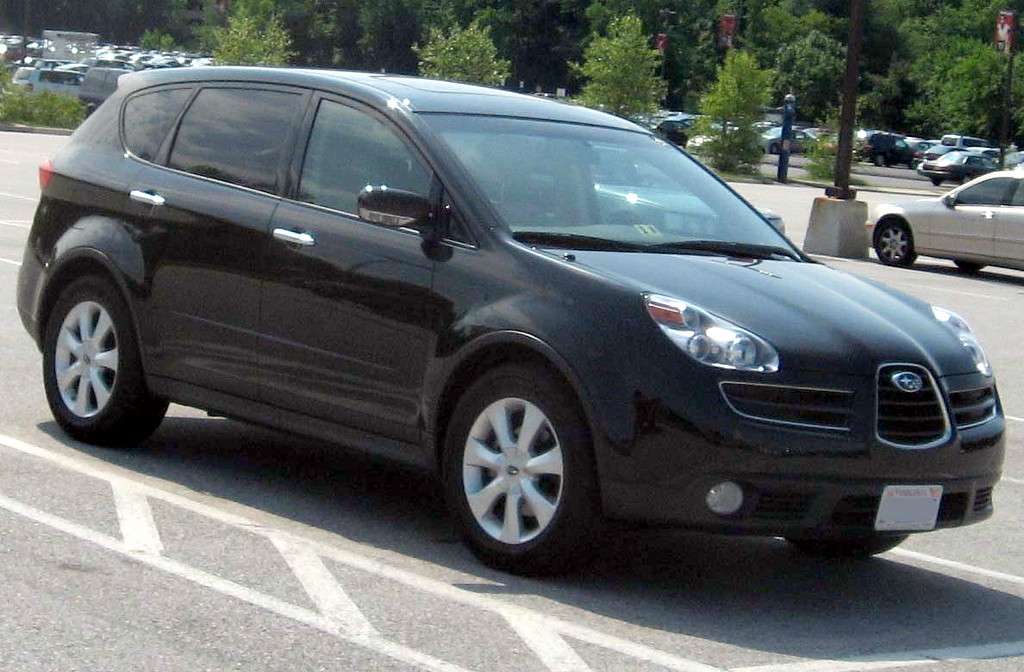
The Subaru B9 Tribeca was one of the boldest and least commercially successful cars officially sold by Subaru in Britain. A large American-built SUV with a 3.0-litre flat-six, permanent four-wheel drive and five or seven seats, it arrived in UK showrooms in November 2006 with prices beginning at £28,995. Its unusual nose and appetite for petrol ensured rarity almost immediately.

Subaru’s move upmarket
The Tribeca was conceived primarily for North America and built at Subaru’s Indiana plant. Its name referred to New York’s TriBeCa district, while the B9 prefix briefly formed part of Subaru’s intended global naming strategy. It was the brand’s first large SUV and its first production model with an optional third row of seats.
Britain received the car late in 2006. The range comprised five-seat S5 and SE5 versions plus the seven-seat SE7. Even the entry model was well equipped, while higher specifications added leather, navigation, a reversing camera, sunroof and, on the SE7, rear entertainment and separate ventilation controls.
The controversial design
The three-part grille was intended to recall Subaru’s aviation heritage, but the reaction dominated early coverage. The styling obscured a technically interesting package: the low-mounted boxer engine, four-wheel-drive system and relatively low roof created a lower centre of gravity than many similarly sized SUVs.
A rapid facelift appeared for the 2008 model year with a conventional grille and a larger 3.6-litre engine in some markets. British sales were already tiny, and the original 3.0-litre B9 version remains the model most closely associated with the UK launch.
Engine, transmission and performance
The only UK engine at launch was Subaru’s 2,999cc EZ30 flat-six, also used in the Legacy 3.0R. UK figures quoted around 245PS and 297Nm. A five-speed Sportshift automatic was standard, sending power through a permanently engaged four-wheel-drive system with a nominal rear bias that could be varied electronically.
Contemporary tests recorded 0–60mph in roughly nine to ten seconds and a top speed of 121mph. The engine is smooth and sounds distinctive at higher revs, but the Tribeca weighs close to two tonnes and official combined consumption was only about 23mpg. Real-world urban economy can fall well below that.
Specifications
| UK launch | November 2006 |
|---|---|
| Engine | 2,999cc naturally aspirated flat-six |
| Power | Approximately 245PS / 242bhp |
| Torque | 297Nm at 4,200rpm |
| Transmission | Five-speed Sportshift automatic |
| Drive | Permanent four-wheel drive |
| Seating | Five or seven |
| UK price when new | From £28,995 |
| Official combined economy | Approximately 23mpg |
On the road
The Tribeca feels less cumbersome than its dimensions suggest. The steering is accurate, body control is good for a large SUV and the permanent four-wheel drive gives secure traction. It is happiest as a quiet long-distance family car rather than a sports model or serious off-roader.
The five-speed automatic is smooth but can hunt for ratios when the engine is asked to move a full complement of passengers. The six-cylinder engine makes progress refined rather than urgent. Large tyres and firm low-speed ride are the trade-offs for its road-focused handling.
Cabin and practicality
The sweeping dashboard, twin instrument binnacles and metallic-effect trim were unlike other Subarus of the period. Front and middle-row space is generous, but the optional third row is best reserved for children. With seven seats raised, luggage room is limited.
The SE7’s equipment level remains impressive, but age has not been kind to every navigation screen, DVD player or electrical accessory. Replacement trim and model-specific electronic parts can be difficult to locate because so few UK cars were sold.
Buying guide
Engine and cooling system
The EZ30 is generally durable, but maintenance access is tight. Check for oil leaks, cooling-system pressure, overheating and timing-chain noise. Misfires may come from coils or plugs, both labour-intensive jobs. A complete service record is more important than low mileage alone.
Automatic transmission and four-wheel drive
Changes should be smooth from cold and hot, with no delay selecting drive or reverse. Warning lights, shuddering or a burnt-fluid smell require investigation. Confirm that all four tyres match closely in size and wear.
Suspension, brakes and tyres
The Tribeca is heavy, so bushes, wheel bearings, dampers and brakes work hard. Listen for knocks and rumbling, check that it tracks straight and inspect the inner edges of all four tyres. Correct 18-inch tyres are not cheap.
Rust and underside condition
Inspect subframes, suspension mounts, brake pipes, exhaust and the underside around plastic covers. Cars used for towing or winter transport deserve extra scrutiny. Cosmetic body parts, lamps and bumper trim can be harder to source than mechanical service items.
Running costs
Fuel consumption and high emissions place the Tribeca in an expensive tax and running-cost bracket. Before buying, check insurance, annual tax, tyre prices and the availability of a Subaru specialist. Low purchase prices do not make neglected examples cheap to own.
Why the B9 Tribeca matters
The Tribeca is an unusually pure example of Subaru doing things its own way: flat-six power, permanent four-wheel drive and unconventional design in a class dominated by diesel rivals. Its failure in Britain is part of its fascination. Survivors are scarce, distinctive and far more interesting than their modest values suggest.

