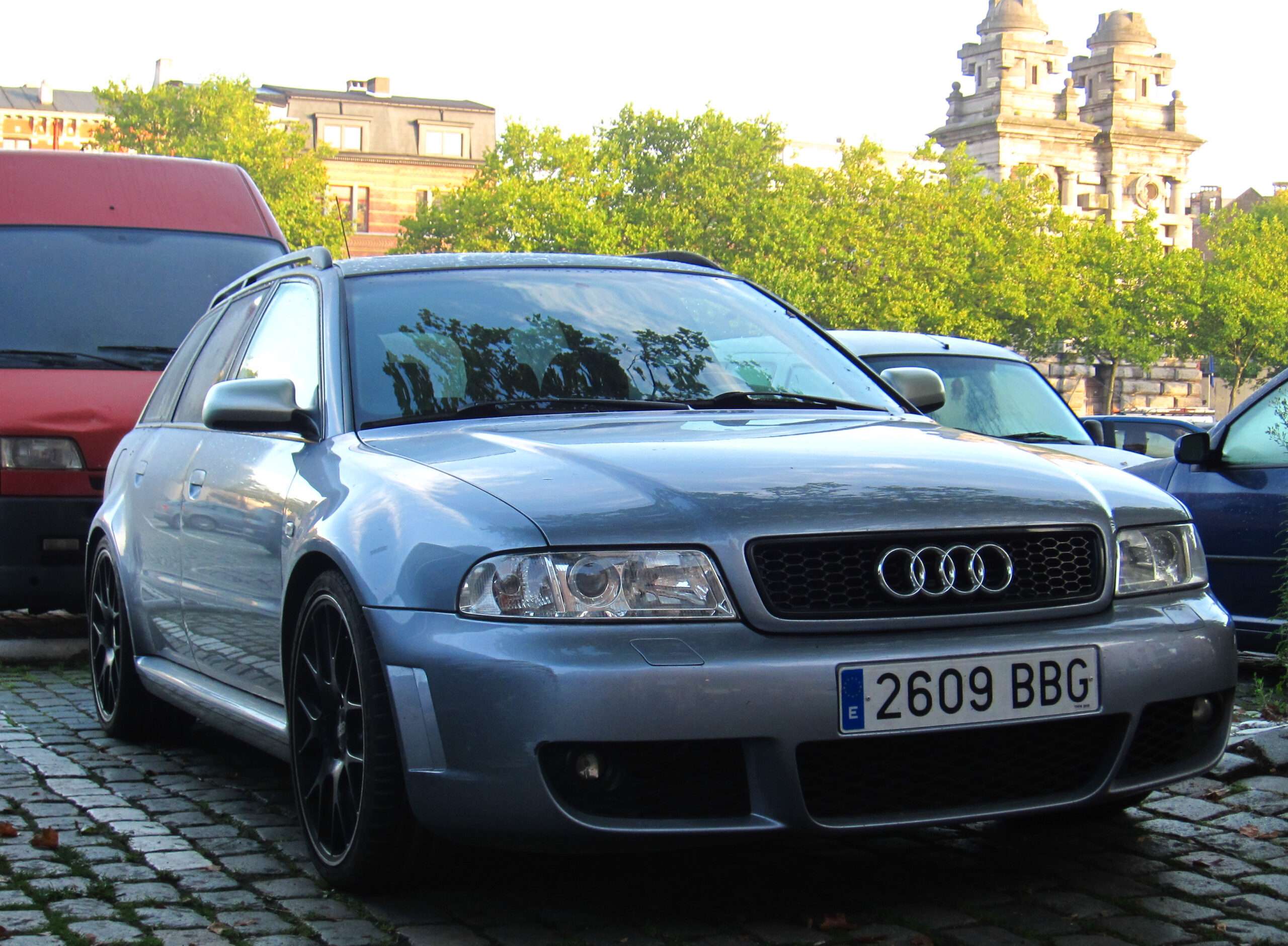
The B5 Audi RS4 Avant was the car that turned Audi’s fast-estate idea into a repeatable RS formula. Launched in 2000, it took the already rapid S4’s 2.7-litre biturbo V6, re-engineered it with quattro GmbH and Cosworth Technology, and delivered 380PS through a six-speed manual gearbox and permanent four-wheel drive. Audi planned 3,000 cars. Demand was strong enough for just over 6,000 to be built.
There had been an RS2, but the RS4 was different in one crucial respect: it was the first complete RS model developed independently by quattro GmbH. Its commercial success established a line that continues today and made the high-performance estate one of Audi’s defining products.
From Audi S4 to RS4
The starting point was the B5-generation Audi S4. Its compact 2.7-litre V6 used five valves per cylinder and two turbochargers, producing 265PS in European specification. For the RS4, Audi’s performance subsidiary worked with Cosworth Technology in Northampton to create something substantially more serious than a tuned S4.
Audi’s own history records redesigned cylinder heads, block and crankshaft assembly, enlarged intake and exhaust passages, bigger turbochargers, higher boost and larger intercoolers. The result was 380PS and 440Nm. Third and fourth gears were shortened, helping the Avant reach 100km/h in 4.9 seconds—sports-car pace from a practical five-door estate in 2000.

Why it was sold only as an Avant
The B5 RS4 was never offered as a saloon or coupé. That was deliberate rather than a compromise. The Avant body linked it directly to the RS2 and made its performance more surprising: wide arches, 18-inch wheels and deeper bumpers announced its intent, but the underlying shape remained that of a useful compact estate.
The layout also gave the RS4 a clear identity beside contemporary super-saloons. Its luggage space, split rear seat and all-weather traction were not excuses for the performance; they were central to the point of the car.

Hand-finished by quattro GmbH
The extensive changes could not simply be absorbed into the regular A4 production line. Audi describes B5 RS4 bodies arriving at quattro GmbH as “three-quarter cars”, without bumpers, sills or intercooling. The final quarter of assembly was completed by hand at Neckarsulm by a team recruited for the project.
The body itself required wider side frames around the rear wheels, while the completed car received model-specific cooling hardware, brakes, suspension and trim. Around 25 cars a day were completed during a production run of roughly 15 months.

Inside the B5 RS4
The cabin combined late-1990s Audi restraint with visible performance cues. Depending on market and specification, cars could have leather sports seats or more focused bucket seats, with carbon trim and an RS instrument cluster. It remains recognisably related to an A4, which is part of the appeal: the drama is concentrated in the drivetrain rather than in a theatrical dashboard.

The rarer RS4 Sport
The RS4 Sport package sharpened the formula with a chassis lowered by a further 10mm, a stronger rear anti-roll bar, drilled brake discs, sports pads and a sports exhaust. Audi also lists racing bucket seats with a yellow centre section, plus a suede-covered steering wheel and gear lever.
It was not a separate engine derivative: its significance lies in the more focused chassis and equipment. Surviving cars are frequently modified, so original build data and specification matter when identifying a genuine Sport.
Love cars you don’t see every day?
Get forgotten cars, surprising motoring stories and the most interesting finds from Unusual Cars by email.
Free to join. No spam. Unsubscribe whenever you like. See our privacy policy.
Why the B5 RS4 matters
The RS4’s influence is larger than its production total. It proved that an RS estate could be manufactured beyond the small Porsche-assisted RS2 programme, sold in meaningful numbers and recognised as a flagship in its own right.
Later RS4s used very different engines and were offered in other body styles, but the B5 established the core idea: restrained Audi practicality, heavily reworked engineering and performance that belonged in another class.
Frequently asked questions
How much power does a B5 Audi RS4 have?
The European-market B5 RS4 is rated at 280kW, equivalent to 380PS. Audi quotes 440Nm of torque.
Was the B5 RS4 available as a saloon?
No. The first RS4 was built only as an Avant estate. Later RS4 generations expanded into saloon and cabriolet forms, but the B5 remained estate-only.
How many B5 RS4s were built?
Audi says just over 6,000 were produced—about twice the original 3,000-car plan.
Did Cosworth build the RS4 engine?
Cosworth Technology worked with quattro GmbH on the extensively re-engineered 2.7-litre biturbo V6. Audi records major changes to the heads, block, crankshaft, airflow, turbochargers and intercooling.
What is the difference between an S4 B5 and RS4 B5?
The RS4 uses a much more extensively developed 380PS version of the S4’s 265PS biturbo V6, a wider body, model-specific chassis and brakes, and Avant-only bodywork. It was completed by quattro GmbH rather than being a normal A4-line derivative.
Research sources
- Audi: From bestseller to legend
- Audi: RS4 legendary history
- Wikimedia Commons creator and licence records linked beneath each photograph.
Specifications and equipment varied by market. Confirm an individual car from its VIN, build data and original documents.
Continue the Audi story
Browse the Rare & Performance Audi hub, or continue with the Audi RS2 Avant and Audi Ur-quattro.