The Lotus Carlton remains one of the most audacious saloons ever sold in Britain. Lotus took Vauxhall’s respectable executive car, rebuilt its engine and chassis, and created a four-door capable of embarrassing contemporary supercars.

1. Lotus rebuilt completed Carltons at Hethel
The project began with partially completed Opel Omega and Vauxhall Carlton bodies supplied to Lotus. At Hethel they were extensively re-engineered rather than simply fitted with a tuning kit.
2. Its engine grew from 3.0 to 3.6 litres
Lotus enlarged the straight-six, fitted a new forged crankshaft and strengthened its internals. Two Garrett turbochargers and charge-cooling helped produce 377 PS and a huge 568 Nm of torque.
3. The gearbox came from the Chevrolet Corvette ZR-1
A six-speed ZF manual was selected because ordinary production transmissions could not comfortably handle the torque. The same basic gearbox served in the contemporary Corvette ZR-1.
4. It could reach about 176 mph
With no artificial 155 mph limiter, the Carlton’s claimed maximum was approximately 176 mph. In 1990 that placed a practical four-door saloon in genuine supercar territory.
Love cars you don’t see every day?
Get forgotten cars, surprising motoring stories and the most interesting finds from Unusual Cars by email.
Free to join. No spam. Unsubscribe whenever you like. See our Privacy Policy.
5. Politicians tried to have it restricted
Its speed caused a public controversy in Britain. Newspapers and politicians questioned whether any saloon needed such performance, but Vauxhall and Lotus resisted calls for a ban or mandatory limiter.

6. It was a Lotus Omega outside Britain
Right-hand-drive cars carried Vauxhall Lotus Carlton badging, while left-hand-drive versions were sold as the Opel Lotus Omega. Mechanically they were the same extraordinary machine.
7. The bodywork was functional as well as menacing
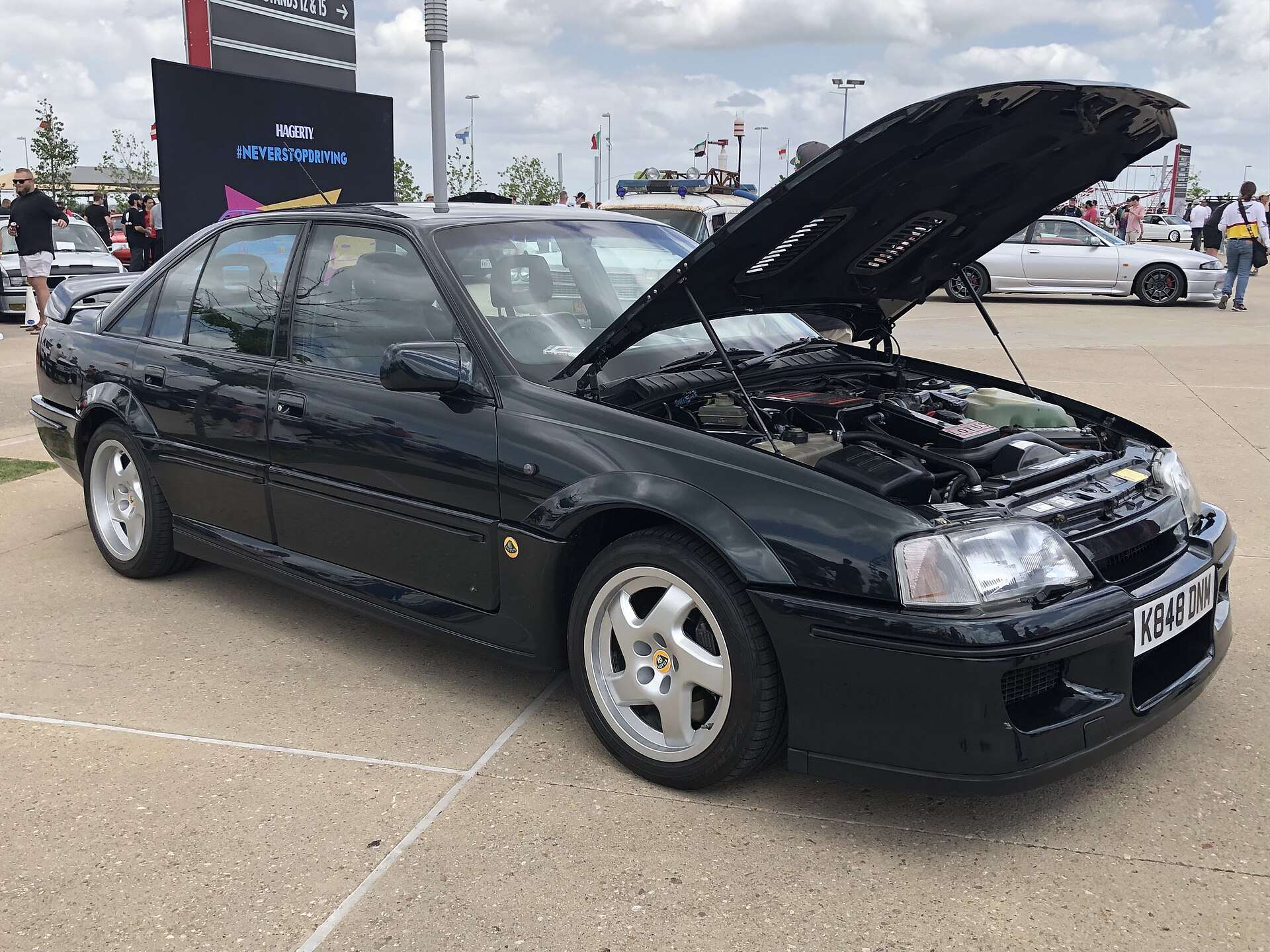
Broader wheelarches covered 17-inch wheels and enormous tyres. The deep front bumper fed air to the engine, charge-cooler and brakes, while subtle rear aerodynamic additions helped stability.
8. Lotus redesigned the suspension and brakes
Self-levelling rear suspension, revised geometry and specially developed dampers allowed the car to combine high-speed control with usable ride quality. AP Racing brakes were fitted to contain its performance.

9. Every car wore Imperial Green
The exceptionally dark Imperial Green paint can appear almost black in poor light. It was paired with a grey leather interior, making colour one of the easiest ways to identify an authentic car.
10. Production totalled only 950
Lotus built 950 examples between 1990 and 1992: 320 Vauxhall Lotus Carltons and 630 Opel Lotus Omegas. The limited production, complexity and cultural notoriety have made surviving cars highly collectible.
Love cars you don’t see every day?
Get forgotten cars, surprising motoring stories and the most interesting finds from Unusual Cars by email.
Free to join. No spam. Unsubscribe whenever you like. See our Privacy Policy.
More British performance cars
Read our MG XPower SV-R facts, then explore the Lotus archive.
Sources
For more about this car, read our Lotus Carlton guide.